Archive | 2015/08/11

11 sierpnia 1945 roku, pogrom ludności żydowskiej w Krakowie.

logopl11 sierpnia 1945 roku, w czasie szabatu, miał miejsce pogrom ludności żydowskiej w Krakowie.

Synagoga Kupa, stan powojenny. Yad Vashem Photo Archive

11 sierpnia 1945 roku, w czasie szabatu, miał miejsce pogrom ludności żydowskiej w Krakowie.

Żydów modlących się w sobotni poranek w synagodze Kupa (pomiędzy ulicą Miodową i Warszauera) zaatakował tłum zgromadzony na pobliskim placu (Plac Nowy) zwanym Tandetą. Ataki rozprzestrzeniły się w ciągu dnia na pozostałe ulice Kazimierza. Pretekstem do ataków miały być pogłoski o tym, że w synagodze znaleziono ciała i krew dzieci chrześcijańskich. Dowodów nie znaleziono, a sprawa okazała się prowokacją (której sprawców również jednoznacznie nie wskazano). W wyniku zajść zginęła co najmniej jedna osoba (Róża Berger), a wiele zostało rannych, w tym kilka – bardzo ciężko.

Kim była śmiertelna ofiara pogromu Żydów w Krakowie 11 sierpnia 1945 roku? Róża Berger miała wtedy 56 lat i była ocaloną z Zagłady, wraz ze swoją córką przeżyła pobyt w obozie Auschwitz-Birkenau. Gdy wróciły po wojnie do Krakowa zostały odszukane przez jej męża, który przeżył wojnę uciekając z transportu do obozu śmierci. W czasie zajść antysemickich Róża została zabita, natomiast jej mąż Józef/Josef Berger, miał ocalić życie tylko dzięki temu, że ranny upadł na ziemię i udawał martwego. Róża zginęła od strzałów 11 sierpnia 1945 r. o godz. 12.30, w mieszkaniu przy Pl. Wolnica 4. Została pochowana na cmentarzu żydowskim przy ul. Miodowej. Wkrótce po tych zdarzeniach mąż Róży Berger wyjechał z Krakowa i wyemigrował do USA, podążając za swoją córką i zięciem.


Kraków pogrom

Kazimierz 2007-01-07 057.jpg

Kazimierz 2007-01-07 057.jpg

The Kraków pogrom refers to the violent events that occurred on August 11, 1945, in the city of Kraków, Poland, which resulted in the death of Róża Berger shot by security forces while standing behind closed doors, and five wounded victims. According to the report prepared for Joseph Stalin by the Russian special services in Soviet-occupied Kraków,[1] it was Polish militiamen who sanctioned the violence

Background

Around 68,000–80,000 Jews lived in Kraków before the September 1939 German invasion of Poland. Because of the Holocaust and further migration following the arrival of the Soviet Red Army only 2,000 prewar inhabitants of the city were still present after January 1945. Many Jewish refugees returned to Kraków from the Soviet Union, including those who came from the neighbouring villages and towns.[3][4]

By May 1945, the number of Jews in the city reached 6,637. The return of the Jewish population was not always welcomed, especially by the anti-Semitic elements in the populace. The safety of the Jewish community in Kraków was becoming a very serious problem according to the Soviet-installed starosta in the city, even though “no serious antisemitic events were recorded in the rural and small-town regions.”[5] In his report for 1–10 August, the Kraków city administrator (starosta grodzki) noted the “insufficient supply of food.”[6] In June 1945, the new communist voivode of Kraków described growing tensions in his report in the following way:

In regard to the attitudes of the Polish population towards the Jews, the remnants of Nazi influences acquired during the occupation still linger… Robberies combined with murdering Jews occur: the motives and the perpetrators are usually not found. Nevertheless, their anti-Semitic background is apparent…In the previous month there were no serious anti-Jewish events in the voivodeship, yet there is no evidence that society’s attitude towards the Jews has changed … An utterly insignificant event, or the most improbable rumour can trigger serious riots. The populace’s attitude towards the Jews is a serious problem requiring a constant vigilance on the side of the authorities, and proper interaction with lower level offices.

Unrest

On June 27, 1945, a Jewish woman was brought to a local Milicja Obywatelska police station falsely accused of attempting to abduct a child. Despite the fact that the investigation revealed that the mother had left her child in the care of the suspect, rumours started to spread that a Jewish woman abducted a child in order to kill it.[7] A mob shouting anti-Jewish slogans gathered at Kleparski square, but a Milicja detachment brought the situation under control. Blood libel rumours continued to spread. False claims that thirteen corpses of Christian children had been discovered were disseminated. By 11 August, the number of rumoured “victims” had grown to eighty.[7] Groups of hooligans who gathered at Kleparski Square had been throwing stones at the Kupa Synagogue on a weekly basis.[7] On 11 August an attempt to seize a thirteen-year-old boy who was throwing stones at the synagogue was made, but he managed to escape and rushed to the nearby marketplace screaming “Help me, the Jews have tried to kill me”.[8] Instantly the crowd broke in into the Kupa synagogue and started beating Jews, who had been praying at the Saturday morning Sabbath service;[9] and the Torah scrolls were burned.[10] The Jewish hostel was also attacked.[10] Jewish men, women and children, were beaten up on the streets; their homes were broken into and robbed.[8] Some Jews wounded during the pogrom were hospitalized and later were beaten in the hospitals again. One of the pogrom victims witnessed:

I was carried to the second precinct of the militia where they called for an ambulance. There were five more people over there, including badly wounded Polish woman. In the ambulance I heard the comments of the escorting soldier and the nurse who spoke about us as Jewish crust whom they have to save, and that they shouldn’t be doing this because we murdered children, that all of us should be shot. We were taken to the hospital of St. Lazarus at Kopernika Street. I was first taken to the operating room. After the operation a soldier appeared who said that he will take everybody to jail after the operation. He beat up one of the wounded Jews waiting for an operation. He held us under cocked gun and did not allow us to take a drink of water. A moment later two railroadmen appeared and one said, “It’s a scandal that a Pole does not have the civil courage to hit a defenceless person”, and he hit a wounded Jew. One of the hospital inmates hit me with a crutch. Women, including nurses, stood behind the doors threatening us that they were only waiting for the operation to be over in order to rip us apart

During the pogrom some Poles, mistaken for Jews, were also attacked.[12] The centre of these events was Miodowa, Starowislna, Przemyska, and Jozefa Streets in the Kazimierz quarter.[13] The riots were most intense between 11am and 1pm, calming down around 2pm, only to regain strength in the late afternoon when the Kupa synagogue was set on fire.[13] Polish policemen and soldiers actively participated in these events.[14] Among twenty-five of those accused of inciting racial hatred, robberies, and violence against Jews, twelve were officers.[14]

Casualties

There is one record of a death relating to Kraków events in the archives of the Forensic Medicine Department in Kraków. The victim was 56-year old Auschwitz survivor Róża Berger, shot while standing behind closed doors.[15][16]

Polish historian Anna Cichopek stated in her university Master Thesis later published as a book[17] that all historical sources confirmed this one death.[18] However, she also noted that in an archival photo of a funeral there were five coffins visible, thus suggesting that there might have been five fatalities; she also claimed in her book that the New York Times in 1946 had noted a death of a man (Anszel Zucker), and Polska Agencja Prasowa noted a death of another unknown woman (in addition to Róża Berger) and five wounded.[18]

Polish historian, Julian Kwiek, who has published existing Polish documents regarding the Kraków event stated that he is not familiar with the documents quoted by Cichopek from outside the scientific literature. He stated that one death is confirmed in all historical sources, therefore it is questionable whether this event truly falls under the definition of a pogrom,[19] even though most other sources refer to the event as such.

Another historian, Dariusz Libionka from the Center for Holocaust Research[35] of the Polish Academy of Sciences, suggested that the photos showing the coffins were taken in the Spring (April 24, 1946) of the following year and came from the Kraków funeral of five Jews shot on April 21, 1946 by partisans of Józef Kuraś “Ogień” near Nowy Targ. In many cases – Libionka suggested – it would have been more appropriate if Anna Cichopek relied on existing studies rather than on archival material. He stated, that Polska Agencja Prasowa noted one dead person and five wounded. Libionka questioned the source of information regarding Anszel Zucker’s death. According to him it should have been concluded that the Kraków pogrom resulted in one dead and five wounded victims.

Read more: Kraków pogrom


twoje uwagi, linki, wlasne artykuly, lub wiadomosci przeslij do: webmaster@reunion68.com



Palestinians: The Difference between Us and Them

Palestinians: The Difference between Us and Them

Bassam Tawil


◾We Palestinians have failed to educate our people on the principles of tolerance and peace. Instead, we condone and applaud terrorism, especially when it is directed against Jews. We want the world to condemn terrorism only when it claims the lives of Palestinians.

◾Abbas’s ambiguous, half-hearted condemnations of attacks by Palestinians against Israelis are only intended for public consumption and are primarily aimed at appeasing Western donors so that they will continue channeling funds to the Palestinian Authority. In addition, his condemnations seek to blame Israel for Palestinian terror attacks.

◾Netanyahu’s strong and clear condemnation left me and other Palestinians wondering when was the last time we heard similar statements from our leaders. I cannot remember Abbas or any other Palestinian leader ever expressing shock and outrage over the killing of a Jew in a Palestinian terror attack, nor the last time a Palestinian official visited the Israeli victims of a Palestinian terror attack.

◾Each time Abbas reluctantly condemns a Palestinian terror attack, he faces a wave of criticism from many Palestinians. Unlike the Israeli public, many Palestinians often rush to justify, and even welcome, terror attacks against Jews. Has there ever been a Palestinian activist who dared to hold a rally in a Palestinian city to condemn suicide bombings or the murder of an entire Jewish family? The Israeli president has good reason to feel ashamed for the murder of the baby. But when will we Palestinians ever have a sense of shame over the way we react to the murder of Jews?


I cannot count the number of times that I heard from Israeli Jews the phrases “I’m ashamed” and “I’m sorry” in response to the horrific crime that claimed the life of Palestinian toddler Ali Dawabsha in the West Bank village of Duma last week.

The strong response of the Israeli public and leaders to the arson attack is, truthfully, somewhat comforting. The wall-to-wall Israeli condemnation of this crime has left me and other Palestinians not only ashamed, but also embarrassed — because this is not how we Palestinians have been reacting to terror attacks against Jews — even the despicable murder of Jewish children.

Our response has, in fact, brought feelings of disgrace and dishonor. While the Israeli prime minister, president and other officials were quick strongly to condemn the murder of Dawabsha, our leaders rarely denounce terror attacks against Jews. And when a Palestinian leader such as Mahmoud Abbas does issue a condemnation, it is often vague and equivocal.

Take, for example, what happened after last year’s kidnapping and murder of three Israeli teenagers by Palestinians in the West Bank. It not only took President Abbas four days to issue a statement condemning the terror attack, but even then, the condemnation was at best a tentative: “The Palestinian presidency… condemns the series of events that happened last week, beginning with the kidnapping of three Israeli youths.” Abbas then went on to denounce Israel for arresting dozens of Hamas members after the abduction and murder of the three youths.

Later in 2014, when Abbas did condemn a Palestinian terror attack that killed five Israelis in a Jerusalem synagogue, Fatah official Najat Abu Baker, a few days later, explained that Abbas’s condemnation was made “within a diplomatic context… [he] is forced to speak this way to the world.”

Abbas’s condemnation of the attack at the synagogue in Jerusalem’s Har Nof neighborhood apparently came only under pressure from U.S. Secretary of State John Kerry, who telephoned the Palestinian leader twice to demand that he speak out against the killings. Abbas’s statement said that the Palestinian leadership condemns the “killing of worshippers in a synagogue and all acts of violence, regardless of their source.” His statement then also called for an end to “incursions and provocations by settlers against the Aqsa Mosque.”

Abbas’s ambiguous, half-hearted condemnations of attacks by Palestinians against Israelis are only intended for public consumption and are primarily aimed at appeasing Western donors, so that they will continue channeling funds to the Palestinian Authority (PA). In addition, his condemnations almost always seek to blame Israel for the Palestinian terror attacks — presumably an attempt to justify the killing of Jews at the hands of Palestinian terrorists.

In contrast, Israeli leaders who condemned the murder of the Palestinian toddler sound firm and unambiguous. Here is what Prime Minister Netanyahu said after visiting the murdered baby’s parents and brother, who were wounded in the arson attack and are receiving medical treatment in Israeli hospitals: “When you stand next to the bed of this small child, and his infant brother has been so brutally murdered, we are shocked, we are outraged. We condemn this. There is zero tolerance for terrorism wherever it comes from, whatever side of the fence it comes from.”

Netanyahu’s strong and clear condemnation left me and other Palestinians wondering when was the last time we heard similar statements from our leaders. I cannot remember ever hearing Abbas or any other Palestinian leader express shock and outrage over the killing of a Jew in a Palestinian terror attack. Nor can I remember the last time we heard of a Palestinian official visiting the Israeli victims of a Palestinian terror attack.

The Israeli leaders’ condemnation of the baby’s murder is a sincere voice that reflects the views of the overwhelming majority of the Israeli public. In contrast, the Palestinian leaders’ denunciations of terror attacks do not reflect the general feeling on the Palestinian street. Each time Abbas reluctantly condemns a Palestinian terror attack, he faces a wave of criticism from many Palestinians.

Unlike the Israeli public, many Palestinians often rush to justify, and even welcome, terror attacks against Jews. This was the situation just a few weeks ago, when an Israeli man was shot dead near Ramallah. Several Palestinian factions and military groups applauded the murder, calling it a “natural response to Israeli crimes.”

This is the huge difference between the way Israelis and Palestinians react to terrorism. The murder of Dawabsha saw thousands of Israelis hold anti-violence rallies to condemn the horrible crime. But has anyone ever heard of a similar rally on the Palestinian side whenever terrorists kill innocent Jewish civilians? Is there one top Palestinian official or prominent figure who dares to speak out in public against the murder of Jews, at a rally in the center of Ramallah or Gaza City? Has there ever been a Palestinian activist who dared to hold a rally in a Palestinian city to condemn suicide bombings or the murder of an entire Jewish family?

While Israelis have been holding rallies to condemn terror attacks against our people, we have been celebrating the killing of Jews. How many times have we taken to the streets to hand out sweets and candies in jubilation over the killing of Jews? Such sickening scenes of men and women celebrating terror attacks against Jews on the streets of the West Bank and Gaza Strip have never been condemned by our leaders. These scenes have become commonplace each time Palestinian terrorists carry out an attack against Jews.

These scenes stand in sharp contrast to the public statements and rallies in Israel in response to terror attacks against Palestinians. Our leaders need to learn from Israel’s President, Reuven Rivlin, who said he was “ashamed” and “in pain” for the murder of the Palestinian toddler. When was the last time a Palestinian leader used such rhetoric to condemn the murder of Jews? The laconic statements issued by Abbas’s office in response to anti-Jewish terror attacks never talked about shame or pain.

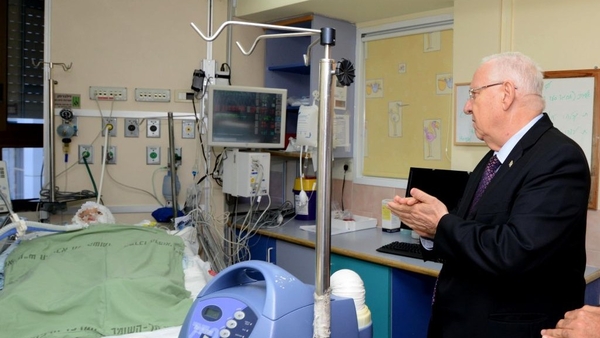
Israeli President Reuven Rivlin visits 4-year-old Ahmed Dawabsha in hospital on July 31. Dawabsha was badly burned in an arson attack on his house in the village of Duma, which killed his baby brother and also injured his parents. (Image source: Mark Neyman/Israel Government Press Office)

We have failed to educate our people on the principles of tolerance and peace. Instead, we continue to condone and applaud terrorism, especially when it is directed against Jews. We want the whole world to condemn terrorism only when it claims the lives of Palestinians. We have reached a point where many of us are either afraid to speak out against terrorism or simply accept it when it claims the lives of Jews.

The Israeli president has good reason to be ashamed for the murder of the baby. But when will we Palestinians ever have a sense of shame over the way we are reacting to the murder of Jews? When will we stop glorifying terrorists, and naming streets and public squares after them, instead of strongly denouncing them and expelling them from our society? We still have a lot to learn from Israeli leaders and the Israeli public.

Bassam Tawil is based in the Middle East.


twoje uwagi, linki, wlasne artykuly, lub wiadomosci przeslij do: webmaster@reunion68.com


Turkish ‘UFO’ Turns Out to be Israeli ‘Spy Balloon’

Turkish ‘UFO’ Turns Out to be Israeli ‘Spy Balloon’

By Ari Yashar


Locals excited at finding UFO in air quickly change tack to accuse Israel of nefarious tourist balloon, joining pantheon of ‘spy’ charges.

UFOs? Spy balloons?

UFOs? Spy balloons?

Turkish residents refused to be disappointed from their conspiracy theories on Thursday, after their wonder at an alleged UFO they spotted in the skies quickly morphed into anti-Israel hostility when they claimed the Israeli tourist balloon they found was a “spy balloon.”

The close encounter of the third kind took place in Turkey’s central Malatya province, reports the Turkish Hurriyet Daily News on Friday.

Locals saw what they believed to be a UFO floating in the air, and one resident named Ersin Evren even filmed its slow descent, sure he was about to see spacemen step out onto Turkish soil.

They were disappointed to find that the object, which fell into the garden of a home in Malatya’s Hekimhan district, was a white-and-blue balloon with the tourist phrase “Welcome to Israel” written on it in English, reports Cihan News Agency.

But it didn’t stop there – locals complained Israel was likely using the air-filled plastic to “spy” on them, leading gendarmerie forces to seize the suspicious artifact.

Why Israeli spies would choose to use a balloon floating in random directions with an eye-catching design as opposed to an advanced drone apparently was a question that never crossed their minds.

It is anticipated the balloon may have come from a nearby vacation town that Israeli tourists sometimes frequent.

As far out as the “spy balloon” claim is, it is actually not the most outlandish claim made against Israel’s Mossad spy agency.

Those claims have included “spy ducks” in Egypt, a “spy vulture” in Saudi Arabia, a “spy bird” in Turkey, and a “spy eagle” in Sudan.

Israel has also been accused of unleashing attack sharks in Egypt, in addition to Palestinian Authority (PA) claims of attack boars and anti-Arab rats.

But Iran likely takes the cake for the most outrageous claim, after back in 2007 it arrested 14 squirrels it claimed were foreign spies.

“In recent weeks, intelligence operatives have arrested 14 squirrels within Iran’s borders,” the state-run IRNA claimed at the time. “The squirrels were carrying spy gear of foreign agencies, and were stopped before they could act, thanks to the alertness of our intelligence services.”

Iranian police commander Esmaeil Ahmadi-Moqadam confirmed the incredible report.


twoje uwagi, linki, wlasne artykuly, lub wiadomosci przeslij do: webmaster@reunion68.com