Archive | September 2016

Portrety Józefa Sandla ze zbiorów Żydowskiego Instytutu Historycznego

Żydowski Instytut HistorycznyPortrety Józefa Sandla ze zbiorów Żydowskiego Instytutu Historycznego

dr Mikołaj Getka-Kenig


W zbiorach Żydowskiego Instytutu Historycznego, zachowało się kilka portretów Józefa Sandla (1894–1962), historyka sztuki będącego właściwym twórcą (choć nie pierwszym kierownikiem) Muzeum ŻIH, który poświęcił znaczną część swojego życia na badanie dorobku polskich artystów-Żydów.

Wide grundig lea a 1452 1

Pod względem historycznym warto wyróżnić dwa – odznaczający się oryginalną kolorystyką portret olejny (jedyny zachowany) z r. 1928, pędzla Maxa Busyna (A-1434) oraz rysunek tuszem z r. 1949 autorstwa Lei Grundig (A-1452). Maks (wł. Mojżesz) Busyn lub Bussin urodził się w Łodzi w r. 1900, w późniejszym czasie przeniósł się jednak do Niemiec.

Ukończył akademię sztuk pięknych w Dreźnie i tam właśnie zetknął się z Sandlem, który w r. 1928 wrócił po kilkuletniej przymusowej emigracji politycznej we Francji (wywodził się z Galicji, ale od r. 1912 pracował w Niemczech). Busyn, którego twórczość wyraźnie pozostawała w nurcie antykapitalistycznie zaangażowanego malarstwa ekspresjonistycznego (czego dobrym przykładem również rzeczony portret z kolekcji ŻIH), należał do drezdeńskiego środowiska lewicowo usposobionych artystów (często żydowskiego pochodzenia), których na przełomie lat 20. i 30. Sandel otaczał opieką jako marszand i krytyk artystyczny.

W tym gronie znajdowała się również Lea Grundig, z domu Langer, urodzona w Dreźnie w r. 1906. Podobnie jak Busyn, Grundig była absolwentką tamtejszej akademii i tworzyła pod silnym wpływem sztuki ekspresjonistycznej (zwłaszcza Otto Dixa). Po r. 1945 należała do czołowych osobistości życia artystycznego w NRD, i jako jedyna kobieta zasiadała na stanowisku przewodniczącego krajowego Związku Artystów Plastyków.

Portret Sandla, dość typowy dla jej twórczości, powstał przy okazji wizyty w Warszawie, kiedy spotkała się ze starym przyjacielem. Właśnie ten wizerunek został wybrany przez Ernestynę Podhorizer-Sandel jako ilustracja rysu biograficznego jej męża, który ukazał się w Biuletynie ŻIH w r. 1973. Portret Sandla stanowi zresztą pendant do portretu Ernestyny (A-1453), który także znajduje się w zbiorach ŻIH.

Wszystkie te portrety będzie można obejrzeć na wystawie czasowej poświęconej Józefowi Sandlowi, która zostanie otwarta w październiku b.r. w Żydowskim Instytucie Historycznym.


twoje uwagi, linki, wlasne artykuly, lub wiadomosci przeslij do: webmaster@reunion68.com


Why the Oslo Process Doomed Peace

Middle East ForumWhy the Oslo Process Doomed Peace

Efraim Karsh


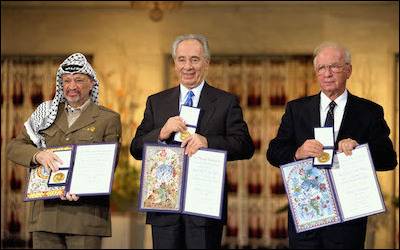
In 1994, (left to right) PLO chairman Yasser Arafat, Israeli prime minister Yitzhak Rabin, and foreign minister Shimon Peres received the Nobel Peace Prize following the signing of the 1993 Oslo accords. But twenty-three years later, peace is still illusive. For Israel, the accords have been the starkest strategic blunder, establishing an ineradicable terror entity on its doorstep, deepening its internal cleavages, and weakening its international standing.

Twenty-three years after its euphoric launch on the White House lawn, the Oslo “peace process” between Israel and the Palestine Liberation Organization (PLO) stands out as one of the worst calamities to have afflicted the Israeli-Palestinian conflict. For Israel, it has been the starkest strategic blunder in its history, establishing an ineradicable terror entity on its doorstep, deepening its internal cleavages, destabilizing its political system, and weakening its international standing. For the West Bank and Gaza Palestinians, it has brought subjugation to the corrupt and repressive PLO and Hamas regimes, which reversed the hesitant advent of civil society in these territories, shattered their socioeconomic wellbeing, and made the prospects of peace and reconciliation with Israel ever more remote. This in turn means that, even if the territories were to be internationally recognized as a fully-fledged Palestinian state (with or without a formal peace treaty with Israel), this will be a failed entity in the worst tradition of Arab dictatorships at permanent war with both Israel and its own subjects.

False Partner, Missed Partner

“We make peace with enemies,” Prime Minister Yitzhak Rabin reassured a concerned citizen shortly after the September 13, 1993 conclusion of the Israel-PLO Declaration of Principles on Interim Self-Government Arrangements (DOP, or Oslo I). “I would like to remind you that the [March 1979] peace treaty with Egypt had many opponents, and this peace has held for 15 years now.”[1] True enough. But peace can only be made with enemies who have been either comprehensively routed (e.g., post-World War II Germany and Japan) or disillusioned with the use of violence—not with those who remain wedded to conflict and war. And while Egyptian president Anwar Sadat was a “reformed enemy” eager to extricate his country from its futile conflict with Israel, Yasser Arafat and the PLO leadership viewed the Oslo process not as a springboard to peace but as a “Trojan Horse” (in the words of prominent PLO official Faisal Husseini) designed to promote the organization’s strategic goal of “Palestine from the [Jordan] river to the [Mediterranean] sea”—that is, a Palestine in place of Israel.[2]

Arafat admitted as much five days before signing the accords when he told an Israeli journalist, “In the future, Israel and Palestine will be one united state in which Israelis and Palestinians will live together”[3]—that is, Israel would cease to exist. And even as he shook Rabin’s hand on the White House lawn, the PLO chairman was assuring the Palestinians in a pre-recorded, Arabic-language message that the agreement was merely an implementation of the organization’s “phased strategy” of June 1974. This stipulated that the Palestinians would seize whatever territory Israel surrendered to them, then use it as a springboard for further territorial gains until achieving the “complete liberation of Palestine.”[4]

The next eleven years until Arafat’s death on November 11, 2004, offered a recapitulation, over and over again, of the same story. In addressing Israeli or Western audiences, the PLO chairman (and his erstwhile henchmen) would laud the “peace” signed with “my partner Yitzhak Rabin.” To his Palestinian constituents, he depicted the accords as transient arrangements required by the needs of the moment. He made constant allusion to the “phased strategy” and the Treaty of Hudaibiya—signed by Muhammad with the people of Mecca in 628, only to be disavowed a couple of years later when the situation shifted in the prophet’s favor—and insisted on the “right of return,” the standard Palestinian/Arab euphemism for Israel’s destruction through demographic subversion. As he told a skeptical associate shortly before moving to Gaza in July 1994 to take control of the newly established Palestinian Authority (PA):

I know that you are opposed to the Oslo accords, but you must always remember what I’m going to tell you. The day will come when you will see thousands of Jews fleeing Palestine. I will not live to see this, but you will definitely see it in your lifetime. The Oslo accords will help bring this about.[5]

This perfidy was sustained by Arafat’s successor, Mahmoud Abbas, who has had no qualms about reiterating the vilest anti-Semitic calumnies: In his June 2016 address to the European Parliament, Abbas accused Israeli rabbis of urging the poisoning of Palestinian water.[6] In his doctoral dissertation, written at a Soviet university and subsequently published in book form, he argued that fewer than a million Jews had been killed in the Holocaust, and that the Zionist movement colluded in their slaughter.[7] He has vowed time and again never to accept the idea of Jewish statehood, most recently in March 2014, when he rallied the Arab League behind his “absolute and decisive rejection to recognizing Israel as a Jewish state,”[8] and in September 2015, when he derided Israel in his U.N. address as “a historic injustice … inflicted upon a people … that had lived peacefully in their land.”[9]
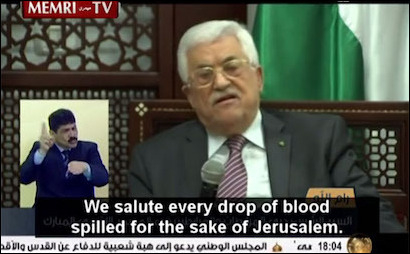
An unreconstructed Holocaust denier, PA president Mahmoud Abbas has voiced incessant anti-Semitic and anti-Israel incitement. In his June 2016 address to the European Parliament, Abbas accused Israeli rabbis of urging the poisoning of Palestinian water. He has pledged to prevent the Jews from “defiling al-Aqsa with their filthy feet” and has vowed time and again never to accept the idea of Jewish statehood.

Back home in the PA, Abbas was even more forthright, pledging to prevent the Jews from “defiling al-Aqsa with their filthy feet” and stating that “every drop of blood that has been spilled in Jerusalem is holy blood as long as it was for Allah.”[10] When this incitement culminated in a sustained wave of violence that killed scores of Israelis in a string of stabbings, car rammings into civilians, and shooting attacks, Abbas applauded the bloodshed as a “peaceful, popular uprising. … We have been under occupation for 67 or 68 years [i.e., since Israel’s establishment],” he told his subjects in March 2016. “Others would have sunk into despair and frustration. However, we are determined to reach our goal because our people stand behind us.”[11]

In other words, more than two decades after the onset of the Oslo process, Israel’s “peace partner” would not even accept the Jewish state’s right to exist, considering its creation an “illegal occupation of Palestinian lands.”

What makes this state of affairs all the more tragic is that, at the time of the Oslo accords, the Rabin government had a potentially far better peace partner in the form of the West Bank and Gaza leadership. To be sure, Israel’s hand-off policies during the two-and-a-half decades from the June 1967 capture of the territories to the onset of the Oslo process enabled the PLO to establish itself as the predominant force there at the expense of the more moderate local leadership. But this meant no blind subservience to the organization’s goals or means. Unlike the PLO’s diaspora constituents (or the “outside” in Palestinian parlance) who upheld the extremist dream of returning to their 1948 dwellings at the cost of Israel’s destruction, West Bankers and Gazans (the “inside”) were amenable to peaceful coexistence that would allow them to get on with their lives and sustain the astounding economic boom begun under Israel’s control. During the 1970s, for example, the West Bank and Gaza were the fourth fastest-growing economy in the world, ahead of such “wonders” as Singapore, Hong Kong, and Korea, making socioeconomic conditions there far better than in most neighboring Arab states. While the “outside” diaspora had no direct interaction with Israelis (and for that matter with any other democratic system), Israel’s prolonged rule had given the “inside” Palestinians a far more realistic and less extreme perspective: hence their perception of Israel as more democratic than the major Western nations;[12] hence their overwhelming support for the abolition of those clauses in the Palestinian charter that called for Israel’s destruction and their rejection of terror attacks;[13] and hence their indifference to the thorniest issue of the Palestinian-Israeli dispute, and the one central to the PLO’s persistent effort to destroy Israel, namely, the “right of return.” As late as March 1999, two months before the lapse of the official deadline for the completion of the Oslo final-status negotiations, over 85 percent of respondents did not consider the refugee question the most important problem facing the Palestinian people.[14]

Against this backdrop, the Rabin government had a unique opportunity to steer the Palestinian populace in the West Bank and Gaza in the direction of peace and statehood, possibly in collaboration with Jordan’s King Hussein, who just a few years earlier had thrown his hat in the ring only to be rebuffed by Prime Minister Shamir. In a Nablus public opinion poll shortly before the DOP signing, 70 percent of respondents preferred Hussein to the PLO as their sovereign,[15] not least since the PLO had been totally ostracized by its Arab peers following its support for Iraq’s brutal occupation of Kuwait. At that point, its prestige in the territories was at one of its lowest ebbs; Hamas was at an early stage of development; the radical Arab regimes were thoroughly disorientated by the collapse of their communist backers; and the West Bank and Gaza leadership was bent on participating in the U.S.-sponsored peace talks between Israel and its neighbors, launched at the October 1991 Madrid Conference and sustained in Washington, against the PLO’s adamant objection.[16]

But then, instead of seizing the moment and opting for the obvious peace partner that was far better attuned to the needs and wishes of the local Palestinian populace, and against his personal inclination to strike a deal with the “moderate insiders” rather than the “extremist Tunis people [i.e., PLO leadership],” Rabin was persuaded by Foreign Minister Shimon Peres and his deputy Yossi Beilin (who reportedly collaborated with the PLO in obstructing the Washington talks) into surrendering the West Bankers and Gazans to an unreconstructed terror organization whose leader would not hang up his ubiquitous battledress, not even for the signing ceremonies of the various Oslo accords or the receipt of the Nobel Peace Prize, and who used peace as a strategic deception aimed at promoting the eternal goal of Israel’s destruction.[17]

As a result, twenty-three years of 1) incessant hate mongering by the PLO/PA (not to mention Hamas, which exploited the Oslo process to become the preeminent military and political factor in the territories); 2) countless terror attacks (including a full-fledged terror war, euphemistically named “al-Aqsa Intifada” after the Jerusalem mosque); 3) three protracted large scale military encounters between Hamas and Israel; and 4) economic collapse induced by the PA’s and Hamas’s corrupt and inept rule have thoroughly radicalized the West Bank and Gaza populace with a new generation of Palestinians brought up on vile anti-Jewish (and anti-Israel) incitement unparalleled in scope and intensity since Nazi Germany.

Tarnished Security

Apart from making the prospects of peace and reconciliation….

read more: Why the Oslo Process Doomed Peace


twoje uwagi, linki, wlasne artykuly, lub wiadomosci przeslij do: webmaster@reunion68.com


138 lat temu otwarto najwspanialszą budowlę żydowskiej Warszawy

Warszawa.wyborcza.pl138 lat temu otwarto najwspanialszą budowlę żydowskiej Warszawy

Jerzy S. Majewski


W historii żydowskiej Warszawy nie było bardziej znamienitej świątyni. 26 września mija 138 rocznica otwarcia Wielkiej Synagogi na Tłomackiem. Dziś w jej miejscu wznosi się błękitny wieżowiec

Synagoga przy Tłomackiem

Otwarcie miało miejsce wieczorem 26 września 1878 r. w święto Nowego Roku (Rosz Ha-Szana). Henryk Natanson zapalił wieczne światło przed Aron Ha-Kodesz szafą ołtarzową służąca do przechowywania rodału, czyli zwojów Tory. Podczas uroczystości uczestniczył też rosyjski dygnitarz, generał gubernator hr. Paweł Kotzebue. A ponieważ nie zaprotestował, gdy kaznodzieja Izaak Cylkow, manifestacyjnie powitał go nie w języku hebrajskim, jidisz, niemieckim czy rosyjskim lecz po polsku, to zgromadzeni odczytywali to jako zgodę na wygłaszanie kazań w synagodze w języku polskim. Synagoga była bowiem świątynią tej część społeczeństwa żydowskiego, która dążyła do asymilacji z Polakami.

Bankierska rodzina Natansonów podarowała Arkę Przymierza. Była wspaniała, wykonano ją na wzór biblijnej z drewna cedrowego sprowadzonego z gór Libanu. Przysłaniały ją czerwone i białe zasłony przetykane srebrem i złotem. Znany warszawski wydawca i drukarz Salomon Lewental, zięć wielkiego finansisty i działacza społecznego Matiasa Bersona ufundował pulpit. Misternie wyrzeźbiony w drewnie dębowym przez Gunderlacha stanął przed Aron ha-Kodesz.

Z inicjatywy panien Paprockich wnuczek Antoniego Ejzenbauma bogate Żydówki same utkały ozdobny dywan złożony z kwadratów. Przykrył on wyniesioną posadzkę bimy. Wszystkie te wspaniałości znalazły się wewnątrz wielkiej synagogi, która 16 maja 1943 r. została wysadzonej przez Niemców w powietrze.

Wszystko w tym miejscu wygląda dziś inaczej

Zanim przystąpiono do budowy w 1873 r. rozpisano konkurs architektoniczny. Zwyciężył w nim Stanisław Adamczewski. Jego projekt nie został jednak zamówiony. Komitet budowy zapewne nie był zadowolony z rezultatów konkursu i projekt realizacyjny zamówiono u przedstawiciela znanego warszawskiego rodu architektów i artystów – Leandra Marconiego.

3 stycznia 1874 r. namiestnik Królestwa, gen Fiodor Fiodorowicz Berg zaakceptował go. Zamówiono cegłę w firmie Kazimierza Grantzowa, kupiono dwa XVIII-wieczne budynki przy Placu Tłomackie, które zburzono oraz fragment dawnego ogrodu pałacowego i ogrodzono teren budowy. Synagoga stanęła tam, gdzie obecnie wznosi się Błękitny Wieżowiec. Niemal wszystko tu wyglądało inaczej niż dziś. Ulica Leszno (dziś al. Solidarności) była o połowę węższa. Trójkątny plac Bankowy łączył się z Lesznem oraz z równie wąska ulicą Przejazd jeszcze węższą uliczką Rymarską. Tam gdzie dziś znajdują się wyjścia z przejścia podziemnego przy metrze i przystanki tramwajowe w Al. Solidarności był prostokątny placyk Tłomackie. Pośrodku placu stała istniejąca do dziś studnia Gruba Kaśka a wokół wznosiły się klasycystyczne kamienice. W latach późniejszych część kamienic zburzono wznosząc w ich miejscu wielkie domy składowe, centralę telefoniczną i wielopiętrowe kamienice czynszowe. W latach 70 XIX w. plac wciąż wyglądał tak jak u schyłku wieku XVIII.

Budowa Synagogi w tym miejscu była pierwszym wyłomem w przestrzeni Tłomackiego, które utraciło południową pierzeję i zostało znacznie powiększone. Uroczystość wmurowania kamienia węgielnego odbyła się 14 maja 1876 r. Jak pisze Ewa Małkowska uczestniczyli w nim m.in. architekt Leandro Marconi, jego brat Władysław, który został kierownikiem budowy, dwaj wykonawcy Kazimierz Grantzow i Ferdynand Martens oraz członkowie komitetu budowy: m.in. Ludwik i Henryk Natansonowie, Jan Berson, Hersz Wawelber, Lesser Lewi, wreszcie znakomity historyk i jeden z najwybitniejszych varsavianistów przełomu XIX i XX wieku Aleksander Kraushar. Budowa trwała dwa lata.

Zwiedzanie synagogi polecały turystyczne przewodniki

Marconi wzniósł budowlę o stylistyce łączącej formy klasycyzmu i renesansu. W fasadzie zaprojektował wielki, klasycystyczny portyk kolumnowy. Ponad nawą wyrosła kopuła otoczona koroną. Wnętrze było trójnawowe, zamknięte półkolistą, pseudoromańską apsydą, za którą zaprojektowano pomieszczenia kancelaryjne i pokój zaślubin.

Ewa Małowska pisze, że o ile elewacja budziła rozmaite uwagi to wnętrzem powszechnie się zachwycano. Przytacza jedną z wypowiedzi: “Całość mająca za ozdoby tylko brązowe świeczniki i takież balustrady na galeriach dookoła świątyni swą prostotą imponować musi. Ze zbliżaniem się do samej głębi, powaga czerwonych i białych zasłon, złotem i srebrem przetykanych, cedrowej arki, marmurowych tablic z napisami, ołtarza, świeczników i lampy wieczystej robi prawdziwie religijne wrażenie – tu czujesz, że jesteś w świątyni.”

Pomimo schowania pomiędzy budynkami kopuła synagogi widoczna była z wielu miejsc. W roku 1909 przed fasadą urządzono skwer bardzo starannie utrzymywany przez ogrodników, obsadzony krzewami i otoczony metalowym ogrodzeniem.

Zwiedzanie synagogi polecały niemal wszystkie przewodniki wydawane przed 1939 r. “W świątyni jest miejsc dla 2 tys. 200 osób, a mianowicie 1150 na dole i 1050 na galerii dla kobiet. Wewnątrz znajduje się kilka pulpitów artystycznie rzeźbionych, wartościowych lichtarzy, wspaniała arka. Nad arką chór dla śpiewaków. Nadto znajduje się tu cenna biblioteka zawierająca rzadkie druki hebrajskie i spora wiązka ważnych manuskryptów, do których zaliczyć należy: >Księgi pamiętnicze, rodzaj kronik spisywanych przez rabinów w Buczaczu i Rohatynie itp.” – czytamy w przewodniku po Warszawie z roku 1893.

Z kolei w roku 1922 Mieczysław Orłowicz pisał: “W piątek o zmierzchu podczas nabożeństwa (wstęp możliwy też dla chrześcijan, panowie wchodzą na parter w kapeluszach na głowach, panie na galerie) produkcje dobrego chóru przy akompaniamencie organów.”

Chasydów tradycyjnie ubranych wpuszczano niechętnie

W latach międzywojennych jak pisze Ewa Małkowska synagoga na Tłomackiem była najważniejszą świątynią dla “żydowskiego odłamu społeczeństwa polskiego”. To tutaj odbywały się uroczyste nabożeństwa w rocznicę wszystkich świat państwowych, świętowano odzyskanie niepodległości 11 listopada, uchwalenia konstytucji 3 maja. Stąd po nabożeństwie 3 maja ruszał kondukt rzemieślników żydowskich do Zamku Królewskiego. Do synagogi niechętnie wpuszczano tradycyjnie ubranych chasydów. Nie raz zdarzało się że już przy drzwiach byli wypraszani.

Od roku 1923 rabinem Wielkiej Synagogi był Mojżesz Schorr. Gdy w końcu lat 30 zaczął się bojkot żydowskich sklepów, starał się mu przeciwdziałać. Miał możliwości, bo w 1935 r. wybrany został do senatu RP. Popierał stworzenie państwa żydowskiego w Palestynie. Pełnił nawet godność prezesa Towarzystwa Przyjaciół Uniwersytetu Hebrajskiego w Jerozolimie. Pochodził z rodziny bankierskiej z Galicji. Do Warszawy przybył dopiero w 1923 gdy był już znanym naukowcem. Gdy wybuchłą II wojna światowa, znalazł się na wschodzie. Tam aresztowała go NKWD i pod zarzutem działalności kontrrewolucyjnej zesłała do Uzbekistanu gdzie zmarł w 1941 r.

Przy synagodze mieszkali wybitni kantorzy: m.in. Mosze Kusewicki, nadkantor, zwany też królem kantorów młodszego pokolenia. Jego śpiewem powszechnie się zachwycano, wpadano w ekstazę. Dawał on też koncerty świeckie, nagrywał płyty, jeździł z występami za granicę. Innym mieszkańcem był obdarzony pięknym barytonem Pinchas Szerman. Jednak najsławniejszy był nadkantor Gerszon Sirota – tenor dramatyczny – nazywany żydowskim Caruso. Był obdarzony talentem improwizatorskim.

Jürgern Stroop zachwyca się wysadzeniem świątyni

Po utworzenie getta Niemcy zabrali się do systematycznej dewastacji świątyni. Plac Tłomackie znalazł się początkowo w granicach getta. W 1941 r. synagoga była znacznie uszkodzona. Ołtarz leżał zwalony, w dachu widniały dziury.

W 1942 r po zmniejszeniu obszaru getta i wyłączeniu z niego synagogi Niemcy urządzili w świątyni magazyn mebli zwożonych z domów żydowskich. Jednak los synagogi dopełnił się wraz z upadkiem Powstania w getcie. Jak czytamy w “Rozmowach z katem” Kazimierza Moczarskiego – dowodzący likwidacją getta gen. Jürgern Stroop relacjonował: “Postanowiłem zakończyć Grossaktion 16 maja 1943 o godzinie 20 minut 15.”

Klamrą oficjalnego zamknięcia Wielkiej Akcji było wysadzenie w powietrze Wielkiej Synagogi. “Przygotowania trwały 10 dni. Synagoga byłą gmachem solidnie zbudowanym. Aby ją za jednym zamachem wysadzić w powietrze, należało przeprowadzić pracochłonne roboty saperskie i elektryczne. Ależ to był piękny widok! Z punktu widzenia malarskiego i teatralnego obraz fantastyczny. Oficer saperów wręczył mi aparat elektryczny wywołujący detonację ładunków wybuchowych. Przedłużałem chwilę oczekiwania. Wreszcie krzyknąłem: Heil Hitler! – i nacisnąłem guzik. Ognisty wybuch uniósł się do chmur. Przeraźliwy huk. Bajeczna feeria kolorów. Niezapomniana alegoria tryumfu nad żydostwem. Getto warszawskie skończyło swój żywot. Bo tak chciał Adold Hitler i Heinrich Himmler” – zachwycał się Stroop.

Wieżowiec złoty, potem błękitny

Po wojnie Wielkiej Synagogi nie odbudowano. W związku z budowa Trasy WZ z pejzażu Warszawy zniknął też plac Tłomackie. Za to w miejscu gdzie wznosiła się świątynia u schyłku lat 50 podjęto decyzje o budowie wysokościowca. Tu jednak miała działać klątwa rzucona przez rabinów. Nie wdając się w sprawy nadprzyrodzone trzeba przypomnieć, ze budowa wieżowca wlokła się przez ponad dwa dziesięciolecia. Zmieniały się koncepcje i projekty budynku. Potem prace przerywano. Około 1976 r. wyrósł szkielet budynku. Obłożono go złocistymi blachami elewacyjnymi i budowa stanęła. Konstrukcja rdzewiała, metalowe panele wyglądały coraz gorzej. W latach 80. prasa cyklicznie zapowiadała wznowienie prac przy budowie, ale zapowiedzi nie były realizowane. Dopiero u schyłku dekady po podpisaniu umowy z firmą jugosłowiańską, znów rozpoczęto prace. Złociste elewacje zamieniono na błękitne. W środku znalazła się niewielka sala modlitwy. Ponoć przy okazji rabini odczynili klątwę i pozwoliło to na pomyślne dokończenie realizacji. Wiosną przyszłego roku minie 25 rocznica ukończenia budowy wieżowca.

• Pisząc artykuł korzystałem z książki Ewy Małkowskiej “Synagoga na Tłomackiem”, PWN, Warszawa 1991


twoje uwagi, linki, wlasne artykuly, lub wiadomosci przeslij do: webmaster@reunion68.com


European Jews Under Siege and Terrified

European Jews Under Siege and Terrified

Michael Laitman


Now that anti-Semitism has spread throughout the world, we would be wise to rule out the possibility of safe havens.

A poll conducted last week by the European Jewish Association and the Rabbinical Center of Europe claims that despite increased security measures taken by their respective governments, 70% of European Jews won’t go to synagogue on Rosh Hashanah or Yom Kippur this year due to security concerns and.


DANISH POLICE PRESENCE AT A SYNAGOGUECredit: Dreamstime

The immigration crisis and the rise of the extreme right combine to make the Jews in Europe feel very insecure. Many have removed all visible Jewish symbols such as Magen-David necklaces and yarmulkes. Many have also removed the mezuzah (small case with Biblical text attached to doorposts and gates of Jewish homes, synagogues, and businesses) from the entrance to their homes and businesses. This year, they will avoid even going to shul on Yom Kippur, the most sacred day for observant Jews. Once again, the Jews in Europe feel afraid and vulnerable.

The Law of Anti-Semitism

However alarming, what is happening in today’s Europe is merely new clothing for an old loathing. Europe has always been plagued with Jew-hatred, and the hiatus we have been given after World War II seems to be running out of steam.

There is a reason why anti-Semitism is perpetual, just as there is a reason for the perpetuation of the Jews throughout the ages and against all odds. Author Mark Twain wondered, “All things are mortal but the Jew; all other forces pass, but he remains. What is the secret of his immortality?”

The “force” that Mark Twain sensed in us is the force of our unity. The Maor Vashemesh wrote that “the prime defense against calamity is love and unity. When there are love, unity, and friendship within Israel, no calamity can come upon them.”

When we unite, the force of unity spreads out to the world, everyone benefits from it, and anti-Semitism disappears. But when we part from one another, we prevent that power from spreading to the world and alienation and dislike take over. This is why our sages wrote (Yevamot 63): “No calamity comes to the world but for Israel.”

The more we are apart, the more the world subconsciously tries to push us back together by returning the hatred. As a result, all the hatred we are spreading comes back to us in what we perceive as anti-Semitism. Accordingly, the archetype of the modern anti-Semite, industrialist Henry Ford, wrote in his infamous composition, The International Jew—The World’s Foremost Problem: “Society has a large claim against the Jew, that he cease exploiting the world and begin to fulfill the ancient prophecy that through him all the nations of the earth shall be blessed.”

Budapest SynagogueDreamstime

The resurgence in hatred reminds us the hard way that we are here for a reason. As much as we would like to be the same as all other nations, those same nations keep reminding us that we are not. Jews are a nation that was formed when people of different tribes and cultures resolved to follow the ideal of love of others. Aspiring to live by the motto, “Love your neighbor as yourself,” we united and became a nation when we pledged to bond “as one man with one heart.” Thereafter, we were given the task to spread that unity, to be “a light unto nations.”

For this reason, when we are not united, the nations feel that we are harm-doers and blame us for whatever plight afflicts them at the moment. To put it simply, the “Law of Anti-Semitism” asserts that the more we are disunited, the more the nations hate us.

Nowhere Left to Run

There should be no doubt in our minds: If we are singled out for extinction once again, no one will come to our aid. As the case of the German ocean liner MS St. Louis demonstrates, even before World War II the European Jews were denied access to the US. Now that anti-Semitism has spread throughout the world, we would be wise to rule out the possibility of safe havens; they will not exist.

The one thing we can and should do is acknowledge that the hatred among us is our only enemy. As former Mossad Chief Tamir Pardo said, “The greatest danger Israel faces isn’t external, but rather the divisions within the Israeli society.” This is as true for the European Jews as it is for all Jews everywhere

The world is watching our every move. If we unite, we will spread the force of unity and become the role model of social cohesion that the world so desperately needs. In so doing, we will emerge as “a light unto nations,” and the world will finally understand and justify the existence of our people. And when this happens, we will not feel under siege or terrified in Europe, or Israel, or anywhere at all.


twoje uwagi, linki, wlasne artykuly, lub wiadomosci przeslij do: webmaster@reunion68.com