Efraim Karsh
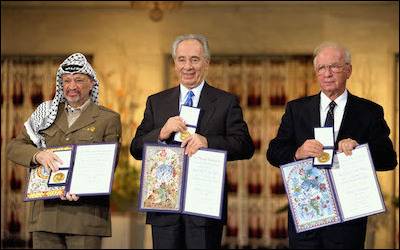 In 1994, (left to right) PLO chairman Yasser Arafat, Israeli prime minister Yitzhak Rabin, and foreign minister Shimon Peres received the Nobel Peace Prize following the signing of the 1993 Oslo accords. But twenty-three years later, peace is still illusive. For Israel, the accords have been the starkest strategic blunder, establishing an ineradicable terror entity on its doorstep, deepening its internal cleavages, and weakening its international standing.
Twenty-three years after its euphoric launch on the White House lawn, the Oslo “peace process” between Israel and the Palestine Liberation Organization (PLO) stands out as one of the worst calamities to have afflicted the Israeli-Palestinian conflict. For Israel, it has been the starkest strategic blunder in its history, establishing an ineradicable terror entity on its doorstep, deepening its internal cleavages, destabilizing its political system, and weakening its international standing. For the West Bank and Gaza Palestinians, it has brought subjugation to the corrupt and repressive PLO and Hamas regimes, which reversed the hesitant advent of civil society in these territories, shattered their socioeconomic wellbeing, and made the prospects of peace and reconciliation with Israel ever more remote. This in turn means that, even if the territories were to be internationally recognized as a fully-fledged Palestinian state (with or without a formal peace treaty with Israel), this will be a failed entity in the worst tradition of Arab dictatorships at permanent war with both Israel and its own subjects.
False Partner, Missed Partner
“We make peace with enemies,” Prime Minister Yitzhak Rabin reassured a concerned citizen shortly after the September 13, 1993 conclusion of the Israel-PLO Declaration of Principles on Interim Self-Government Arrangements (DOP, or Oslo I). “I would like to remind you that the [March 1979] peace treaty with Egypt had many opponents, and this peace has held for 15 years now.”[1] True enough. But peace can only be made with enemies who have been either comprehensively routed (e.g., post-World War II Germany and Japan) or disillusioned with the use of violence—not with those who remain wedded to conflict and war. And while Egyptian president Anwar Sadat was a “reformed enemy” eager to extricate his country from its futile conflict with Israel, Yasser Arafat and the PLO leadership viewed the Oslo process not as a springboard to peace but as a “Trojan Horse” (in the words of prominent PLO official Faisal Husseini) designed to promote the organization’s strategic goal of “Palestine from the [Jordan] river to the [Mediterranean] sea”—that is, a Palestine in place of Israel.[2]
Arafat admitted as much five days before signing the accords when he told an Israeli journalist, “In the future, Israel and Palestine will be one united state in which Israelis and Palestinians will live together”[3]—that is, Israel would cease to exist. And even as he shook Rabin’s hand on the White House lawn, the PLO chairman was assuring the Palestinians in a pre-recorded, Arabic-language message that the agreement was merely an implementation of the organization’s “phased strategy” of June 1974. This stipulated that the Palestinians would seize whatever territory Israel surrendered to them, then use it as a springboard for further territorial gains until achieving the “complete liberation of Palestine.”[4]
The next eleven years until Arafat’s death on November 11, 2004, offered a recapitulation, over and over again, of the same story. In addressing Israeli or Western audiences, the PLO chairman (and his erstwhile henchmen) would laud the “peace” signed with “my partner Yitzhak Rabin.” To his Palestinian constituents, he depicted the accords as transient arrangements required by the needs of the moment. He made constant allusion to the “phased strategy” and the Treaty of Hudaibiya—signed by Muhammad with the people of Mecca in 628, only to be disavowed a couple of years later when the situation shifted in the prophet’s favor—and insisted on the “right of return,” the standard Palestinian/Arab euphemism for Israel’s destruction through demographic subversion. As he told a skeptical associate shortly before moving to Gaza in July 1994 to take control of the newly established Palestinian Authority (PA):
I know that you are opposed to the Oslo accords, but you must always remember what I’m going to tell you. The day will come when you will see thousands of Jews fleeing Palestine. I will not live to see this, but you will definitely see it in your lifetime. The Oslo accords will help bring this about.[5]
This perfidy was sustained by Arafat’s successor, Mahmoud Abbas, who has had no qualms about reiterating the vilest anti-Semitic calumnies: In his June 2016 address to the European Parliament, Abbas accused Israeli rabbis of urging the poisoning of Palestinian water.[6] In his doctoral dissertation, written at a Soviet university and subsequently published in book form, he argued that fewer than a million Jews had been killed in the Holocaust, and that the Zionist movement colluded in their slaughter.[7] He has vowed time and again never to accept the idea of Jewish statehood, most recently in March 2014, when he rallied the Arab League behind his “absolute and decisive rejection to recognizing Israel as a Jewish state,”[8] and in September 2015, when he derided Israel in his U.N. address as “a historic injustice … inflicted upon a people … that had lived peacefully in their land.”[9]
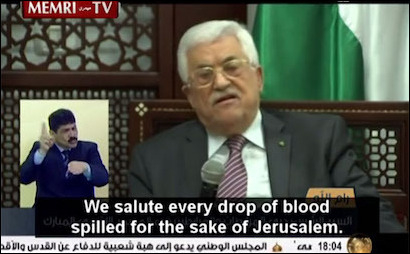 An unreconstructed Holocaust denier, PA president Mahmoud Abbas has voiced incessant anti-Semitic and anti-Israel incitement. In his June 2016 address to the European Parliament, Abbas accused Israeli rabbis of urging the poisoning of Palestinian water. He has pledged to prevent the Jews from “defiling al-Aqsa with their filthy feet” and has vowed time and again never to accept the idea of Jewish statehood.
Back home in the PA, Abbas was even more forthright, pledging to prevent the Jews from “defiling al-Aqsa with their filthy feet” and stating that “every drop of blood that has been spilled in Jerusalem is holy blood as long as it was for Allah.”[10] When this incitement culminated in a sustained wave of violence that killed scores of Israelis in a string of stabbings, car rammings into civilians, and shooting attacks, Abbas applauded the bloodshed as a “peaceful, popular uprising. … We have been under occupation for 67 or 68 years [i.e., since Israel’s establishment],” he told his subjects in March 2016. “Others would have sunk into despair and frustration. However, we are determined to reach our goal because our people stand behind us.”[11]
In other words, more than two decades after the onset of the Oslo process, Israel’s “peace partner” would not even accept the Jewish state’s right to exist, considering its creation an “illegal occupation of Palestinian lands.”
What makes this state of affairs all the more tragic is that, at the time of the Oslo accords, the Rabin government had a potentially far better peace partner in the form of the West Bank and Gaza leadership. To be sure, Israel’s hand-off policies during the two-and-a-half decades from the June 1967 capture of the territories to the onset of the Oslo process enabled the PLO to establish itself as the predominant force there at the expense of the more moderate local leadership. But this meant no blind subservience to the organization’s goals or means. Unlike the PLO’s diaspora constituents (or the “outside” in Palestinian parlance) who upheld the extremist dream of returning to their 1948 dwellings at the cost of Israel’s destruction, West Bankers and Gazans (the “inside”) were amenable to peaceful coexistence that would allow them to get on with their lives and sustain the astounding economic boom begun under Israel’s control. During the 1970s, for example, the West Bank and Gaza were the fourth fastest-growing economy in the world, ahead of such “wonders” as Singapore, Hong Kong, and Korea, making socioeconomic conditions there far better than in most neighboring Arab states. While the “outside” diaspora had no direct interaction with Israelis (and for that matter with any other democratic system), Israel’s prolonged rule had given the “inside” Palestinians a far more realistic and less extreme perspective: hence their perception of Israel as more democratic than the major Western nations;[12] hence their overwhelming support for the abolition of those clauses in the Palestinian charter that called for Israel’s destruction and their rejection of terror attacks;[13] and hence their indifference to the thorniest issue of the Palestinian-Israeli dispute, and the one central to the PLO’s persistent effort to destroy Israel, namely, the “right of return.” As late as March 1999, two months before the lapse of the official deadline for the completion of the Oslo final-status negotiations, over 85 percent of respondents did not consider the refugee question the most important problem facing the Palestinian people.[14]
Against this backdrop, the Rabin government had a unique opportunity to steer the Palestinian populace in the West Bank and Gaza in the direction of peace and statehood, possibly in collaboration with Jordan’s King Hussein, who just a few years earlier had thrown his hat in the ring only to be rebuffed by Prime Minister Shamir. In a Nablus public opinion poll shortly before the DOP signing, 70 percent of respondents preferred Hussein to the PLO as their sovereign,[15] not least since the PLO had been totally ostracized by its Arab peers following its support for Iraq’s brutal occupation of Kuwait. At that point, its prestige in the territories was at one of its lowest ebbs; Hamas was at an early stage of development; the radical Arab regimes were thoroughly disorientated by the collapse of their communist backers; and the West Bank and Gaza leadership was bent on participating in the U.S.-sponsored peace talks between Israel and its neighbors, launched at the October 1991 Madrid Conference and sustained in Washington, against the PLO’s adamant objection.[16]
But then, instead of seizing the moment and opting for the obvious peace partner that was far better attuned to the needs and wishes of the local Palestinian populace, and against his personal inclination to strike a deal with the “moderate insiders” rather than the “extremist Tunis people [i.e., PLO leadership],” Rabin was persuaded by Foreign Minister Shimon Peres and his deputy Yossi Beilin (who reportedly collaborated with the PLO in obstructing the Washington talks) into surrendering the West Bankers and Gazans to an unreconstructed terror organization whose leader would not hang up his ubiquitous battledress, not even for the signing ceremonies of the various Oslo accords or the receipt of the Nobel Peace Prize, and who used peace as a strategic deception aimed at promoting the eternal goal of Israel’s destruction.[17]
As a result, twenty-three years of 1) incessant hate mongering by the PLO/PA (not to mention Hamas, which exploited the Oslo process to become the preeminent military and political factor in the territories); 2) countless terror attacks (including a full-fledged terror war, euphemistically named “al-Aqsa Intifada” after the Jerusalem mosque); 3) three protracted large scale military encounters between Hamas and Israel; and 4) economic collapse induced by the PA’s and Hamas’s corrupt and inept rule have thoroughly radicalized the West Bank and Gaza populace with a new generation of Palestinians brought up on vile anti-Jewish (and anti-Israel) incitement unparalleled in scope and intensity since Nazi Germany.
Tarnished Security
Apart from making the prospects of peace and reconciliation….
read more: Why the Oslo Process Doomed Peace
 Portrety Józefa Sandla ze zbiorów Żydowskiego Instytutu Historycznego