
Archive | 2016/09/23

Komunikat redakcji ‘NIGDY WIĘCEJ’

‘Na faszyzm nigdy zgody nie będzie’. Pamięci Marcina Kornaka
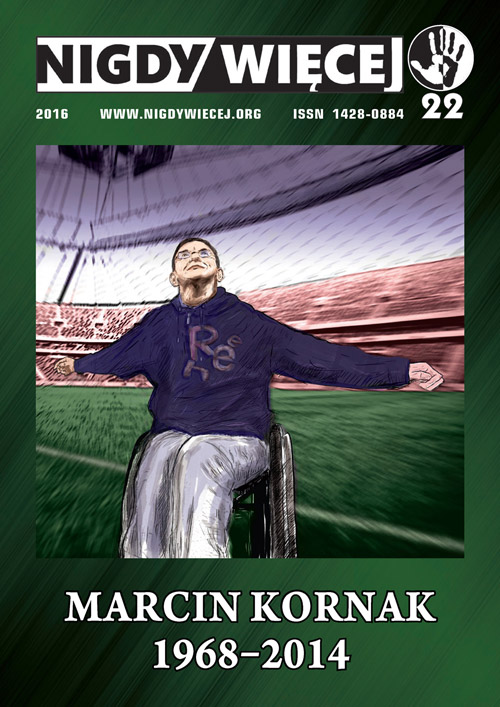
„NIGDY WIĘCEJ” nr 22

Napaści na cudzoziemców, rasistowskie wyzwiska i groźby, a także przemarsze faszyzujących bojówek stały się w Polsce częstymi zdarzeniami. Przed zagrożeniem ze strony skrajnego nacjonalizmu i bezkarnością sprawców już od połowy lat dziewięćdziesiątych przestrzegał Marcin Kornak (ur. 1968 – zm. 2014), twórca Stowarzyszenia ‘NIGDY WIĘCEJ’. Jego postać upamiętnia specjalny numer założonego przez niego magazynu ‘NIGDY WIĘCEJ’.

Na łamach ponad 200 stron pisma znajdują się artykuły, rozprawy i wypowiedzi wybitnych humanistów i działaczy społecznych, m. in. Michała Głowińskiego, Adama Michnika, Roberta Biedronia, Szymona Rudnickiego, Barbary Nowackiej, Anny Grodzkiej, Sylwii Chutnik, Dawida Warszawskiego i Adama Szostkiewicza.

‘Wkład Marcina Kornaka w budowanie nowoczesnego, otwartego i tolerancyjnego społeczeństwa był wyjątkowy i stanowić będzie inspirację dla kolejnych pokoleń ludzi, którzy mają w sobie wrażliwość i energię do działania’ – napisał były minister spraw zagranicznych i marszałek sejmu Radosław Sikorski. O zasługach Marcina Kornaka pisze były prezydent Aleksander Kwaśniewski: ‘Był odważnym człowiekiem o wielkim sercu, który poświęcił wiele lat budowaniu świata pozbawionego dyskryminacji. Zapoczątkował wiele pięknych inicjatyw na rzecz tolerancji i promocji wielokulturowości, które wzbogaciły nasze społeczeństwo’. Zaś Elżbieta Janicka podkreśla: ‘Był bardzo świadomy tego, że faszyzm nie jest tylko ekscesem czy problemem marginesu, lecz zjawiskiem obecnym w głównym nurcie kultury i elicie społeczeństwa. Bez niego wiele spraw, wiele aktów przemocy przepadłoby bez śladu’.

Marcin Kornak był autorem monumentalnej ‘Brunatnej Księgi’ – monitoringu ksenofobii, rasizmu i aktów dyskryminacji. W najnowszym numerze pisma ‘NIGDY WIĘCEJ’ znajduje się jej kontynuacja, wybór zdarzeń z lat 2014-2016, wśród których odnotowano m.in. pobicie romskiego poety Edwarda Dębickiego w Gorzowie Wlkp., atak łódzkich pseudokibiców na grupę studentów z Turcji, Iraku i Kazachstanu, rasistowskie groźby kierowane pod adresem czteroletniego dziecka w Rzeszowie, antysemicką pikietę Narodowego Odrodzenia Polski pod ambasadą Izraela, manifestacje ONR-u i Młodzieży Wszechpolskiej, podczas których skandowano ‘Znajdzie się kij na islamski ryj’, napaść na małżeństwo Hindusów we Wrześni oraz na Ukraińców w Kutnie, a także dewastację tablicy upamiętniającej obszar getta warszawskiego.

Nowy numer ‘NIGDY WIĘCEJ’ zawiera również teksty poświęcone ksenofobii i populizmowi, jakie nasiliły się w obliczu kryzysu humanitarnego związanego z sytuacją uchodźców z Afryki Północnej i Bliskiego Wschodu. Wojciech Burszta, Aleksander Smolar i Marcin Czerwiński zwracają uwagę na to, w jaki sposób publiczny przekaz na temat uchodźców doprowadził w wielu europejskich społeczeństwach do wzrostu nastrojów ksenofobicznych i przemocy.

Specjalny numer magazynu ‘NIGDY WIĘCEJ’ ma charakter niekomercyjny i jest bezpłatnie dostępny dla zainteresowanych pod adresem www.nigdywiecej.org

Stowarzyszenie ‘NIGDY WIĘCEJ’ jest założoną przez Marcina Kornaka w 1996 roku niezależną, apolityczną organizacją ekspercką, która monitoruje incydenty na tle ksenofobicznym oraz wydaje antyrasistowski magazyn ‘NIGDY WIĘCEJ’. Prowadzi kampanie społeczne, m.in. ‘Muzyka Przeciwko Rasizmowi’ i ‘Wykopmy Rasizm ze Stadionów’.

Spis treści i wybrane artykuły on-line http://www.nigdywiecej.org/3508
Pamieci Marcina Kornaka – specjalny 22. numer magazynu ‘NIGDY WIECEJ’ (VIDEO)


Dodatkowe informacje:
tel. 601 360 835
www.nigdywiecej.org
www.facebook.com/respect.diversity
www.twitter.com/StowNIGDYWIECEJ

***

* Jeżeli nie chcą Państwo otrzymywać od nas komunikatów, prosimy o przesłanie e-maila z nagłówkiem ‘usuń’ na adres: redakcja@nigdywiecej.org .
* Prosimy o umieszczenie adresu e-mailowego redakcja@nigdywiecej.org w Państwa książce adresowej oraz ewentualnie na liście zatwierdzonych nadawców (biała lista) w celu zapewnienia poprawnego dostarczania wiadomości.
* Zapraszamy do umieszczania linku do strony www.nigdywiecej.org na Państwa stronach internetowych i blogach.
* Zapraszamy do ‘polubienia’ profilu ‘NIGDY WIĘCEJ’ na Facebooku: www.facebook.com/respect.diversity.


twoje uwagi, linki, wlasne artykuly, lub wiadomosci przeslij do: webmaster@reunion68.com


8 Little-Known Facts about Jewish Pirates

8 Little-Known Facts about Jewish Pirates

Dr. Yvette Alt Miller


8 Little-Known Facts about Jewish Pirates

Some Jews turned to piracy as a way to fight against Spain and Portugal, the hosts of the brutal Inquisition.

Jewish pirates? It’s not a joke. Turns out, some of the most well-known and respected buccaneers in previous centuries were Jews. These captains were not the dreaded pirates of popular imagination; many worked in the employ of Britain, the Netherlands, and other maritime powers, protecting those nations’ coasts and seas.

While many of the details of these captains’ lives are mysterious, historians have pieced together some details of their lives, giving us a glimpse into the little-known world of Jewish pirates. Here are eight interesting facts about Jews and piracy.

Abraham Henriques Cohen and the World’s Biggest Heist

Abraham Henriques Cohen started life as a secret Jew living under the Inquisition in his native Portugal. One of the most prominent merchants in Lisbon, he was discovered to be a practicing Jew in 1605 and publicly tortured, along with 150 other hidden Jews. This experience apparently led Cohen to decide to work against Spain and Portugal, the hosts of the brutal Inquisition.

After escaping to Amsterdam, Cohen seemingly became a secret agent for the Dutch navy, and made his way to the New World, settling in Jamaica, which was then a haven for Jews. He worked on behalf of the Netherlands to attack Spanish ships and frustrate Spain’s colonial designs in the New World.

Cohen teamed up with one of the most feared pirates of the time, Sir Henry Morgan, with the tacit backing of both the Dutch and British governments. In 1628, along with Dutch folk hero Admiral Piet Pieterszoon Hein, Cohen captured a Spanish treasure fleet off the coast of Cuba. The ships were carrying gold and silver worth 11,509,524 guilders, around $1 billion today. It was the largest theft in the history of the Spanish fleet.

Cohen gave up piracy in old age when Sir Henry Morgan became Lieutenant Governor of Jamaica, and pardoned his longtime friend. The two lived out their days in Jamaica, their pirate ways behind them for good.

Jean Laffite, War Hero and Pirate

Jean Laffite

One of the most fabled and swashbuckling pirates of all time, Jean Laffite, was born in France in about 1780. He later wrote that his grandparents were Jews who were tortured by the Inquisition. This sparked a lifelong disdain for Spain in young Jean, and inspired him to turn to piracy to attack Spanish holdings in the New World where the Inquisition held sway.

Moving to the French colony of New Orleans, Jean Laffite and his brother Pierre founded a blacksmith shop, but they had a second secret profession as well: they held commissions from the Republic of Cartagena (in modern day Colombia) to intercept Spanish boats. They carried on this secret activity from a secluded colony in Barataria Bay, off the coast of New Orleans.

Jean Laffite

During the War of 1812, Laffite warned American troops of British invasion plans. He offered the help of his pirate gang to Gen. Andrew Jackson in the defense of New Orleans in exchange for a pardon for their pirate activities. Gen. Jackson agreed and Laffite’s gang fought with distinction. Jackson later called Laffite “one of the ablest men” of the Battle of New Orleans.

A few years later, in 1817, Laffite once again turned to piracy, taking nearly a thousand followers with him to the site of present-day Galveston, Texas. Until his death in about 1825, Jean Laffite remained one of the most feared pirates of the “Spanish Main,” the eastern coast of Spain’s holdings in the New World.

“Brotherhood of the Black Flag” and Buried Treasure

Sudel Deul, a 16th Century Jewish physician, was an early explorer of the Americas and is credited with introducing the potato to Europeans. His son Subatol found fame in a very different route: becoming one of the most feared pirates in the world.

Subatol formed an alliance with another son of a famous explorer who’d also turned to piracy: Henry Drake, son of the great British explorer Sir Francis Drake. Together the two buccaneers formed the “Brotherhood of the Black Flag”, leading a band of pirates in attacking Spanish ships off the coast of present-day Chile. It is said that the duo buried 6,000 pounds of Spanish gold and an even greater amount of silver near the Guayacan harbor in present-day Chile. No one has found the buried treasure yet, though seekers have discovered documents written partly in Hebrew, possibly written by Subatol.

Pirate Gravestones in a Jewish Cemetery

read more: 8 Little-Known Facts about Jewish Pirates


twoje uwagi, linki, wlasne artykuly, lub wiadomosci przeslij do: webmaster@reunion68.com


The Hall of Names

Yad Vashem. The World Holocaust Remembrance CenterThe Hall of Names

Bildresultat för the hall of names yad vashem

No cemeteries, no headstones, no traces were left to mark the loss of the six million Holocaust victims. The Hall of Names at Yad Vashem is the Jewish People’s memorial to each Jew murdered in the Holocaust – a place where they are commemorated for generations to come.

Yad Vashem, with the support of Jewish communities and organizations around the world, is leading the historic mission to memorialize Jewish victims of the Holocaust by collecting “Pages of Testimony” – special one-page forms designed to restore the personal identity and brief life stories of the six million Jews murdered by the Nazis and their accomplices. Submitted by survivors, remaining family members or friends and acquaintances in commemoration of Jews who perished in the Holocaust, Pages of Testimony document the names, biographical details and, when available, photographs, of each individual victim. The first 800,000 names on Pages of Testimony were collected during the 1950’s, with ongoing global outreach efforts to identify the unnamed victims of the Shoah so they will always be remembered.

Collection efforts continued throughout the years in Israel and among Jewish communities throughout the world. A “Room of Names” was opened in 1968 on Yad Vashem’s campus on the Mount of Remembrance in Jerusalem. The room was the repository for the original handwritten Pages of Testimony stored in special black Yizkor files, catalogued alphabetically in Hebrew according to first and last names. In 1977 the “Hall of Names” was inaugurated in a specially designed building in the presence of Prime Minister Menachem Begin and Joseph Burg, the Chairman of Yad Vashem’s International Council.

Between 1984 to 1985 Yad Vashem undertook to microfilm close to 1.1 million Pages of Testimony that had been collected up to that time. On the backdrop of a growing number of public inquries on the fate of Holocaust victims, the microfilm enabled staff to search for victims’ names more efficiently thereby improving their service. At the same time it created a vital backup copy of the Pages of Testimony collection. During the 1980’s the average number of Pages of Testimony collected at Yad Vashem’s Hall of Names was 15,000 new pages per year. The fall of the “Iron Curtain” separating the former Soviet Union from the West, resulted in a dramatic increase of new Pages of Testimony in the 1990’s, raising the annual collection to around 35,000.

In 1990, the Hall of Names extended its scope beyond Pages of Testimony, and began to actively gather and process lists of names originating from deportations, camps and ghetto records. The computerization of the names from all sources began in late 1991 and expanded until the end of 1998 when almost one million names had beed computerized.

A milestone in the history of the Hall of Names was reached in 1999. Yad Vashem embarked on an impressive and intensive project to computerize more than 1.1 million Pages of Testimony, including the scanning of all 1.6 million paper forms collected up to that time. The project was implemented together with Tadiran Information Systems and Manpower Israel in conjunction with, and funded by the Independent Committee of Eminent Persons (ICEP) established to resolve the public issue of the dormant accounts in Swiss banks. The project spanned from February to May 1999 with the assistance of a staff of 1,000 and 100 IT and content specialists working two shifts in two different locations, Jerusalem and Beer Sheba. The computerized database with over two million names of Holocaust victims, enabled the ICEP representatives to cross-reference the names with owners of the the dormant accounts.

On May 8th 1999, under the auspices of President Ezer Weizman, Yad Vashem initiated a well publicized world wide media campaign to collect Pages of Testimony. The public response was overwhelming: a call center with 20 phone lines and 90 staff members working double shifts was established to handle the large volume of incoming inquiries in real time. During the months of April and May alone some 147,000 Pages of Testimony were received, amounting to a total of about 380,000 by the end of 1999. The aftermath of the campaign was felt in 2000 as well; an additional 70,000 Pages of Testimony were collected. Although the names collection campaign was targeted also to Jewish communities around the world, around 85% of the Pages of Testimony collected had been submitted in Israel. Surprisingly, more than 80% of all incoming pages actually contained names of victims that were not previously recorded at the Hall of Names. This statistic reinforced the great significance of the campaign at that point in time.

By the year 2000, the initial computerization project and media campaign resulted in the creation of a database containing close to 2.5 million names of Holocaust victims at the Hall of Names. Founded on a sophisticated technological platform the names database was updated and upgraded. Advanced search capabilities including soundex and synonym searches were developed in order to enhance retrieval possibilities. On November 22nd 2004, the Central Database of Shoah Victims’ Names was launched and uploaded to the Yad Vashem website offering the general public full and free accessibility to close to three million victims’ names in English and Hebrew. In 2007, the option to consult the names database in Russian (Cyrillic characters) was also made available.

The new Holocaust History Museum complex inaugurated in spring 2005, includes a newly designed Hall of Names, built with the generous contribution of the Rothschild-Caesarea Foundation. The Hall of Names currently houses about 2.5 million original Pages of Testimony in a temperature and humidity controlled environment. Surrounded by fragments of Pages of Testimony and portraits of Holocaust victims from different countries and backgrounds, visitors to the Hall can reflect on the destruction of the pre-war Jewish world. Adjacent to the circular memorial is a computer center where the public may seek information on the fates of the victims through the Central Database of Shoah Victims’ Names.


twoje uwagi, linki, wlasne artykuly, lub wiadomosci przeslij do: webmaster@reunion68.com