
Archive | November 2016

Gwiazda Dawida staje się w Niemczech swastyką

Gwiazda Dawida staje się w Niemczech swastyką

Giulio Meotti
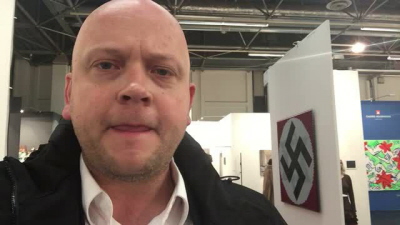

Dzieło i koneser sztuki.Dzieło i koneser sztuki.

To nie jest pierwszy raz, kiedy duże muzeum w Europie bierze udział w podżeganiu do nienawiści do Izraela i Żydów.

W galerii sztuki Antonopoulou w Atenach Alexandros Psychoulis stworzył “dzieło sztuki” z kamizelek wybuchowych Arabów palestyńskich, zamachowców-samobójców.

Muzeum Jeu de Paume w Paryżu zorganizowało wystawę Ahlam Shibli, która gloryfikuje palestyńskich zamachowców-samobójców jako męczenników”.

W muzeum w Sztokholmie była “Śnieżno Biała”, basen pełen czerwonej wody, po którym unosiła się łódź z fotografią Hanadi Jaradat, która detonując bombę zamordowała dwudziestu jeden Izraelczyków w restauracji Maxim w Hajfie.

Teraz wystawiono olbrzymi panel artystyczny w Kolonii w Niemczech: jeśli patrzysz na niego od prawej strony, widzisz swastykę, jeśli przechodzisz na lewo, swastyka zamienia się w Gwiazdę Dawida. Jest tylko kwestią tego gdzie stoisz, czy widzisz symbol nazistowski, czy flagę Izraela.

To nie jest ekspozycja wystawiona w Iranie, gdzie ajatollah Chamenei wyciera buty na fladze izraelskiej. To dzieje się w Niemczech i nie była to inicjatywa grupy islamskiej ani neonazistów, ale szacownej galerii sztuki. Dzieło podpisał artysta Juraj Kralik. Juan Romero Cárdenas, dyrektor galerii Kir Royal, z dumą przypisuje sobie odpowiedzialność za tę instalację, mówiąc, że praca “’Cztery pory’ jest o dwóch symbolach państwowych, symbolu Niemiec do 1945 r. i obecnym symbolu państwa Izrael”.

Raz jeszcze pojawił się w Niemczech jawny antysemityzm, który przybrał formę „krytyki” Izraela. Najpierw słynny, luksusowy dom towarowy w Berlinie, znany jako KaDeWe, największy w Europie, zawiesił sprzedaż win izraelskich. Potem, po raz pierwszy od Holocaustu, organizacja niemieckiego społeczeństwa obywatelskiego oficjalnie wezwała do bojkotu Izraela w mieście Oldenburg (Dolna Saksonia, 164 tysiące mieszkańców), gdzie związek nauczycieli opublikował dokument wzywający do całkowitego bojkotu państwa żydowskiego. Autor tego dokumentu, Christoph Glanz, zaproponował także przeniesienie Izraela do Badenii-Wirtembergii.

Profesor Monika Schwarz-Friesel z Uniwersytetu Technicznego w Berlinie dokonała analizy listów z groźbami, jakie w ciągu dziesięciu lat przysłano do Centralnej Rady Żydów w Niemczech i do ambasady izraelskiej w Berlinie. Listy zawierały klasyczne wypowiedzi antysemickie, takie jak: „mordowanie dzieci odpowiada waszej tradycji” lub „przez ostatnie dwa tysiące lat kradliście ziemię i dokonywaliście ludobójstwa”. Profesor Schwarz-Friesel zaskoczyło to, że tylko trzy procent listów pochodziło od prawicowych nacjonalistów, podczas gdy ponad sześćdziesiąt procent napisali wykształceni członkowie głównego nurtu, dobrzy ludzie, którzy tylko nienawidzą Żydów. I jeśli zauważą gdziekolwiek Gwiazdę Dawida, widzą nazistowską swastykę.

Giulio Meotti

Włoski publicysta, autor książki „A New Shoah: The Untold Story of Israel’s Victims of Terrorism”.


twoje uwagi, linki, wlasne artykuly, lub wiadomosci przeslij do: webmaster@reunion68.com


Austria: One-third of Muslim youth in Vienna…

Europe Israel NewsAustria: One-third of Muslim youth in Vienna are « Anti-Semitic, homophobic and sympathising with Jihad »

Austria: One-third of Muslim youth in Vienna are « Anti-Semitic, homophobic and sympathising with Jihad »

27 percent of young Muslim respondents in Vienna support Jihad, 47 percent hold anti-Semitic views.

“Anti-Semitic, homophobic and sympathising with Jihad.” This is how a leading Austrian newspaper summed up the latest study looking into the attitudes of young Muslims living in the city of Vienna. The study commissioned by the city reveals that nearly one-third of the Muslim youth living in the Austrian capital hold radical Islamic views and support armed Jihad against the West.

The leftist coalition running the city attacked the findings of the study that yet again reveal the clutching hold of Islamism over Europe’s migrant Muslim population. The study also exposes the failure of Multiculturalism, a policy pursued for decades by Social Democrats and ecological Green Party, who run the Austrian capital.

The study also highlights Europe’s lingering Anti-Semitism. 33 percent of all young Viennese respondents held negative opinion of Jews — among Muslim respondents that number was 47 percent. Austrian newspaper Kronen Zeitung reports:

The finding of a study on identity and radicalisation amongst Viennese youth commissioned by the city of Vienna are alarming: 27 percent of Muslim participants reject the West and place their religion above Austrian laws. They also view Jews and homosexuals negatively. (…)

The main focus of the study was threat of radicalisation amongst teenage Muslims. The extremists are recruiting supporters; be it on the internet, in the gyms or on the streets. (…) 27 percent of respondents sympathise with Jihadism, support violence and are anti-Western. [Author’s translation]
Vienna Socialist (SPÖ) City Councilwoman Sandra Frauenberger downplayed the findings saying, “Young people talk about things that they don’t fully understand.” She also rejected the idea that these young Muslims could pose a threat to Austrian society, saying that it was these ‘vulnerable’ Muslims who needed state protection. “We have to protect them.”

“Multiculturalism is finally dead,” declared the Austrian right-wing Freedom Party (FPÖ) reacting to the study. Maximilian Krauss of the Freedom Party called for the removal of Councilwoman Frauenberger, saying, “Instead of somehow integrating the second generation, we are partially raising a new generation of fanatical Jihadi.”

The study once again shows that other European metropoles too are fast catching up with Paris, Brussels and Stockholm. The rise in Muslim populations owing to higher birth-rates and unrestricted migration goes hand in hand with radicalisation of European inner cities.

Europe’s denial to stand up for Western values, paraded politically as Multiculturalism, offers no resistance to the march of fanatical Islamism. In fact, Liberal Europe celebrates its piecemeal surrender as “diversity” and “cultural enrichment”. Just like the short-sighted politicians of Vienna, politicians across Europe are busy attacking the messenger instead of facing the facts.


twoje uwagi, linki, wlasne artykuly, lub wiadomosci przeslij do: webmaster@reunion68.com


Jerusalem hills fire threatened to consume mountainside village

Jerusalem hills fire threatened to consume mountainside village

TIMES OF ISRAEL STAFF


Blaze surrounded Beit Meir, burned at least 10 buildings before it was beaten back; one suspected arsonist held by police; tens of thousands can’t yet return to Haifa homes

Footage of a fire in the mountainous village of Beit Meir, west of Jerusalem, November 25, 2016. (YouTube screen capture)

Dozens of firefighters spent the night battling a massive forest fire in the Jerusalem hills that threatened to obliterate one small community west of Jerusalem, fire officials said early Friday. A “great many” homes in Beit Meir, near Abu Ghosh, were overtaken by the flames, police said, but there were no reports of injuries as the village’s residents had already been evacuated.

The blaze is part of a wave of forest and brush fires that have cut a path of destruction across several of Israel’s forests in recent days – and in several places entered residential areas. No one has been killed in the blazes, but hundreds have been injured and dozens of homes burned.

In Beit Meir, at least 10 buildings had been burned by 6 a.m. Friday, and small fires remained in public spaces in the village.


An estimated 25 fire trucks and 60 firefighters spent several hours overnight fighting to stop the spread of the blaze, which started some 15 kilometers west of the capital.

Police sealed off the main entry road into the hamlet while residents were taken to nearby villages Shoresh and Tzora.

read more: Jerusalem hills fire threatened to consume mountainside village


twoje uwagi, linki, wlasne artykuly, lub wiadomosci przeslij do: webmaster@reunion68.com



ZiH – Newsletter 23-30 listopada 2016

Newsletter 23-30 listopada 2016

Newsletter 23-30 listopada 2016
CZWARTEK NA TŁOMACKIEM 
24 listopada, godz.18:00
Żydowskie dylematy Andrzeja Wajdy. 
Część I.
 
“Czy się opowiada przedwojenną historię, tak jak w “Ziemi Obiecanej” lub “Panu Tadeuszu”; czy się opowiada o wojnie i wtedy jest to najbardziej tragiczny moment; czy wreszcie opowiada się o okresie powojennym, kiedy następuje decyzja gdzie być, gdzie znaleźć dla siebie miejsce – w każdym z tych przypadków nieustannie mamy do czynienia z żydowskimi motywami” – mówił Andrzej Wajda. 
To był ważny temat dla tego bezgranicznie oddanego dziejom Polski wizjonera, któremu udało się narzucić wielu pokolenim Polaków swój obraz narodowej historii.
A jednak Wajda podejmując tematykę żydowską w swoich filmach często ponosił porażkę: zarzuty wobec “Samsona”, zakaz dystrybucji “Ziemi Obiecanej” w USA, wiele niepochlebnych opinii krytyków filmowych o “Korczaku”- wszytko to układa się w pewien zastanawiający schemat.
Motywy żydowskie często okazywały się dla Wajdy…- no właśnie jakie? Zbyt hermetyczne, niebezpieczne, za trudne? Za co właściwie był krytykowany? I dlaczego wciąż wracał w swej twórczości do relacji polsko-żydowskich, upierając się, że “póki my, Polacy, żyjemy, póty będzie z nami motyw żydowski!”?
 
O żydowskich dylematach Andrzeja Wajdy rozmawiać będą: psychoanalityk Krzysztof Srebrny, aktor Wojciech Pszoniak oraz prowadząca spotkanie – Anna Kaplińska-Struss, dziennikarka i absolwentka łódzkiej Szkoły Filmowej.
SEMINARIUM NAUKOWE
29 listopada 2016r, godz. 11:00
Rola religii w myśli syjonistycznej Achad Ha-ama i Josefa Chaima Brennera
dr Daria Boniecka-Stępień (ŻIH)
 
Celem wykładu będzie prześledzenie jak rozumienie pojęcia religii w ogóle oraz judaizmu w szczególe wpłynęło na wizję ideologii syjonistycznej Achad Ha-Ama oraz Josefa Chaima Brennera. 
Ci dwaj myśliciele hebrajscy przełomu XIX i XX wieku byli jednymi z najważniejszych ideologów syjonistycznych. Ich głos w dyskusji nad nową żydowską tożsamością i odnowieniem żydowskiego życia był niezwykle znaczący. Zaproponowali oni inny sposób myślenia o żydowskości, poddali ją krytyce, zaproponowali nowe kategorie jej definiowania.
21 listopada 2016 roku w auli Domu Literatury w Warszawie miała miejsce uroczystość wręczenia Nagrody Edytorskiej Polskiego Pen Clubu im. Juliusza Żuławskiego Zespołowi Edytorskiemu Pełnej Edycji Archiwum Ringelbluma. 
 
Prezes Polskiego PEN Clubu Adam Pomorski oraz Małgorzata Horodyniec — dyrektor banku PEKAO S.A. przekazali nagrodę na ręce dyrektora Żydowskiego Instytutu Historycznego prof. Pawła Śpiewaka, prof. Tadeusza Epszteina i dr Katarzyny Person. Laudacje wygłosili: prof. Jacek Leociak, Piotr Matywiecki i prof. Henryk Samsonowicz.

twoje uwagi, linki, wlasne artykuly, lub wiadomosci przeslij do: webmaster@reunion68.com


Russian war film set to open amid controversy over accuracy of events

Russian war film set to open amid controversy over accuracy of events

Shaun Walker


Panfilov’s 28 tells the story of a Russian division who fought to the death to defend Moscow, but some are questioning the story’s validity

A still from Panfilov’s 28, which tells the story of a defence of Moscow under attack from the Nazis. Photograph

Every Soviet schoolchild was taught about the heroic feats of the last 28 members of Ivan Panfilov’s division, which in late 1941 fought to the death to stop a Nazi tank assault on Moscow in one of the best known episodes of the Soviet war effort.

“Russia is vast, but there is nowhere to retreat – Moscow is behind us,” one of the Red Army soldiers, armed at the end with just Molotov cocktails and grenades, said as the attack was halted.

But as a film about the events, Panfilov’s 28, opens in Russia this week, controversy rumbles on over the fact that many of the details of that last stand – both in the film and versions pre-dating it – appear to have been invented.

Arguments over the upcoming film and the mythology around the episode in general began last spring, when Sergei Mironenko, the director of Russia’s state archive, gave an interview stating that while there had indeed been a bloody battle outside Moscow, it was not as many had understood it.

His words provoked such outrage that over the summer the archive posted online a 1948 internal Soviet military report into the events, which came to the conclusion that a journalist from the Red Army’s newspaper had made up the particulars of the story, inventing quotes and ignoring the fact that some of the soldiers had survived and one was believed to have surrendered to the Germans.

The legend was cooked up to fit in with the Soviet demand that soldiers should fight to the death rather than surrender.


‘The whole world is watching us with bated breath, because right here we are defending it’, says a soldier in the trailer for the film.

Vladimir Medinsky, the culture minister, reacted furiously to the intervention, saying it was not the job of archivists to make historical evaluations, and if Mironenko wanted to change professions, he should do so. Shortly after, Mironenko was fired.

The nationalist politician Vladimir Zhirinovsky said in recent weeks that he had called at a government meeting for Mironenko to be fired. He claimed his uncle had fought in Panfilov’s division and said those griping about the exact numbers were missing the point. “It’s unacceptable for someone from the archives to start telling the whole country that there were no Panfilov heroes,” he said.

Medinsky later went further in his defence of the film and his disgust for those who questioned the story.

“It’s my deep conviction that even if this story was invented from the start to the finish, even if Panfilov never existed, even if there was nothing at all, it’s a sacred legend which it’s simply impossible to besmirch. And people who try to do that are total scumbags.”

Medinsky said he would like to send such people, who “poked their dirty, greasy fingers into the history of 1941” back to the war period in a time machine and leave them in a trench to face Nazi tanks armed with just a hand grenade.

Panfilov’s division included many central Asians, and last month Putin and Kazakhstan’s president Nursultan Nazarbayev watched the film together.

Under Putin, victory in the second world war has become the main building block of modern Russian identity, and criticism of the Red Army or mentions of the darker sides of the war effort are unwelcome.

The war’s huge place in the national psyche is understandable, given the Soviet Union lost more than 20 million citizens during the war years. But some are uncomfortable that the mythology has overtaken the facts.

Alexander Morozov, a history teacher and the chair of the editorial board of a magazine on the teaching of history in schools, called the film a “big mistake”, and said mythologising the war would only confuse children.

He told Ekho Moskvy radio: “We should try to tell the truth, of course. Yes, there was a battle, yes there was heroism. This is what they should have made a film about… But as it is, they’ll watch this film, go online and find a whole load of different information about this battle, and it will undermine their trust in these kind of things.”


twoje uwagi, linki, wlasne artykuly, lub wiadomosci przeslij do: webmaster@reunion68.com