Archive | August 2024

The Anti-Israel Sanctions Machine

The Anti-Israel Sanctions Machine

Michael Doran


In response to Hamas’ Oct. 7 terror attack, the Biden-Harris administration assembled a team tasked with toppling Bibi

.
Kamala Harris and Benjamin Netanyahu before the start of a meeting in the vice president’s ceremonial office in Washington, D.C., on July 25, 2024
Kenny Holston-Pool/Getty Images

President Biden recently achieved a historic first for which he has received no credit. He is the first president to form an interagency team dedicated to imposing sanctions on an ally, namely, Israel.

To be sure, the United States sanctioned allies on many occasions. Recent examples of this kind include sanctions designed to prevent Germany from completing the Nord Stream 2 natural gas pipeline, and sanctions on Turkish defense industries to penalize Ankara for its procurement of the Russian S-400 surface-to-air missile system. These sanctions resulted from a specific action by an allied government that Washington sought to reverse.

But the sanctions against Israel are of a qualitatively different kind. The Biden administration has assembled an interagency team of targeteers tasked with finding individuals and groups to sanction—not to reverse a specific policy, but to weaken if not topple the government of Prime Minister Benjamin Netanyahu.

The existence of this machine has been hiding in plain sight since last February, when Biden issued an executive order claiming that violence by Israeli settlers in the West Bank was threatening the stability of the entire Middle East. The order laid out the justification for the interagency team of targeteers and provided it with the necessary legal authorities to generate sanctions packages.

The press has reported on the executive order and has taken note of the sanctions the administration has generated, but it has also failed to ask some basic questions, which I put to contacts in the government. Here is what I gleaned.

When the Oct. 7 attack generated the fear in Washington that the resulting war would strengthen the Israeli right, Biden launched an initiative to counter it.

The White House has established an interagency initiative to produce sanctions against Israeli entities and individuals. The International Economics Directorate at the National Security Council (NSC) leads the effort. Ilan Goldenberg, who until April worked for Vice President Kamala Harris and has now moved to the Strategic Planning Directorate in the NSC, also plays a very enthusiastic role. In the State Department, the Office of Economic Sanctions Policy has the lead. It works closely with the Office of Foreign Assets Control at Treasury. Together they prepare evidentiary packages.

The team convenes frequently, to meet the goal, set by the president and his top advisers, of rolling out packages of sanctions with regularity. By my count, six tranches have been rolled out so far. The next tranche, I have learned, is already prepared, waiting for release after Iran attacks Israel, so that the administration can dodge the accusation of weakening Israel in time of war.

The regularity of the rollouts, which average about one tranche per month, matter to the administration more than the specific content of the sanctions. The goal is not to reverse any policy by the Israeli government but to create a climate of controversy around Netanyahu and his right-wing coalition partners.

Biden did not create this sanctions machine in response to any development on the ground in the Middle East other than the surprise attack by Hamas on Oct. 7. When the attack generated the fear in Washington that the resulting war would strengthen the Israeli right, Biden launched an initiative to counter it.

Tom Nides, Biden’s ambassador to Israel until July 2023, almost certainly reflected the current view of the Biden administration when, at a recent conference, he called for substituting right-wing ministers like Finance Minister Bezalel Smotrich and Minister of National Security Itamar Ben-Gvir with opponents of Netanyahu like former prime ministers Naftali Bennet and Yair Lapid. “We need to get the crazies out. We need to bring the moderates back in,” Nides said.

It was undoubtedly with this goal in mind that Biden’s Israel sanctions machine proposed sanctioning Ben-Gvir. Biden personally nixed the idea, but someone in the administration made sure to leak to the press the fact that the proposal was under consideration. Even sanctions that do not receive approval can still generate press reports that further the goals of the campaign.

The administration’s cover story, that it is issuing sanctions in reaction to events on the West Bank, evaporates when one examines the specific content of the sanctions. Consider the case of Elor Azaria, whom Secretary of State Blinken sanctioned last month. An Israeli medic, Azaria shot Abdel Fattah al-Sharif, a Palestinian terrorist who was laying wounded on the ground. The administration homed in on Azaria’s story because it can be easily manipulated to support a headline, such as “The Radicalization of Israel’s Military.”

Under scrutiny, however, the propagandistic intentions of the administration become obvious. When I served on the National Security Council in the White House of President George W. Bush, I frequently helped with the sanctioning of specific individuals. This time-consuming process requires meeting strict evidentiary criteria. Treasury regulations require that misdeeds by potential subjects of sanctions must be recent, committed within the last five years.

It was eight years ago, however, that Azaria killed al-Sharif, when President Obama was still in office. Treasury regulations will not allow him to be fitted for economic sanctions. A different legal instrument would be required to make Azaria’s story newsworthy again. Biden’s team found it in a law that bars entry to the United States to foreign officials guilty of gross human rights violations. Azaria is not an official, nor is he the leader of a death squad. He’s a simple baker, who plays no role in politics, but the administration’s lawyers gave the green light, nonetheless.

Azaria served time in an Israeli prison for his crime. Azaria claimed that he used his gun because he feared that al-Sharif was wearing a suicide vest and had made a sudden movement. The Israeli military doubted this defense, tried him for manslaughter, and found him guilty. Stripped of rank, he also served half of an 18-month prison sentence and was released.

Regardless of whether Azaria acted appropriately, or whether he received a just punishment, two things are obviously true. First, his case has nothing to do with the very dubious allegation of a spike in settler violence. Second, he poses no danger to the peace and security of the Middle East—the ostensible reason for creating the interagency team targeting people and entities in Israel.

The rise of the Israel targeteers is not the only historic first of Biden’s presidency. On his watch, the International Court of Justice smeared Israel with the accusation of apartheid. An unprecedented number of American allies have moved to recognize the state of Palestine. Iran attacked Israel with the largest ballistic missile barrage ever launched by any country against another. And for the first time, Tehran mobilized all elements of its “Resistance Axis” in a coordinated campaign.

There is a clear connection between the elements on this list of firsts. Israel’s detractors and its mortal enemies feel they can act with impunity, because Biden has signaled clearly that the United States cares as much about weakening the Israeli right wing as it does with defeating Israel’s foes.


Michael Doran is Director of the Center for Peace and Security in the Middle East and a Senior Fellow at the Hudson Institute in Washington, D.C.


Zawartość publikowanych artykułów i materiałów nie reprezentuje poglądów ani opinii Reunion’68,
ani też webmastera Blogu Reunion’68, chyba ze jest to wyraźnie zaznaczone.
Twoje uwagi, linki, własne artykuły lub wiadomości prześlij na adres:
webmaster@reunion68.com


Trump warns US Jews in most danger since Holocaust

Trump warns US Jews in most danger since Holocaust

Joshua Marks


The Republican nominee for the White House also claimed that Kamala Harris snubbed Josh Shapiro because he is Jewish.

.
Republican presidential candidate, former U.S. President Donald Trump holds a fighting anti-semitism event with Miriam Adelson at the Trump National Golf Club Bedminster on August 15, 2024 in Bedminster, New Jersey. Photo by Adam Gray/Getty Images

Republican presidential nominee Donald Trump said on Saturday that Jews in the United States are facing their greatest threat since World War II.

“What’s happening with Israel and Jewish people, there has never been a more dangerous time since the Holocaust if you happen to be Jewish in America,” the former president told supporters at a rally in Wilkes-Barre in northeastern Pennsylvania.

.

He made similar remarks on Thursday at a “Fighting Antisemitism” event with Miriam Adelson at the Trump National Golf Club in Bedminster, New Jersey.

“What’s going on now is exactly what was going on before the Holocaust,” he said.

The New Jersey event, featuring prominent Jewish supporters, took place the day the Trump campaign launched an initiative to reach out to Jewish voters.

The former president announced Jewish Voices for Trump, which the GOP campaign describes as “a coalition of thought leaders, business trailblazers, former administration officials, authors, influencers and those within the Jewish community.”

According to the group’s mission statement, it seeks to stand up against “radical antisemitism.”

“While the world has fallen into chaos with [presumptive Democratic presidential nominee Vice President Kamala] Harris, President Trump’s Abraham Accords chartered new territory in regional stability, not just for Israel, but for the world,” it states. 

At the Wilkes-Barre rally, Trump also accused his opponent of not choosing the governor of the Keystone State, Josh Shapiro, as her running mate because he is Jewish, a charge that Shapiro has denied.

“They turned him down because he’s Jewish,” said Trump. “They turned him down for other reasons, but the primary reason is because he’s Jewish.”


Zawartość publikowanych artykułów i materiałów nie reprezentuje poglądów ani opinii Reunion’68,
ani też webmastera Blogu Reunion’68, chyba ze jest to wyraźnie zaznaczone.
Twoje uwagi, linki, własne artykuły lub wiadomości prześlij na adres:
webmaster@reunion68.com


Biedni frajerzy i bogate buce

Biedni frajerzy i bogate bucePohamuj entuzjazm”, mat. prasowe


Biedni frajerzy i bogate buce

Krzysztof Świrek


Larry David, legendarny amerykański komik i twórca serialu „Pohamuj entuzjazm”, który zakończył się po 12 latach, namiętnie oddawał się automitologii, czyniąc siebie głównym bohaterem wszystkich dwunastu sezonów


Przypomnę pokrótce punkt wyjściowy serialu: Larry David gra w nim samego siebie, czyli bogatego scenarzystę, mieszkającego w LA, a wywodzącego się z nowojorskiej sceny komediowej. Serial przygląda się mu w jego codziennych zmaganiach z… niczym szczególnym, ponieważ „Pohamuj entuzjazm” to przykład komedii o życiu codziennym, w której brak „wielkich wydarzeń” jest istotną częścią formuły. David był jedną z kluczowych postaci stojących za sitcomem „Kroniki Seinfelda”, jednym z największych sukcesów amerykańskiej telewizji wszech czasów. I ta części jego historii z „prawdziwego życia” jest istotną częścią Larry’ego jako postaci z Pohamuj: zapewnia mu właściwy w Hollywood status – osoby dość bogatej i dość zdolnej, by trafiać w centrum towarzyskiego życia. Równocześnie jednak życie towarzyskie, które oglądamy w serialu, wygląda na coś w rodzaju „klimatyzowanego koszmaru” (pożyczam frazę od Henry’ego Millera): opływającą w luksus wersję niekończącej się gry pozorów i wymian pozbawionych znaczenia uprzejmości, zobowiązań towarzyskich, błahych rytuałów, do których nie sposób znaleźć klucza oprócz uniwersalnej zasady, by nie zadawać pytań i „grać dalej”. Oczywiście wszyscy wokół Larry’ego znają tę zasadę – tylko on wydaje się niezdolny do jej rozpoznania lub nieskłonny do tego, by ją uszanować.

Wymieńmy pokrótce kilka z tych rytuałów, żeby mieć pojęcie, co wypełnia sporą część dwunastu sezonów serialu. Przede wszystkim są to proszone kolacje, lunche ze znajomymi, benefisy na cześć bardziej lub mniej znanych i zasługujących na to osób, wydarzenia dobroczynne, otwarcia i premiery. Rocznice, bar i bat micwy, wesela i pogrzeby (a nawet jeden pogrzeb osoby żyjącej, wystawiany przez nią samą). Spotkania biznesowe, negocjacje, kolacje urodzinowe. Spotkania z sąsiadami i wizyty u lekarzy. Rodzinne święta. W czasie rozwodu Larry’ego – spotkania z prawnikami. Po rozwodzie Larry’ego randki, które też przecież mają swoje specyficzne reguły gry (najwięcej ich chyba złamie Larry w pamiętnym odcinku zatytułowanym „Smiley Face”). Wreszcie wspólna gra i socjalizowanie się w gronie bywalców klubu golfowego. I to ostatnie właściwie należałoby powtórzyć dwa razy: golf jest w serialu tak ważny, że urasta do rangi specyficznego dla tej grupy demograficznej fenomenu: w pewnym sensie nie ma sprawy ważniejszej dla mężczyzny z klasy posiadającej w sile wieku. Dlatego wierni widzowie serialu nie mieli żadnego problemu ze zrozumieniem, dlaczego dyskusja o tym właśnie sporcie stanowiła tak istotny punkt sporów między Donaldem Trumpem a Joe Bidenem, póki ten drugi był jeszcze w prezydenckim wyścigu.

Gdzieś w międzyczasie Larry wykonuje jednak jakąś pracę – próbuje przekonać producentów telewizyjnych do pilota nowej produkcji, organizuje reunion show „Seinfelda”, gra w nowojorskim filmie Martina Scorsese, a nawet zostaje gwiazdą musicalu „Producenci” Mela Brooksa. Z czasem nawet to powiązanie ze światem pracy, zobowiązań, projektów (jakkolwiek abstrakcyjne z punktu widzenia „prawdziwej pracy” od dziewiątej do piątej) zostaje rozluźnione, w miarę jak projekty Larry’ego w kolejnych sezonach z „realistycznych” stają się slapstickowe (jednym z przykładów może być spór z właścicielem kawiarni, który prowadzi Larry’ego do otworzenia własnego, konkurencyjnego biznesu – oczywiście z katastrofalnymi konsekwencjami). Wzmaga to tylko wrażenie, że jego wysiłki właściwie nie mają nic wspólnego z tym, co zwykły, zmuszony borykać się z koniecznościami egzystencji człowiek nazywa „pracą”. Można odnieść wrażenie, że najbliżej pracy właściwej, może nawet harówki Davida, jest „bywanie”. W sezonie dwunastym mamy nawet piękne podsumowanie tego wniosku w postaci konkretnego zlecenia, które Larry otrzymuje od pewnego milionera: ma pojawić się na imprezie urodzinowej tego drugiego z jednym zadaniem – być „serdecznym” (oryginalne cordial bliskie jest też zwykłej uprzejmości). Oczywiście Larry wypada fatalnie.

Od satyry do odlotu (i z powrotem)

To odrywanie się Larry’ego od ostatnich elementów zatrzymujących go w świecie konieczności naprowadza nas na wątek różnic między poszczególnymi sezonami, a serial zmieniał się jednak znacznie w ciągu ponad dwóch dekad produkcji. Pierwsze pięć sezonów w dużo większym stopniu przedstawia świat społeczny Larry’ego i jego żony Cheryl – czyli Hollywood z jego środowiskiem aktorów, producentów, agentów, z dodatkiem pojawiających się w orbicie biznesmenów, lokalnych socialites czy „modnych” i obleganych lekarzy. W tych początkowych sezonach twórcy serialu budują bardzo silny zespół postaci, które pojawiają się w kolejnych odcinkach na okrągło, wytwarzając u widzów poczucie silnej zażyłości, bardzo ważne w przypadku serialu poświęconego codzienności (i to w środowisku mało znanym widzom). Przy tym część aktorów i aktorek występuje pod własnymi nazwiskami (przede wszystkim sam David, obok niego zaś komicy Ted Danson, Wanda Sykes czy Richard Lewis), co przypomina o zakorzenieniu serialu w zamazywaniu granicy między rzeczywistym życiem i fikcją, charakterystycznym dla czasów ogromnej mody na reality TV.


.

.
.

Punktem decydującym dla zmiany tej wyjściowej formuły jest rozwód głównego bohatera w szóstym sezonie i zejście na dalszy plan postaci żony, granej przez Cheryl Hines – osoby kluczowej dla pierwszych sezonów, jako że to ona zapewniała kontrapunkt dla aspołecznych zachowań Davida. Czyniąc z Larry’ego singla, twórcy zmieniają dynamikę serialu, komedię poświęconą relacjom czyniąc w większym stopniu teatrem jednej postaci, przenoszonej w różne miejsca i spotykającej coraz to nowych ludzi. Serial nieco traci przez to satyryczne ostrze, koncentrując się na spinającej całość postaci Davida – z tego punktu widzenia sezony dziewiąty i dziesiąty najbardziej zbliżają się do formuły farsy. W sezonie jedenastym i dwunastym serial wraca na ścieżkę satyry, włączając do niej wątki polityczne (odpowiednio – na poziomie lokalnym i krajowym), korzystnie domykając całość serialu jako znaczącą o współczesnej amerykańskiej klasie półpróżniaczej (bezczynnej tylko w połowie, bo jednak trudniącej się od czasu do czasu tworzeniem tego jakże cennego dziś produktu, jakim jest rozrywka). Ale jedna rzecz w tych wszystkich przemianach formuły się nie zmienia: wspomniana wcześniej „praca bywania”, która jest dla Larry’ego tak trudna, że może stanowić punkt wyjścia niemal każdej komediowej historii z ponad setki odcinków.

Bogaty buc

Reguł bywania Larry na pewno nie uczył się od małego – „prawdziwy” Larry wychował się na Brooklynie, daleko od świata bogatych przedmieść. Zrazu nikt nie wierzył, że na scenie komediowej pisany mu jest sukces. Znamienny jest tu pilot „Pohamuj entuzjazm” (2000), godzinny mockument o (nie)powstaniu trasy z pierwszymi od lat nowymi występami Larry’ego w roli stand-upera – nakręcony w stylu reality TV. Program, wart obejrzenia jako osobne, niezależne od serialu dokonanie, prezentuje sylwetkę Davida – w końcu osoby, którą szerszej publiczności jednak trzeba przedstawić, bo jako scenarzysta był ukryty za hitowym sitcomem, który współtworzył – i dużo miejsca poświęca właśnie wczesnym porażkom Davida na scenie nowojorskiej niezależnej komedii. Sukces „Seinfelda” także nie był pewny – formuła serialu wcale go nie obiecywała, a David miał ponoć modlić się, by telewizyjni decydenci nie dali serialowi zielonego światła – wedle własnej, być może przesadzonej, relacji (opowiadanej podczas odbierania nagrody pisarskiej im. Paddy’ego Chayefsky’ego), po napisaniu pilota David nie wyobrażał sobie, jak miałby powtórzyć wyczyn napisania odcinka choćby jeszcze jeden raz, nie mówiąc o całym sezonie. A jednak – bardzo szybko „Seinfeld” okazał się sukcesem, a Larry David z nikogo stał się ojcem tego sukcesu.

 W charakterystyczny dla siebie sposób w jednym ze swoich monologów David scharakteryzował dziwną drogę swojego życia: dosłownie w ciągu jednej nocy miał z poor schmuck stać się rich prick. Nie jest łatwo przetłumaczyć te idiomatyczne określenia. Poor schmuck to mniej więcej tyle co „biedny frajer”; rich prick przetłumaczyć jeszcze trudniej, by nie urazić polskich uszu. Słowo prick w Biblii króla Jakuba występuje w kontekście cytatu z „Dziejów Apostolskich” o „wierzganiu przeciwko ościeniowi” i dosłownie znaczy właśnie to – oścień, zaostrzony kawałek drewna, ukłucie. Ale ważniejsze chyba jest inne znaczenie – równorzędne staropolskiemu słowu oznaczającemu niegdyś „frędzel u sukmany”. A ponieważ „bogaty frędzel” nie brzmi zbyt dobrze, niech będzie mniej precyzyjny, ale podpowiadany przez słowniki internetowe i lepiej osłuchany w polszczyźnie „bogaty buc”. Powiedzmy więc, że w swoim życiu David z „biednego frajera” błyskawicznie stał się „bogatym bucem”. Ale czy stał się nim do końca? Być może część uroku „Pohamuj entuzjazm” bierze się właśnie stąd, że w głębi duszy autor „Seinfelda” nadal jest biednym frajerem, który na świat bogatych buców patrzy z pewnego dystansu. 


.
„Pohamuj entuzjazm”, mat. prasowe

Oczywiście przy okazji korzystając z uroków tego świata, na dobre i na złe. Bo chociaż Larry bywa często niezadowolony ze swojego życia, to całość serialu dobitnie pokazuje, że jest ono dosyć przyjemne, wolne w każdym razie od większości trosk, z którymi muszą mierzyć się miliony „biednych frajerów”. Czasem te różnice przybierają charakter ekstremalny, a z dość niewinnego ogrywania różnic społecznych wyłania się groźna rzeczywistość. Jak w sezonie jedenastym, w którym Larry znajduje się nieoczekiwanie w kłopocie, gdy włamywacz wpada do jego niegrodzonego basenu i topi się. Ponieważ obowiązkowe ogrodzenie przydomowego basenu zapisane jest w prawie Santa Monica, nad Larrym wisi groźba poważnej odpowiedzialności prawnej, chyba że… no właśnie, chyba że zrobi to, co w takiej sytuacji robią bogate buce – wykorzysta swoje znajomości i możliwości wpływu, między innymi uwodząc lokalną polityczkę. Okropne? Być może w prawdziwym życiu takie korupcyjne intrygi są odrażające, ale decydująca dla komediowego efektu będzie oczywiście nieudolność, z jaką Larry zabiera się do rzeczy.

Logika pieniacza

Wewnętrzną bliskością ze światem „biednych frajerów” można chyba tłumaczyć uporczywość, z jaką Larry absurdalnym społecznym konwencjom przeciwstawia własne, nie mniej absurdalne. W jaki sposób tropi logikę ludzkich zachowań, przypisując im najniższe możliwe motywacje (jak w jednym z „klasycznych” odcinków zatytułowanym „Larry vs. Michael J. Fox”, gdzie chory na chorobę Parkinsona aktor jest podejrzewany przez Larry’ego o celowe wykorzystanie swojej diagnozy tylko po to, by… bezkarnie hałasować mu nad głową w jednym z nowojorskich apartamentowców). Nie jest to wcale spojrzenie prostaczka, który zakłamaniu konwencji przeciwstawia własny zdrowy rozsądek. Rozsądek Larry’ego nie jest „zdrowy”, to raczej pokrętna logika pieniacza, który wykorzysta całą dostępną mu pomysłowość lub inteligencję, by własną najdrobniejszą niewygodę zamieniać w atak na prawa człowieka czy móc bezkarnie wygłosić nikomu niepotrzebną opinię i rozwinąć paranoiczne podejrzenia dotyczące złych intencji innych ludzi. Opinie i teorie Larry’ego nie mają w sobie nic z ostrości ludowego mędrca – jeśli mają sens, to jest to wyłącznie „głupi sens” (jak mówi o własnych refleksjach inny bohater serialu, Leon Black) – dlatego tak ważną funkcję pełnią w tej opowieści wszystkie osoby, które są w stanie odpowiednio głównego bohatera spacyfikować – kiedy w późniejszych sezonach zabraknie w tej roli żony Larry’ego, często przejmuje ją serialowa Suzy, żona agenta Larry’ego grana przez komiczkę Susie Essman – w każdym razie zawsze jakaś postać musi tę funkcję pełnić. Poor schmuck niekoniecznie oznacza osobę o złotym sercu, rich pricks zresztą też ze swojej szlachetności nie są za bardzo znani. Mają raczej wytrenowane nawyki, które uchodzą za godne szacunku, sygnalizują ich cnotę lub choćby otwarte, progresywne głowy. Środowisko ma swoje prawa, które nie muszą być wypowiadane wprost, by były znane.

Wejście polityki

W jednym z nie tak znów częstych przypadków, gdy David pozwala wkroczyć do serialu otwartej i bezpośredniej polityce, serialowy Larry odnajduje wreszcie klucz do uwolnienia się od wszystkich natrętów, niechcianych spotkań na lunch i społecznych przysług: wystarczy tak zwana czapeczka „MAGA”. To magiczne nakrycie głowy bierze swoją nazwę od specyficznego projektu: jest czerwona, a nad daszkiem ma wydrukowane (względnie wyszyte) wielkimi literami: „Make America great again”, czyli hasło wyborców Donalda Trumpa. Wystarczy założyć taką czapkę, by w środowisku społecznym Larry’ego stać się społecznie niewidocznym, z czego bohater serialu z ochotą korzysta.

Cały ostatni sezon oparty jest właśnie na politycznej ramie, potraktowanej w równie ironiczny sposób. Trzeba bowiem podkreślić, że „Pohamuj entuzjazm”, choć w części improwizowany i wykorzystujący szereg środków sugerujących realizm fabuły (dużo scen rozgrywa się w plenerach LA, brak scen kręconych w studio, kamera z ręki itp.) jest serialem perfekcyjnie skonstruowanym. Niemal każdy odcinek ma dość rygorystycznie potraktowaną strukturę: zaczyna się zagajeniem wątku, który następnie zostaje porzucony dla wątku głównego, by w finale odcinka powrócić, dostarczając zazwyczaj zabawnej puenty dla wątku głównego. Oprócz tego niemal każdy sezon posiada wątek fabularny spinający całość sezonu (np. próby sprzedania pilota nowego projektu kolejnym grupom menadżerów, co do jednego zrażanych przez dziwaczne zachowania Larry’ego, rozwód Larry’ego i perypetie związane z rozwodowymi prawnikami czy wspomniana wyżej realizacja scenicznej wersji „Producentów”). Takim spinającym całość wątkiem sezonu dwunastego jest sytuacja, która sprawia, że serialowy David zostanie bohaterem walk o prawa obywatelskie w USA. Otóż w pierwszym odcinku ostatniej serii David podaje wodę stojącej w kolejce do głosowania znajomej czarnoskórej kobiecie. Jak się okazuje, podobny gest (podanie szklanki wody osoby stojącej w kolejce do wyborów) stanowi w Atlancie czyn zakazany – w efekcie Larry’emu grozi rozprawa sądowa i więzienie. Larry z miejsca staje się postacią słynną w całej liberalnej Ameryce, a jego czyn zostaje błędnie zinterpretowany nie jako nieznajomość lokalnego prawa, a akt obywatelskiego oporu. Oczywiście Larry nie zamierza nikogo wyprowadzać z błędu, co pozwala na rozsianie w sezonie mniej lub bardziej subtelnych żartów z liberalnego sygnalizowania cnoty.

Występek w imię cnoty

Ani odcinek o czapeczce MAGA, ani cały dwunasty sezon nie byłyby aż tak celne ani zabawne, gdyby napisał je prawdziwy MAGA-republikanin. David nie ma z tym nic wspólnego, dlatego uchodzi mu na sucho krzyczenie, że rzekomy liberalizm i progresywizm kalifornijskich klas wyższych jest fałszywką. Larry David nawet nie musi się starać, by znajdować się w samym sercu liberalnej Ameryki. Z podobnych powodów w wywiadzie dla „Vanity Fair” może swobodnie deklarować, że nie interesuje go poprawność polityczna. (Jego słynny współpracownik z dawnych czasów, Jerry Seinfeld, wywołał niedawno spore poruszenie swoją deklaracją, że „poprawność polityczna” zabija komedię – jak słusznie zauważył komentator z „The Independent”, Seinfeld jako komik był od zawsze „poprawny” we wszystkich możliwych znaczeniach tego słowa – więc o co mu właściwie chodzi?)

David oczywiście wielokrotnie wykorzystuje normy poprawności politycznej, by w „Pohamuj entuzjazm” doprowadzić do ich towarzyskiego przekroczenia, wywołując dreszcz przyjemnego zażenowania u swoich widzów. Ale komiczny efekt opiera się na tym, że David puszcza oko do tych, którzy owe normy znają i szanują, że przedstawia świat, w którym normy te są standardem, a odejście od nich – skandalem. Dlatego właśnie David jest zabawny, gdy mówi o poprawności politycznej – a Tucker Carlson, choć śmieje się z niej histerycznie, nie jest. Gdyby David naprawdę te normy kwestionował, nie byłoby komicznego efektu. Cała gra z poprawnością: społeczną, towarzyską, polityczną, całe kwestionowanie reguł jest tak zabawne w przypadku serialu Davida właśnie dlatego, że w świecie serialu ostatecznie wszystkie te normy zostaną potwierdzone, a widzowie mają pewność, że na koniec dnia (odcinka) spadną bezpiecznie na miękkie poduszki. Serialowy Larry David obrazi wszystkich, ale nikt się od niego nie odwróci. Zrazi do siebie ważnych ludzi Hollywood, ale nadal będzie sobą – „frajerem”, który jest zarazem chodzącym synonimem sukcesu. Wszystko wróci do normy – występek przeciw społecznej przyzwoitości zostanie ukarany i ostatecznie okaże się błahy.

Dzięki temu pewnie daje się oglądać ten wieloodcinkowy serial o niedolach życia ludzi uprzywilejowanych. Wszyscy bowiem zdają sobie w nim sprawę z własnej śmieszności. Szczególnie dwa ostatnie sezony, jeden zbudowany wokół korupcyjnej intrygi, drugi – wokół kwestii rasowych i praw obywatelskich, osiągają tu pewien poziom aktualności i relewancji, której wcześniej w serialu nie było. I z tego zmagania się z „trudnymi tematami” David wychodzi zwycięsko – udaje się mu zrobić rzeczy horrendalne i obronić pozycję własnego bohatera, którego nadal da się lubić (albo prawie). Mechanizm jest podobny – ostatecznie Larry David „jest nasz” (w szerokim, centrolewicowym sensie), bo widzowie jego serialu rozumieją, dlaczego jego sposób przekraczania reguł przyzwoitości jest zły – i wiedzą, że on także to wie i gra z tymi regułami z premedytacją. Także w świecie przedstawionym serialu standardy głównego nurtu wrażliwości są mocno ustalone, dzięki temu serial ciągle znajduje się na cienkiej granicy, której nie przekracza. Nawet oglądane na ekranie środowisko ludzi show-businessu jest w swoim zepsuciu relatywnie niewinne (czy jest takie w rzeczywistości – to inna kwestia), raczej pełne hipokryzji niż socjopatyczne. Gdyby zrobić serial o innych frakcjach współczesnych klas wyższych – np. elitach high-tech, otwarcie wyznających technofaszyzm i teorie spiskowe – prawdopodobnie śmiech uwiązłby niektórym widzom w gardłach.

Być może to właśnie można byłoby „Pohamuj entuzjazm” ostatecznie zarzucić: że tworzy iluzję bezpieczeństwa i porozumienia, które nie istnieją. Że wyczarowuje sztuczny świat, w którym z różnic bogactwa, z rasizmu, z bigoterii można się śmiać z pełnym poczuciem bezpieczeństwa. Być może jednak tylko takiej dawki realizmu można od komedii oczekiwać: w „Pohamuj entuzjazm” znajdujemy taką właśnie jego dawkę, jaka jest możliwa, żeby całość nie zrobiła się zbyt gorzka. Cała reszta jest rodzajem komediowej fantazji, podobnej do świata kreskówek, w których mysz podkłada kotu pod siedzenie laskę dynamitu i wysadza go w powietrze (koci anioł frunie w tym momencie do nieba), a już w następnej scenie kot znów goni mysz po podłodze mieszkania. Podobną kreskówkową postacią jest Larry David – w każdym z sezonów serialu przeżywa szereg detonacji, z których wychodzi bez szwanku. W ten właśnie sposób jego postać staje się możliwa do komediowej uniwersalizacji, jako figura samobójczego braku społecznego wyczucia, które ostatecznie skończy się dobrze. Choć osadzona jest w samym sercu ekskluzywnego społecznego świata, w którym problemem może być otrzymanie (wyjątkowo, tego akurat wieczoru) stolika w tej gorszej części ulubionej restauracji.


Webmaster:
David’s family is Jewish
. His American Jewish father’s family moved from Germany to the U.S. during the 19th century, while David’s mother was born into a Polish-Jewish family in Ternopil, now in Ukraine, and her mother’s family name was revealed as Superfein.


Zawartość publikowanych artykułów i materiałów nie reprezentuje poglądów ani opinii Reunion’68,
ani też webmastera Blogu Reunion’68, chyba ze jest to wyraźnie zaznaczone.
Twoje uwagi, linki, własne artykuły lub wiadomości prześlij na adres:
webmaster@reunion68.com


Hamas ‘Politicians’ and Terrorists: No Difference Between Them

Hamas ‘Politicians’ and Terrorists: No Difference Between Them

Bassam Tawil


  • The fact that Sinwar was elected shows that Hamas’s political and military branches are the same. It also demonstrates that when it comes to Islamist terrorist organizations, there is no difference between a political and military leader. By electing Sinwar as its “political” leader, Hamas itself is stating that it does not distinguish between a politician and terrorist.
  • Has anyone ever considered referring to Osama bin Laden and Abu Bakr al-Baghdadi, the heads of Al-Qaeda and the Islamic State (ISIS), as the “political leaders” of their respective organizations?
  • In addition to Haniyeh, Hamas’s “political bureau” consists of several figures such as Khalil al-Hayya, Khaled Mashaal, Musa Abu Marzouk, Ghazi Hamad, and Taher a-Nunu who have long been advocating the armed struggle against Israel and glorifying acts of terrorism against Israelis.
  • “For the BBC, Ismail Haniyeh was ‘moderate and pragmatic;’ for the rest of us he was a monster,” commented British author and journalist Stephen Pollard. He pointed out that Haniyeh had recorded the following message to the Palestinians from his luxurious home in Qatar: “We need the blood of women, children, and the elderly of Gaza…so as to awaken our revolution spirit.”
  • “Haniyeh was indeed ‘moderate’. The total number of Jews murdered by Hamas does not come close to six million.” — Stephen Pollard, British author, thejc.com, July 31, 2024.
  • Now that Sinwar has joined Hamas’s inner circle of “political” figures, it is reasonable to presume that he too will be dubbed by the Western media as a “moderate” and “pragmatic” Palestinian leader.
  • What comes next? Will the Biden-Harris administration and other Western governments rush to discuss with the newly elected Palestinian leader and mass murderer the creation of an independent Palestinian state that will be used by the Iranian regime and its terror proxies, including Hamas, to destroy Israel?

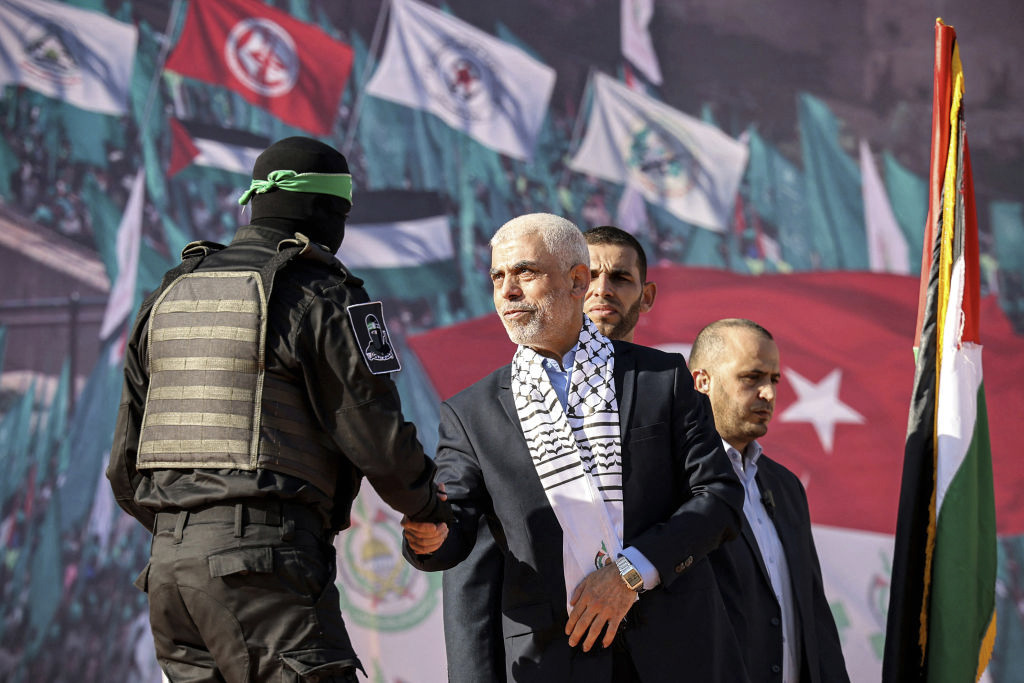
The Iran-backed Palestinian terrorist group Hamas has chosen arch-terrorist Yahya Sinwar, the mastermind of the October 7, 2023, atrocities against thousands of Israelis, as the chairman of its “political bureau.” Now that Sinwar has joined Hamas’s inner circle of “political” figures, it is reasonable to presume that now he too will be dubbed by Western media “moderate” and “pragmatic.” Pictured: Sinwar shakes hands with a masked member of Hamas’ Al-Qassam Brigades in Gaza City on December 14, 2022. (Photo by Mohammed Abed/AFP via Getty Images)

The Iran-backed Palestinian terrorist group Hamas has chosen arch-terrorist Yahya Sinwar, the mastermind of the October 7, 2023, atrocities against thousands of Israelis, as the chairman of its “political bureau.” Sinwar, who has been hiding in the Gaza Strip since the Hamas-led attack, will take over from Ismail Haniyeh, the former chairman of the group’s “political bureau,” who was killed in the Iranian capital of Tehran on July 31.

The fact that Sinwar was elected shows that Hamas’s political and military branches are the same. It also demonstrates that when it comes to Islamist terrorist organizations, there is no difference between a political and military leader. By electing Sinwar as its “political” leader, Hamas itself is stating that it does not distinguish between a politician and terrorist.

Has anyone ever considered referring to Osama bin Laden and Abu Bakr al-Baghdadi, the heads of Al-Qaeda and the Islamic State (ISIS), as the “political leaders” of their respective organizations?

In addition to Haniyeh, Hamas’s “political bureau” consists of several figures such as Khalil al-Hayya, Khaled Mashaal, Musa Abu Marzouk, Ghazi Hamad, and Taher a-Nunu who have long been advocating the armed struggle against Israel and glorifying acts of terrorism against Israelis.

On the day of the Hamas-led attack on Israeli communities, these leaders held a special prayer in the office of Haniyeh in Doha, Qatar, to thank God for the crimes perpetrated by their terrorists and thousands of “ordinary Palestinians.” These crimes resulted in the murders of 1,200 Israelis and the abduction of more than 240 others to the Gaza Strip. During the attack, Israelis and others were beheaded, raped, sexually abused, burned alive, and abducted.

Moreover, the “political” leaders of Hamas have threatened, from their safe villas and offices in Qatar, to carry out more atrocities against Israelis, and added that their ultimate goal is to destroy Israel. One of them, Ghazi Hamad, said in an interview with Lebanon’s LBC TV that Hamas is prepared to repeat the October 7 massacres time and again until Israel is annihilated:

“Israel is a country that has no place on our land. We must remove that country… The Al-Aqsa Flood [the name Hamas gave to the attack] is just the first time, and there will be a second, a third, a fourth… Will we have to pay a price? Yes, and we are ready to pay it. … everything we do is justified…”

Weeks before he was assassinated, Haniyeh called on Palestinians in Jordan, Syria, Lebanon and elsewhere to mobilize and escalate the confrontation with Israel:

“We must rise in the face of the [Israeli] enemy. The free Palestinian people should mobilize on all the fronts – in Jordan, Syria, and Lebanon… They need to escalate the confrontation… to accomplish our plan of liberation and the return of the refugees…. We must be together in this and stand as one to defeat the enemy. We must close ranks together with Gaza, and in all our cities and villages in the West Bank, and in the occupied land inside [Israel].”

When Hamas talks about the “liberation,” it is referring to its declared goal of eliminating Israel and replacing it with an Islamist state, as affirmed in its own charter:

“Israel will exist and will continue to exist until Islam will obliterate it, just as it obliterated others before it.”

The charter also reminds Muslims of the renowned Islamic Hadith:

“The Day of Judgement will not come about until Muslims fight the Jews, when the Jew will hide behind stones and trees. The stones and trees will say O Muslims, O Abdullah, there is a Jew behind me, come and kill him.”

Note the word Jews, not Israelis. At the moment, other non-Muslims are also being slaughtered, such as Christians in Nigeria and other parts of Africa, and the Massalit in Sudan.

The “return of refugees” refers to the Palestinian demand to flood Israel with millions of Palestinians in the hopes of turning it into another Arab state where some Jews could be allowed to live as a “tolerated” minority.

Another Hamas “political” leader, Khaled Mashaal, said earlier this year that his group’s attack on Israel has revived the dream of destroying Israel and “proved that liberating Palestine from the [Jordan] river to the [Mediterranean] sea is a realistic idea.” He noted that there is “nearly a consensus” among the Palestinians that they will not give up their rights to the land stretching “from the Jordan River to the Mediterranean Sea.”

The fiery rhetoric and threats to eliminate Israel by Hamas “political” leaders did not stop some Western media outlets from describing Haniyeh as “a very moderate leader.” Reuters described Haniyeh as “tough-talking” but “the more moderate face of Hamas,” while Sky News called him “the pragmatic face of Hamas.”

In response, Elon Levy, a former spokesman for the Israeli government and former international media advisor to the President of Israel, asked:

“What is a ‘very moderate leader’ of an Islamist jihadist death cult that perpetrated the deadliest terror attacker since 9/11 on October 7?”

“For the BBC, Ismail Haniyeh was ‘moderate and pragmatic;’ for the rest of us he was a monster,” commented British author and journalist Stephen Pollard. He pointed out that Haniyeh had recorded the following message to the Palestinians from his luxurious home in Qatar: “We need the blood of women, children, and the elderly of Gaza… so as to awaken our revolution spirit.”

Pollard added:

“Haniyeh was indeed ‘moderate’. The total number of Jews murdered by Hamas does not come close to six million. Not that Haniyeh would have regarded that as anything other than disappointing, given he led an organisation committed to wiping out every Jew from the face of the earth.

“As for ‘pragmatic’: well, he was prepared to let others join Hamas in murdering Jews. October 7 saw at least four other Islamist terror groups take part. Kudos to Haniyeh for not keeping the glory all to Hamas. That’s proper pragmatism for the good of the cause.”

Now that Sinwar has joined Hamas’s inner circle of “political” figures, it is reasonable to presume that he too will be dubbed by the Western media as a “moderate” and “pragmatic” Palestinian leader.

What comes next? Will the Biden-Harris administration and other Western governments rush to discuss with the newly elected Palestinian leader and mass murderer the creation of an independent Palestinian state that will be used by the Iranian regime and its terror proxies, including Hamas, to destroy Israel?


Bassam Tawil is a Muslim Arab based in the Middle East. The work of Bassam Tawil is made possible through the generous donation of a couple of donors who wished to remain anonymous. Gatestone is most grateful.


Zawartość publikowanych artykułów i materiałów nie reprezentuje poglądów ani opinii Reunion’68,
ani też webmastera Blogu Reunion’68, chyba ze jest to wyraźnie zaznaczone.
Twoje uwagi, linki, własne artykuły lub wiadomości prześlij na adres:
webmaster@reunion68.com


North Carolina Lawmaker Faces Backlash From Local Jewish Leaders, Fellow Democrats Over Attacks on Israel, Zionists

North Carolina Lawmaker Faces Backlash From Local Jewish Leaders, Fellow Democrats Over Attacks on Israel, Zionists

Peter Reitzes


Raleigh City Council member Mary Black. Photo: Screenshot

Last week, The Algemeiner reported that Mary Black, a member of the Raleigh City Council in North Carolina who recently filed for re-election, has come under fire for regularly attacking Israel and Zionists, despite her job having no apparent responsibilities concerning Middle Eastern affairs.

Since then, Black, 30, has come under increased scrutiny from the media, community members, and fellow Democrats. The North Carolina Democratic Party Jewish Caucus told The Algemeiner they have endorsed Mitchell Silver, a former New York City Parks Commissioner and Raleigh Chief Planner, who is running for the Raleigh City Council seat currently held by Black.

Rabbi Eric Solomon of Beth Meyer Synagogue, the largest congregation in Raleigh, publicly endorsed Silver this week in a widely read and shared social media post.

Over the weekend, a local progressive paper reported on some of the Jewish community’s concerns about Black. In addition, a group of more than 20 prominent Democrats wrote a letter asking the Wake County Democratic Party — which includes Raleigh — “not to endorse between Democrats in local elections in Raleigh this fall.” Multiple political insiders told The Algemeiner this is significant because there is widespread agreement that Black won her seat in 2022 in large part based on the endorsement of the Wake County Democratic Party.

Black has alienated many voters and members of the Jewish community by working closely with a pro-Hamas activist and spending much of her time in office attempting to have the Raleigh City Council pass a divisive, anti-Israel, one-sided Gaza ceasefire resolution. After several attempts, the resolution did not pass.

To get a better sense of how local Jewish Democrats are responding to Black’s intense and disproportionate focus on the world’s lone Jewish state and its supporters, The Algemeiner interviewed Conner Taylor, 2nd vice chair of the North Carolina Democratic Party Jewish Caucus; Linda Brinkley, president of the Wake County chapter of the caucus; and Lynn Schwartz, vice president of the Wake chapter caucus

The Jewish Caucus representatives were clear that while their statewide caucus has endorsed Silver in District A (the seat currently held by Black), the local Wake County chapter does not make or ask for specific endorsements when Democrats, such as Silver and Black, are running against one another.

Taylor explained that the Jewish community is concerned about much more than Black’s support for a ceasefire resolution. “For many of Raleigh’s Jews, I think the real turning point, that really galvanized the Jewish community, was her [Black’s] very close working relationship with Rania Masri.”

The Algemeiner was the first to report that in November, Masri spoke at the University of North Carolina at Chapel Hill, declaring that Oct. 7 — when Hamas-led Palestinian terrorists invaded southern Israel and perpetrated the biggest single-day massacre of Jews since the Holocaust — “was a beautiful day.” Masri expressed pride and admiration for Hamas and their paragliders and went on to “demand the eradication of Zionism.” In addition, Masri posted a video on Facebook that called Hamas fighters “heroes.”

In March, Masri asked her Facebook followers to vote for Black for “Best Politician in Wake County.” In June, a smiling Masri attended Black’s campaign kickoff event.

Taylor explained the “betrayal” felt by the Jewish community observing Black and Masri’s close working relationship, seeing Black pose for photographs with Masri, speak on a panel with the pro-Hamas activist, speak at a fundraiser with Masri standing behind her, and speak at a local rally standing with the controversial figure.

“A very important piece of context here,” Taylor shared, “is that Mary Black, in District A, represents the heart of Raleigh’s Jewish community. Two large synagogues are there … Many, many Jewish Democrats who voted for Mary Black in 2022 then had to see their member of City Council — who was supposed to be representing all of her constituents, including her Jewish constituents — openly embracing a woman [Masri] who has said that the rape and murder of Jews is a beautiful thing.”

Rabbi Solomon has attempted many times to start a dialogue with Black. Solomon, a political progressive, recently wrote a widely shared social media post in which he denounced Black’s “incitement” and endorsed her opponent Silver in the upcoming election.

Solomon explained why he went from voting for Black in 2022 to supporting one of her opponents in 2024: “I speak to CM [Council Member] Mary Black *privately* beseeching her to stop speaking/posting about the Gaza War as her words are a source of incitement. After the Pittsburgh Synagogue terrorist attack and the October 7th massacre, District A Jews are living in fear. I explain we need her help, not her antagonism. I am careful not to call her an antisemite but her focus on this issue above all others as well as the tenor and content of her comments lean into antisemitic tropes. Her positions are not pro-Palestinian; they are pro-Hamas.”

The rabbi noted that Black has held many community meetings during Shabbat and on a Jewish holiday, when observant Jews are unable to attend, and devoted significant time and energy to Israel-related issues that are “not relevant” to the City Council’s business.

“CM [Council Member] Black holds numerous District A community discussions on the Jewish Sabbath and one session on Hanukkah during the exact time when it is customary to light candles,” Solomon wrote in his social media post. “I find a way to attend the meeting, racing out by leaving my wife and children behind in hopes that a respectful, face-to-face meeting will help her realize the seriousness of the issue. Nearly all attendees agree with my words and urge her to stop bringing Gaza War resolutions to the council … I speak publicly against Mary Black because she continues to post insidious one-sided statements and videos that are not relevant to the City Council and continues to threaten me and my community.”

As reported by The Algemeiner, Black has publicly used the antisemitic slur “zios,” a term that was originally deployed by far-right extremists and has more recently been used by activists on the progressive far left. In an apparent attempt to delegitimize Israel and its supporters, Black has used an asterisk when discussing Israel, by writing “Isr*ael,” and misspelled Zionist as “xionist.” On a local Jewish social media group, a Raleigh resident explained, “She’s throwing around Zionist like a curse word.”

When asked about Black’s use of the word “zios,” Taylor responded, “It’s bizarre that a Democratic elected official is using online slang that originated with the grand wizard of the Ku Klux Klan.”

Black has also been accused of trivializing the Holocaust, implying that Israel has treated the Palestinians like the Nazis treated the Jews and comparing politics in Raleigh to “Nazi Germany.”

Taylor told The Algemeiner, “As someone who lost many family members to the Holocaust, I don’t think anything happening in Raleigh approaches the Holocaust or is comparable to the Holocaust. I think that is an incredibly bizarre statement regardless of what she may have meant by it. I think many, many of her constituents, just generally speaking, have viewed these social media posts about all of this as unsettling, as bizarre, as unprofessional, and as unbecoming of an elected official.”

Others have also described Black’s social media posts to The Algemeiner as bizarre and unsettling.

Black, a self-described “intersectional environmentalist,” recently shared a post on Threads that celebrated the attempted assassination attempt on former US President Donald Trump. She also posted that those who she calls “zionologists” have taught her that “the massacre of children is justified because Babies [sic] voted for Hamas” and has expressed concern that Palestinians have difficulty obtaining cilantro.

In 2022, Black was endorsed by the Wake County Democratic Party.

The Algemeiner reached out to local and statewide party leaders for additional information and comment for this story. Kevyn Creech, chair of the Wake County Democratic Party; Anderson Clayton, chair of the state party; and Jonah Garson, first vice chair of the state party did not respond.

In addition to attacking Israel, Black has recently attacked the United States, writing, “IM [sic] AMERICAN! We do war crimes for breakfast.”

Taylor told The Algemeiner that Jews in Raleigh, as well as the broader population, are unhappy with the polarization that has taken hold of the City Council and its intense focus on foreign affairs far out of the purview of local lawmakers.

Raleigh City council members Mary Black, right, and Christina Jones. Photo: Screenshot

“Many, many people in the Jewish community in Raleigh, over the past year, have been dismayed with how divisive the City Council has become,” he said. “There have been members of the City Council that have become hyper focused on issues happening thousands of miles away that the City Council has no ability to impact, to the neglect of local issues — things like schools, things like housing, things like transportation. In general, the Jewish community is really searching for, and supportive of, Raleigh-focused candidates for City Council, like … Silver.”

Taylor explained the enthusiasm that the statewide Democratic Party Jewish Caucus has for the candidacy of Silver.

“He’s a Raleigh-focused candidate. He is not campaigning on solving issues in Yemen or Gaza or Tibet or Ukraine,” Taylor argued. “He is focused on Raleigh, North Carolina … He is really a phenomenal candidate. He helped draft Raleigh’s 2030 comprehensive plan.”

Taylor discussed what he described as Silver’s “really robust housing and zoning policy ideas” which, he said, focus on development while protecting “existing communities.” The Jewish caucus’ 2nd vice chair added that Silver’s experience as a former New York City Parks Commissioner and Raleigh Chief Planner would benefit the Raleigh City Council, again noting that he is discussing local concerns rather than Israel or Gaza.

In a recent social media post, Black suggested that opposition to her candidacy was based on racism, noting the Democratic Jewish Caucus’ efforts to oppose her re-election.

In response to the accusation, Taylor told The Algemeiner: “We have endorsed an African-American candidate [Silver]. So, I’m not really sure how anyone could have the impression that our decision not to endorse Mary Black was related to her being African American when we have endorsed an African American for this same seat.”

Black’s social media posts are filled with concerns about racism and white supremacy. Yet, she has also harshly criticized what she calls “black capitalism.” On Threads, Black shared an image which read, “CAPITALISM RUINS EVERYTHING AROUND ME,” followed by the anarchy symbol. She also stated on Threads, “Black capitalism is truly a plague on our people.”

North Carolina civil rights leaders, such as the late Floyd McKissick, took the opposite view, embracing and championing Black capitalism and entrepreneurship in the state.

On Aug. 8, Black was endorsed by a local Democratic Socialists of America chapter “to keep her seat as an anti-Zionist leader on the Raleigh City Council.”

Black has recently dismissed concerns that she is antisemitic as being “funny.” She took to Threads this week to share, “Reading what I’ve written on social media about this war on Gaza and all the responses last week about me being antisemitic when this is who I am is so funny to me.”


Peter Reitzes writes about issues related to antisemitism and Israel.


Zawartość publikowanych artykułów i materiałów nie reprezentuje poglądów ani opinii Reunion’68,
ani też webmastera Blogu Reunion’68, chyba ze jest to wyraźnie zaznaczone.
Twoje uwagi, linki, własne artykuły lub wiadomości prześlij na adres:
webmaster@reunion68.com