WOLFGANG G. SCHWANITZ
Translated from the German by Paul Festa
An analysis of photographs sold at a Jerusalem auction house offers new insight into the role of foreign accomplices in Hitler’s Final Solution
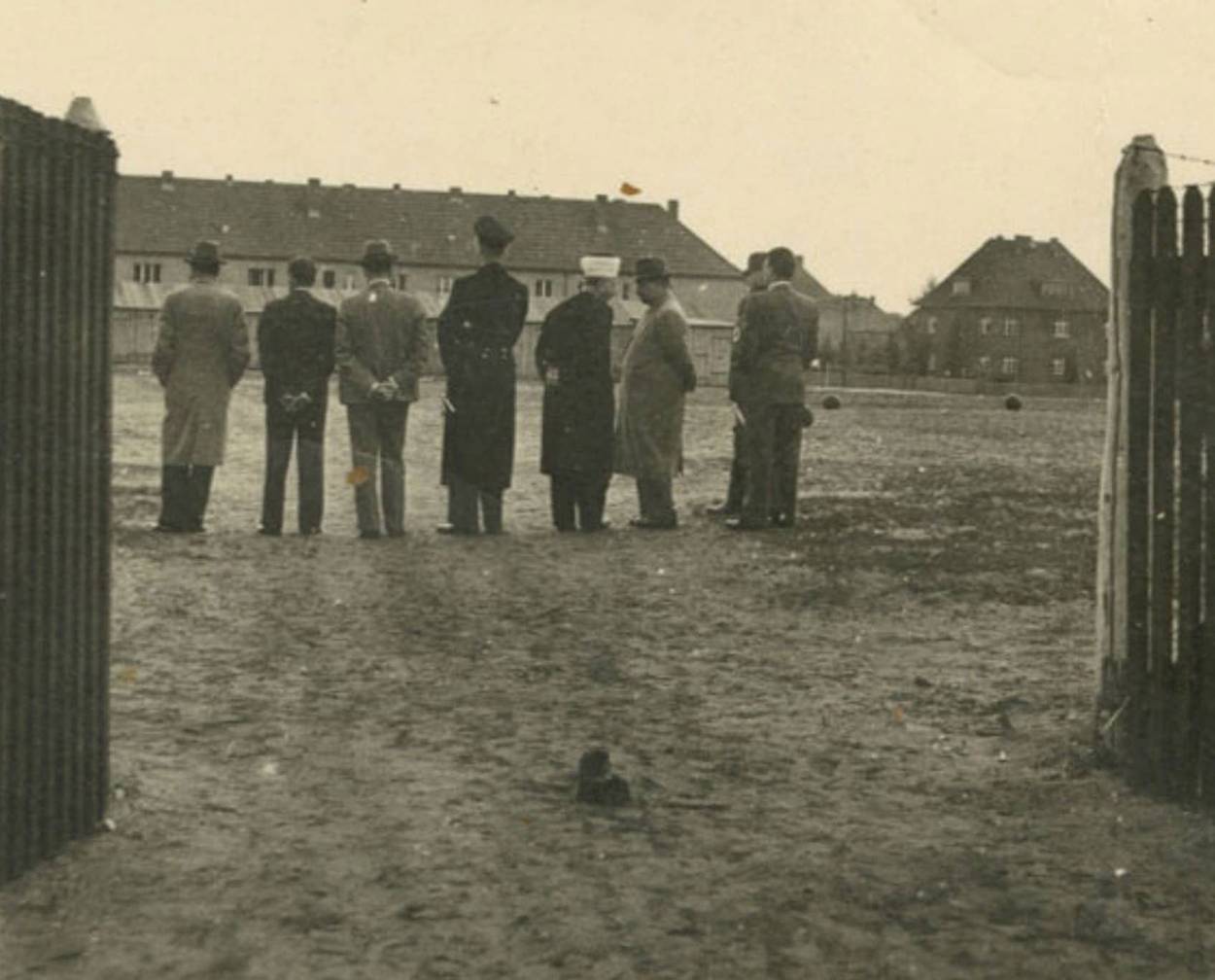 Haj Amin al-Husseini visits the Trebbin concentration camp, 1943KEDEM AUCTION HOUSE
In 2017, Jerusalem’s Kedem auction house posted three of six previously unknown photos on the internet, in which the grand mufti of Jerusalem, Amin al-Husseini, inspects a Nazi concentration camp along with Nazi senior officials and government figures. According to the auctioneers, an expert was of the opinion that these inmates performed forced labor at the Trebbin camp near Berlin, an SS artillery training place with a branch of the Sachsenhausen concentration camp in Oranienburg. Built after World War I as a Christian “City of Peace,” it was taken over by the SS in 1935. Among the prisoners were Jews from Hungary. Forced labor, terror and violence characterized their daily lives. Kedem hoped viewers would help identify men in the photos.
 Photo 1ORIGINAL PHOTO: KEDEM AUCTION HOUSE
As it turns out, I can now shed light on five of the foreign guests in the pictures—global leaders whose presence reflects the transregional history between Europe, the Middle East, India, and America. The photographs also provide irrefutable proof that all of the men present had precise knowledge of the fate of Jews in Hitler’s Germany—and of the likely fate of Jews in their own home countries under Nazi rule. According to Kedem, the photos are stamped “Photo-Gerhards Trebbin.” This stamp indicates that they were probably photographed in Trebbin, 30 kilometers south of Berlin, “around 1943.” The six photos were auctioned for $12,300 to a private individual who, I would argue, should post the remaining three images on the internet as a humanitarian gesture to families of the prisoners.
.
Only three of the seven men pictured survived World War II and its immediate aftermath. The two German officials in uniform were both directly involved in the Holocaust. Before and after their trip to the camp, Adolf Hitler met separately with each of the foreign guests, who included the Palestinian leader al-Husseini, the former Iraqi Prime Minister Ali al-Kailani, the Croatian Ustasha ideologue Mile Budak, and the Indian Hindu leader Subhas Chandra Bose. So who were they?
Mile Budak was the ideologue of Croatia’s ethno-radical, anti-Semitic Ustasha party, which ran a Nazi satellite state formed in 1941. On the left is Dr. Fritz Grobba, a former envoy to Kabul, Baghdad, and Jidda. He was a Protestant and not a member of the Nazi Party. He had been in charge of the Middle East in the German Foreign Office since early 1942.
Grobba and the two Arab leaders pictured had supported the anti-British coup in Iraq, which was followed by the al-Farhud pogrom in mid-1941. In it, 179 Jews were killed and many stores looted. Masterminds like al-Kailani and al-Husseini wanted to signal, there in a 2,500-year-old community, how Arabia’s Jews should be treated.
In the second photo is the politician Arthur Seyss-Inquart, who presided over Hitler’s Anschluss of Austria in 1938 and two years later served as commissioner for the occupied Netherlands. In the process, he oversaw the deportation of 100,000 Jews to death camps and the enslavement of half a million Dutch people, half of whom were forced to go to Germany as slave laborers.
After the Nuremberg trials in 1946, Seyss-Inquart ended up on the gallows for his crimes against humanity. Budak shared this fate a year earlier in Zagreb, where he was hanged as a war criminal for his policy of sending Jews, Serbs, Sinti, and Roma to death camps.
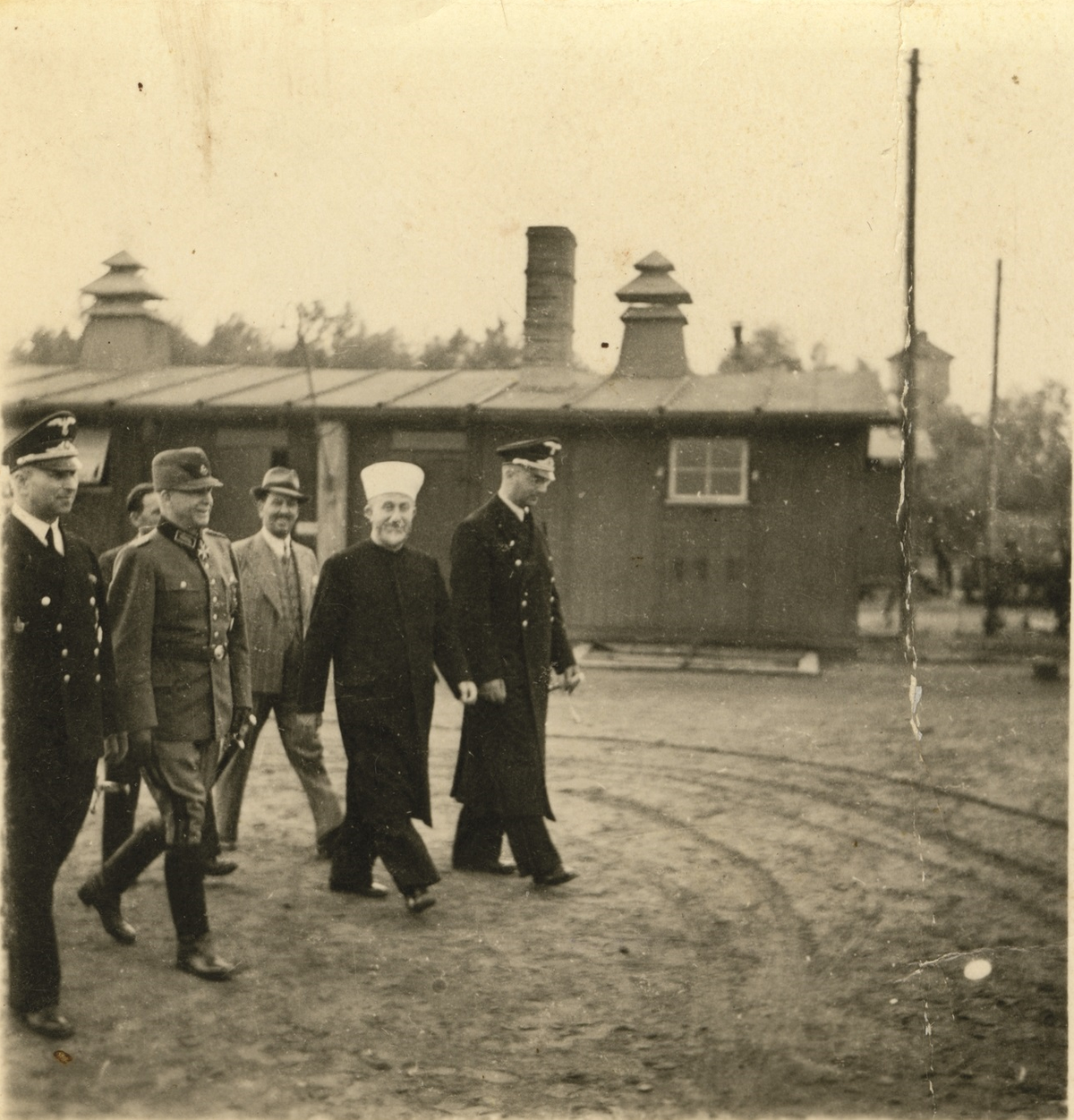 Photo 2, with Arthur Seyss-Inquart appearing second from leftKEDEM AUCTION HOUSE
On the other hand, both Arab leaders continued their anti-Jewish and Islamist policies unimpeded after the end of the war: al-Kailani until 1965 and al-Husseini until 1974. Outside of Israel, Nazism has hardly been delegitimized in the Middle East, and its adherents often came to power after the war ended. The Iraqi al-Kailani staged a coup in Baghdad but failed. He was sentenced to death, then exiled to Beirut.
Al-Husseini also found himself in Beirut, where he was active in the World Islamic Congress, which he founded in Jerusalem in 1931 (he opened a Berlin branch a year later). With robust backing, he rose to become the first “Global Grand Mufti.” A mufti is a religious and legal authority who hands down rulings on everyday issues to believers in his jurisdiction. His late half-brother Kamil was the previous grand mufti of Jerusalem. Al-Husseini received the title in 1921, and in order to preserve and expand his transregional “Mideast-Europe” legacy after 1945, he chose as his representatives Said Ramadan for Europe, in Switzerland, and Yasser Arafat in the Middle East. The Mufti advised Arafat in 1968 to take over the Palestine Liberation Organization (which he headed until 2004) and “to liberate Palestine,” operating out of Gaza with Fatah troops.
Unmentioned, but visible in photo 1—though the angle and quality mar it—is almost certainly Indian nationalist Subhas Chandra Bose. Also called Netaji, Hindi for “The Respected Leader,” he probably died in a mid-1945 plane crash near Taiwan. Controversy over his role diminished in 1997 when he was given his place in the Indian pantheon of liberation leaders. However, questions linger about his close Nazi contacts and meetings in 1942 in Berlin with Hitler and SS chief Heinrich Himmler. Since the first photo shows flowering plants, it probably dates from the second half of 1942, when Bose was still in Berlin—making the identification all the more likely.
Starting with European explorers in 1760, five generations have connected the West and the Middle East. The two Germans in the picture are from the fifth generation of Europe’s Middle East experts. Born in the two decades before 1900, their careers were based within the expanding network of academic institutions devoted to the region: 21 universities with 57 lecturers in Middle Eastern studies. Additionally, there were non-university institutes, such as the Berlin Seminar for Oriental Languages, where Grobba learned Turkish, and Hamburg’s Colonial Institute under Carl Heinrich Becker, a founder of modern Islamic studies. This expansion followed the post-1884 period of the so called “German Mideastern founding years”: three decades in which Germany did not colonize the region but nonetheless dynamically enlarged its presence there.
Born in 1886, Fritz Grobba survived WWII and 10 subsequent years in the Soviet gulag. After his release in 1955, he advised Bonn on Middle East policy as a retiree until 1973. Another German diplomat who appears in the pictures but is not mentioned in the Kedem catalog is Martin Luther, who served as undersecretary of state in the Foreign Office. He conspired against his boss, Joachim von Ribbentrop, and as a result was sent to the Sachsenhausen concentration camp in early 1943. He died shortly after the end of the war.
During WWI, Luther served with an army railroad regiment up to the Balkans, where he heard about the Armenian genocide. Two decades later, as head of the German Department of the Foreign Office, he was one of 15 Nazis at the Wannsee Conference who coordinated the “logistics of mass murder.” About 100 “Asia fighters” who served alongside Germany’s Ottoman allies during WWI rose to Nazi leadership after 1933, many of whom served the West German government in Bonn after 1950.
The auction text mentions al-Husseini, the other key figure in this group. Some see al-Husseini’s Nazi contacts as reflecting a pragmatic interest in obtaining a strong foreign ally for Arab national goals. Others link the mufti’s enthusiasm for Nazi plans for the Final Solution to his additional desire to bring genocide to Palestine and the Middle East. The new pictures are important evidence in this debate.
What is certain is that al-Husseini rose to become the primary non-European aide and activist for Hitler’s Middle East. Interrogated by the Soviets in 1946, Grobba confirmed Hitler’s and von Ribbentrop’s plans for genocide in the Middle East. Some say the mufti embodied the Palestinian national consensus, a claim that rests on the supposition that a Palestinian “nation” existed prior to WWII. Surely, not all Palestinian Arabs should be associated with al-Husseini, whatever his titles and ambitions; some of them worked against the Axis powers.
As officers, Grobba and al-Husseini were brothers-in-arms in 1915, including in areas where Armenians were deported. Both men spoke Turkish. They met during the 1930s in Iraq, where the German envoy Grobba dealt with Iraqi state representatives and grew to dislike al-Husseini. In his eyes, a cleric without a state styling himself the “grand mufti “should not act as a politician. Their mutual dislike increased after the failed Baghdad coup against the British in mid-1941.
A British adviser in Iraq, Archibald McDougall defended Grobba in The Times, saying he was not a “Nazi Lawrence of Arabia” stirring up Muslims but rather a hard-nosed career diplomat. Berlin then grew suspicious of Grobba. Rumors circulated that he had invited Jews to his receptions, that he was a Freemason, and that he preferred al-Kailani to the mufti. His career faltered, as he was caught between the two Arabs frequently arguing over “who would be the real leader.”
Hitler’s choice was clear: al-Husseini. He saw in the mufti a principal actor in the Middle East, and a “realist.” Benito Mussolini followed Hitler’s lead and recognized the mufti as the most competent spokesman for the Arabs who could help the Fascist-Nazi alliance in reshaping North Africa.
It was against this political backdrop that SS chief Heinrich Himmler invited select Nazis and their guests to visit his concentration camp system. At the end of June, Grobba noted, the two Arabs each instructed two of their aides to join an SS training course that included a visit to a concentration camp. Al-Kailani wanted to go along to see if this system could be a model for Iraq, where there was a large Jewish community. Grobba agreed: The assistants were going anyway, so there was nothing wrong with it. Still, the SS asked the German Foreign Office to sign on.
That was Luther’s business. Most likely, he consulted with his “expert on Jews,” Franz Rademacher, for whom the mufti secured asylum in Syria after the war. Rademacher directed the deportation and killing of Serbian Jews in Belgrade; he wrote on his expense account, as the purpose of his official trip, “liquidation of Jews.” He also drafted the Madagascar Plan with officials of the Vichy regime to forcibly deport Jews to the island, a French colony. Confirmed by Hitler in the spring of 1940, the idea was nevertheless abandoned because the British retained their maritime supremacy, making large transports impossible.
On Dec. 18, 1940, Hitler issued Order No. 21, “Barbarossa,” preparing the invasion of Soviet Russia. The Nazi invasion on June 22 was followed by the mass shooting of Jews. At the turn of the year, Himmler began building death camps in occupied Poland at Chełmno, Bełżec, Sobibor, and Treblinka. From the spring of 1942, the death camps used poison gas, like in Auschwitz, to exterminate millions of Jews who were transported there from ghettos and labor camps.
Following the initial Nazi victories in North Africa, Hitler ordered Arabs trained in desert warfare and al-Kailani to take part. Erwin Rommel’s army rolled into Egypt and was poised to invade Palestine and Iraq. On April 28, both Arabs—the Mufti carried the pan-Arab flag on his car, the Iraqi had himself addressed as az-Za’im الزعيم, Fuehrer—signed a secret letter with Berlin and Rome for joined struggle until final victory, and for liquidation of the Jewish home in Palestine. To be clear, this always meant killing Jews: This was a quadrilateral, Palestine-oriented genocide pact for “Jew-free Arab lands or empires,” signed by the two Arab leaders and by the Axis foreign ministers.
In June, the SS affirmed an Arab tour of the Sachsenhausen camp. In mid-July, Hitler agreed with al-Kailani to fight enemies together until final victory. Luther read Grobba’s report, in which an officer spoke to four Arabs, gave them a two-hour tour of the camp, and they inspected captive Jews in formation. The guests were “excellently impressed” by everything. Luther found the experience unpleasant, so Grobba promised not to agree to further Arab concentration camp tours.
Al-Husseini, whom some saw as a possible caliph, then pushed Grobba out of Arab politics: The German was sent to work in French archives in Paris as a “Christmas gift,” a move against which al-Kailani protested in vain. In February 1943, Bose left Germany, while Luther became a prisoner in Sachsenhausen after his failed coup against von Ribbentrop.
Subhas Chandra Bose sought Nazi help to drive the British out of India during WWII, just as some other Indians had previously sought help from the Germans to fight the British during WWI. Kaiser Wilhelm gave India’s nationalists money, weapons and experts. Wilhelm’s military attaché in America, Franz von Papen, directed this Hindu-German conspiracy. Von Papen was caught and had to leave the United States on Christmas 1915. Later he fought with the Ottomans in Palestine. Hitler appointed von Papen envoy in Ankara, a valuable Middle East post, where von Papen and al-Husseini profited from the stolen-gold trade of Deutsche Orientbank.
Berlin united Indians and Arabs in WWI in order to incite them to rebel against the British. The German effort included funding periodicals, assigning experts, and sponsoring travel to faraway lands like Afghanistan to incite Islamist revolts and to attract clerics for old and new brotherhoods under German influence. This framework helped Bose when he arrived in Berlin in early 1941, looking for aid. At the end of that year, Himmler ordered volunteers to be recruited as SS troops, and Bose created a Free India Center, or Azad Hind, and used the name Azad Hind for both his Indian Legion and a radio station in mid-1942. His 3,000 men were joined by many British Indians captured by General Rommel in Libya.
 Subhas Chandra Bose meeting Hitler in East Prussia, Germany. Interpreter Paul Schmidt is on the left, 1942.WIKIPEDIA
On May 29, Hitler received Bose in Berlin. The Hindu leader handed him a document detailing how he wanted to attack the British by means of Indian mass uprisings. The timing wasn’t bad: Hitler’s blitzkrieg against Russia had stalled, and the Nazi leader was now pushing for the inclusion of Dutch, Indian, Arab, and Croatian troops in his power pyramid. He told Bose that they had common enemies: the English, the Bolsheviks and the Americans. Germany’s ambition of destroying Russia would help Japan in East Asia and Bose in India. Submarine attacks, air strikes on British centers, and on the defeated British troops in North Africa would help India and provide the country with soldiers for its liberation.
Perhaps he would reach India’s border in two years, Hitler said. Then he could ask Bose to invade there jointly. Meanwhile, he would start his anti-British revolt, which would tie down British troops. Moreover, he might win over the Japanese. As an old revolutionary, Hitler told Bose, he might be able to incite a domestic revolt, but only if this uprising would be protected from the outside by a foreign military power. Gandhi’s passive resistance and Nehru’s hostility to fascism and Nazism would achieve nothing.
Bose, Hitler continued, needed to get closer to India. As a man of stature, he should avoid boarding a plane that the British could force down; a submarine would be safer. So Bose, who was married to a then-pregnant Austrian woman, transferred from a German U-180 submarine to the Japanese I-29 near Madagascar and arrived in Japanese-occupied Sumatra.
The mufti arrived at Bellevue Palace in Berlin on Nov. 6 and met with Bose. Both agreed on propaganda maneuvers. Al-Husseini used the next 22 days until his meeting with Hitler to solicit from Nazi leaders two commitments: The end of legal travel by Jews to the Middle East (Himmler ordered it on Oct. 23, both Arabs having demanded this again on Sept. 24 in their 11 points, see documents) and the destruction of the Jewish homeland in Palestine.
To build consensus for his ambitions within the Nazi state, the mufti consulted German and Italian envoys in Vichy and Rome on such points as Syria, the Arab Legion, and an Axis declaration on Arabia. On Nov. 20, Foreign Minister von Ribbentrop told him that Palestine was “purely Arab” and met him twice more: before talking to Hitler and the following day, when he likewise received Bose. Alluding to the looming Japanese invasion of Pearl Harbor, the foreign minister told the Indian that Japan and America would soon experience a state of conflict that could lead to war.
On Nov. 22, Rademacher penned a memorandum about the ideas of the Foreign Office for the overall resolution of the Jewish question in Europe, which Luther took to the Wannsee Conference. These ideas included the deportation of Jews from the German Reich and from occupied Europe to the east, and the imposition of Nuremberg-style anti-Jewish laws everywhere in Europe.
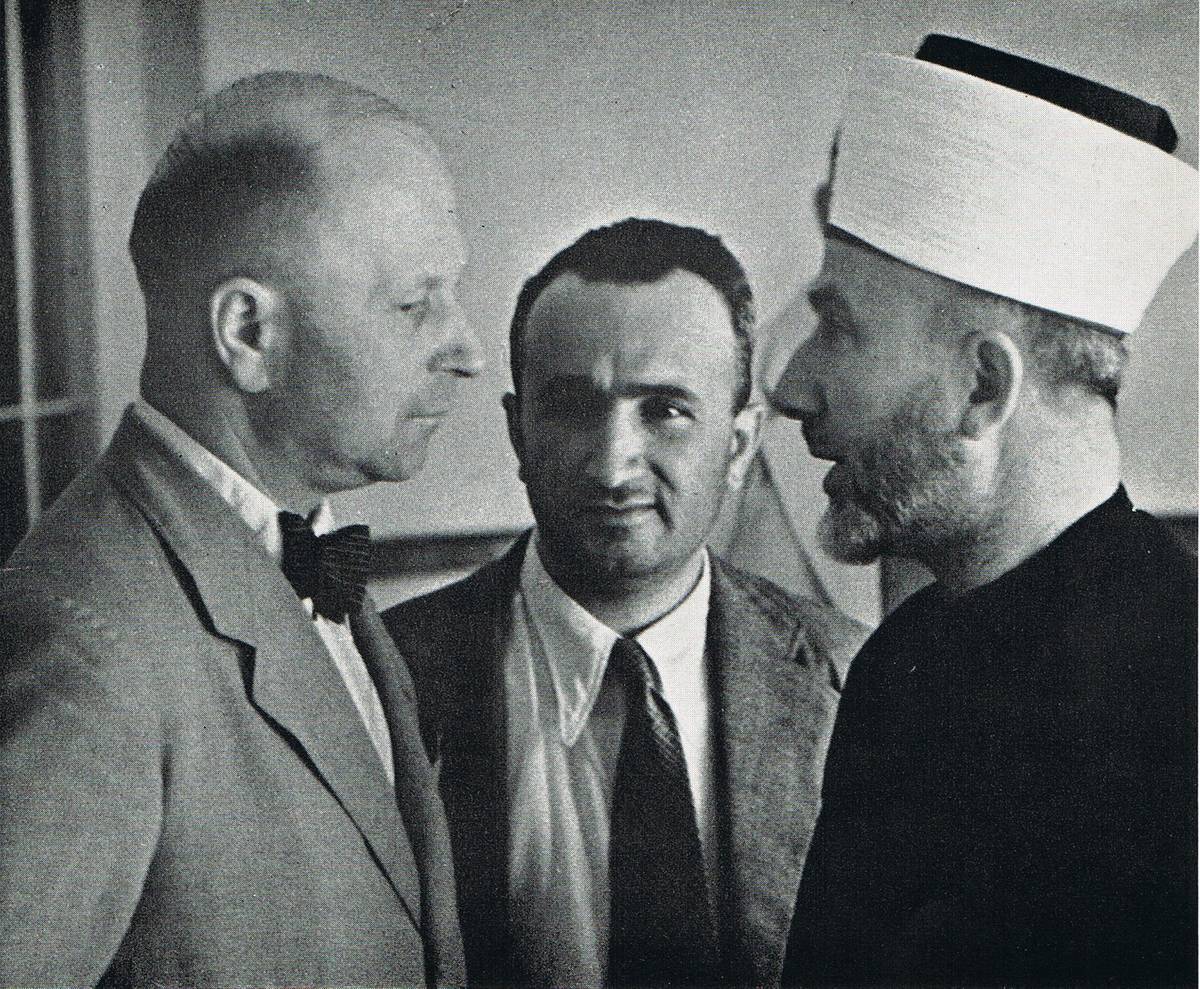 From left, Fritz Grobba, Uthman Kamal Haddad, Amin al-HusseiniHELMUT LAUX, BERLIN
The mufti’s meetings over his 22 days in Berlin centered around debates about the Arabia declaration by Berlin and Rome, which his secretary Uthman Kamal Haddad took down and handed over to Grobba on Feb. 25, 1941. This declaration had been maturing since mid-1940. Its clause 7 stipulated that Berlin and Rome would declare a Jewish homeland in Palestine illegal. Furthermore, they would recognize the right of Arabs, including those in Palestine, to solve the question of Jewish populations there “in the Arab national interest and in the same manner as the question has been resolved in the Axis countries.” Rademacher’s text stipulated that Jews be deported to Eastern Europe; it mentions nothing about the Middle East, although immigration had previously been Hitler’s preferred course of action: The Haavara pact of 1933 allowed for about 60,000 German Jews to emigrate to Palestine, up until 1939.
Al-Kailani’s military agreement with Berlin provided that the Axis military occupation would be replaced by a civilian government after six months—and it is clear what Iraq’s Jews would have faced in those six months. Meanwhile, Berlin and Rome honed their Arabia declaration up until Hitler received the mufti.
The two men met for 95 minutes on Friday, Nov. 28. In that meeting, Hitler revealed to al-Husseini his plan to kill Jews in Europe, the Middle East and globally, and his desire to invade Iraq and Iran. His guest was to wait until Nazi troops reached the southern point of departure from the Caucasus. Von Ribbentrop had already planned the Tbilisi moment, when the Nazis reached the Middle East and India via the Suez Canal and/or the Caucasus via this Georgian city. From there, the Arabs and Bose were to call for revolts “from Jerusalem via Baghdad to Calcutta,” form governments in exile, and then proceed homeward with the Nazis.
Al-Husseini agreed with Hitler and awaited his order. Their genocidal pact was a further marker in the spiral of wartime escalations against Jews that intensified on Jan. 30, 1939, when Hitler threatened before the Reichstag that a new world war would be followed by “the annihilation of the Jewish race in Europe”—a threat he repeated again in a public speech at the end of January 1941 in Berlin. To al-Husseini he went further, promising him the annihilation of the Jews of the Middle East and globally. Because of Japan’s approaching attack on Pearl Harbor 10 days later, which Hitler had learned of in advance, the subject of total world war came up. Hitler now wanted to realize plans far beyond the German Reich.
When the mufti left, Hitler laid down four points with von Ribbentrop. He put on hold the Arabia declaration, which he discussed with Mussolini. It was not until 12 days later that the short text, complete with photos and film, arrived without the date of the meeting: Hitler’s adjutant’s office did not release the text until Dec. 9, 1941, and the press reported it the following day, again without a date, the delay serving to obscure the specific context to Hitler’s meeting with al-Husseini. Hitler also planned to install an Arab Islamic leadership council in Berlin that would agree to his reordering of the Middle East.
However, the evening after al-Husseini left, Hitler triggered the Wannsee Conference, now that America’s entry into the war, like Hitler’s counterdeclaration of war, had become inevitable. Luther received the invitation to the Wannsee Conference on Saturday, Nov. 29, and later his minutes were the only ones to survive. Most likely, Hitler made his decision for the Wannsee Conference after his Friday meeting with al-Husseini. He set the date for the meeting of the undersecretaries of state in a villa on Lake Wannsee for Dec. 9.
With the global distraction of Japan’s attacks on Pearl Harbor, Hitler saw his chance to keep the meeting under the radar. On Saturday, Hitler told Rome’s foreign minister, Ciano, that the war against Russia had been won in principle, and that he was now turning his attention to the Middle East via the Caucasus—though he badly underestimated the Russian counteroffensive, and the effects of the Russian winter on his armies. Soon Adolf Eichmann was explaining the Final Solution to the mufti in his map room.
In their planning and strategizing, Hitler and his guests followed patterns of the German-Ottoman jihadization of Islamism in WWI, inciting insurrections and eliminating minorities that were seen as troublesome. Even though Hitler had in 1925 dismissed jihad in the service of Berlin as “the pleasant thrill of thinking that others are willing to shed their blood for us,” he now asked India’s and Arabia’s nationalists and Islamists to do just that. In turn, they offered him revolts and legions. After the war, the mufti said the Nazis had not needed him. But Hitler’s order No. 30 Iraq, and No. 32 Russia, relied on liberation movements as “natural allies.” Meanwhile, genocides under the Vichy regime were already envisaged in North Africa, and failed in Iraq and other Middle Eastern countries.
Still, continuing Axis victories up until the Allied invasion of North Africa on Nov. 8, 1942, encouraged Hitler’s “natural allies” to study the know-how of Nazi concentration camps.
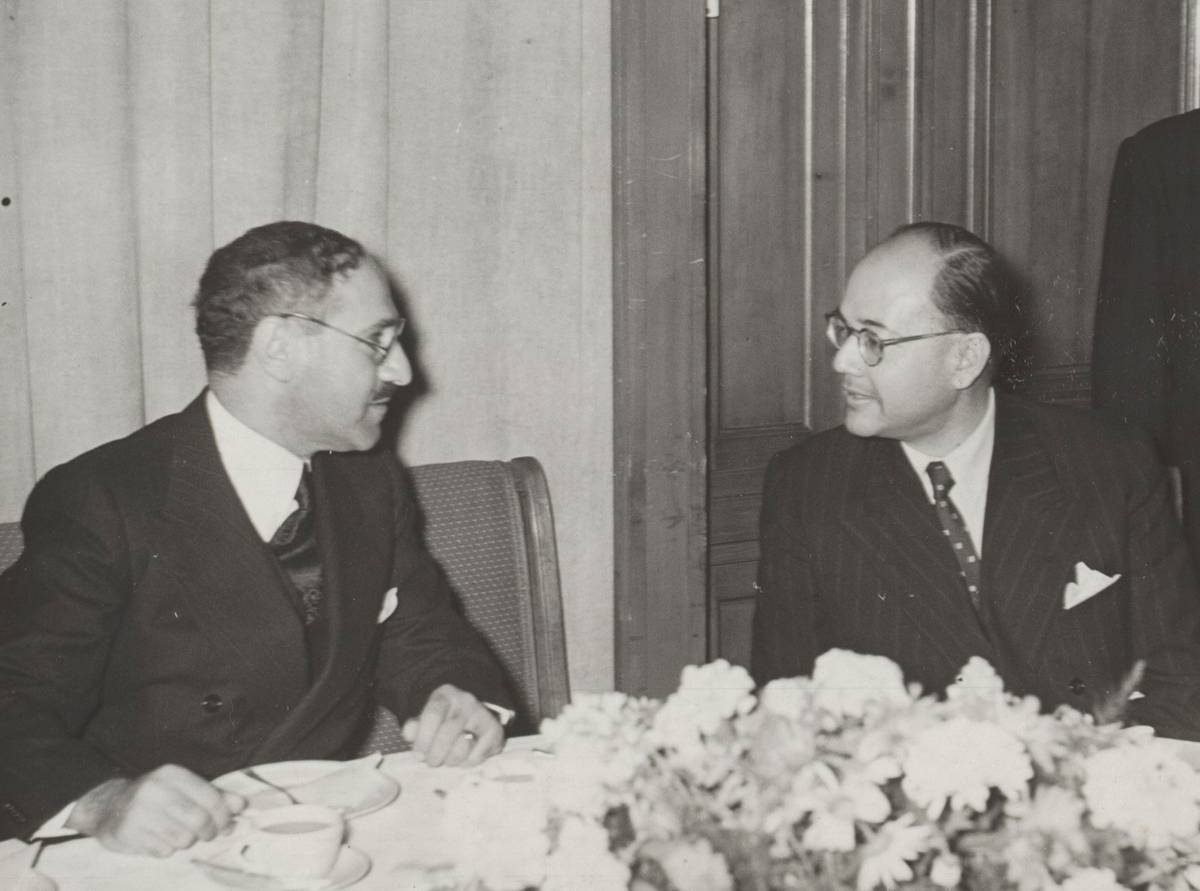 Ali al-Kailani and Subhas Chandra Bose , 1942WIKIPEDIA
During WWI, Berlin had united Indian and Arab rebels. Bose and the mufti therefore organized a meeting of solidarity at the Haus der Flieger (House of the Aviator) at the Brandenburg Gate, which housed the offices of Hermann Goering. The photo of al-Kailani and Bose on Sept. 23, 1942, may date from around the Fatal Seven’s visit to the artillery school with the Nazi camp near Berlin.
This camp visit gave real-time insights into the Shoah, as did the visit before that by the four Arab aides. Luther, who attended the Wannsee meeting, accompanied these five guests. Because of the Soviet offensive and Pearl Harbor aftermath, the Wannsee meeting had to be postponed from Dec. 9, 1941, to Jan. 20, 1942.
The day after the Wannsee meeting, Grobba met with the mufti. One can assume what Grobba reported was conveyed to him directly by Wannsee participant Luther. The envoy witnessed Hitler’s genocidal pacts with both Arabs. In signing those pacts, Hitler followed his early idea “in special times to find partners who must follow the same path for their own goals.”
 Subhas Chandra Bose with Heinrich Himmler, 1942WIKIPEDIA
Bose, Budak, and Seyss-Inquart saw everything that Hitler was doing in real time. They deported Jews, or followed Hitler’s advice for raising legions of Waffen-SS, police units, and camp guard troops. When Seyss-Inquart met Himmler in May 1941, the subject was SS units in the Netherlands, where Indian legionnaires reportedly arrived at the end of 1942: This was the issue when Himmler received Bose in his East Prussian command on July 15, 1942, which could be another plausible date for the Fatal Seven’s camp visit. More likely, though, the visit occurred on or around Sept. 23, when the SS leader Gottlob Berger received in the evening Croats in Berlin. Certainly Budak was among them.
Berger, chief of the SS main office, directed the resettlement of ethnic Germans, which meant deportation of other groups. He cooperated closely with al-Husseini, who as a former Ottoman officer had already witnessed the work of special units that persecuted minorities such as the Teşkilât-ı Mahsusa. Indeed, Himmler’s troops had him later name one of his lightning units “as-Sa’iqa.”
Gerhart M. Riegner’s mid-1942 cable alerting the Allies to Hitler’s plan to liquidate up to 4 million Jews in his sphere of power in occupied Poland by no means deterred Nazi authorities and their helpers from their intentions. In early December, a clandestine report about the mufti arrived in Berlin from Rome, where he talks with the Abwehr secret service. Under the headline “The Mufti as Co-Worker,” he laid out his position: He could achieve his own political goals only if the Axis powers are victorious. He gave four reasons for going along with the Nazis: 1) Germany has at no time occupied or attacked Arab-Islamic territory; 2) it was the only country that sought to resolve the Jewish question in a principled and radical way, a struggle he took up in a decisive manner long before 1933; 3) Germany was the enemy of England, an enemy of all Arab countries; 4) Germany was the only country capable of banishing Bolshevism; the Arab peoples were enemies of Bolshevism because of their religious attitudes.
The mufti and al-Kailani created an all Arab and Islamist “never-peace veto to Jews,” blocking in parallel British advances and Jewish emigration to the Middle East. Jews could not save themselves there, where their ancestors came from, In agreeing, Hitler limited his options: His helpers were interested in their own “Jew-free countries and empires”: Iraq, the former Ottoman Greater Syria with Syria, Lebanon, Palestine, East Jordan, and the Emirates, according to the mentioned 11-points plan of late 1941 that linked them to Nazi principles in the three-power pact Rome-Berlin-Tokyo. Paris and London were even to pay reparations to Arab lands.
Thanks to the Allies, the Middle East did not experience the barbaric trauma that the Nazis and their local allies had planned. The mufti, for his part, later would write in his Damascus memoirs that claims that he visited a concentration camp were a “smear” propagated by “Zionist leaders.” The Nazis, he argued, “did not need me to spur them on.” His policy “was not extermination, instead it was and still is simply to drive them out of our lands.”
However, al-Husseini’s written pact with the Nazis, and now the pictures of his visit to a concentration camp, and his subsequent close involvement with the Final Solution, show beyond any doubt that the Palestinian leader wanted the Jews of the Mideast to share the same fate as the Jews of Europe. On that fateful Friday, Hitler explained the nature of this joint course to him in detail, and he fully agreed to it.
Due to this new photographic evidence explained here, it seems that the last word should belong to the Nazi-hunter Simon Wiesenthal, who asserted that the grand mufti met Hitler several times and that the mufti had visited a concentration camp as part of a commission or group. Wiesenthal has been proven correct—although he may have had yet another group visit in mind.
Wolfgang G. Schwanitz is a Middle East historian living in the United States. He authored 10 books and edited 10 books, among them Germany and the Middle East 1871-1945; Islam in Europe, Revolts in the Middle East; Nazis, Islamists, and the Making of the Modern Middle East (with Barry Rubin) and yearly The Middle East Mosaic 2015-2019. He is a senior fellow at the Foreign Policy Research Institute in Philadelphia.
 2005, sierżant US Air Force Frank Lillich podczas służby na Grenlandii
 Anne Applebaum: List do premiera Norwegii zdradza rzeczy, które Trump niekoniecznie chciał zdradzić
 15 stycznia 2026. Przywódczyni opozycji w Wenezueli Mara Corina Machado przekazała prezydentowi Trumpowi swój medal noblowski, mówiąc, że to wyraz uznania dla jego zaangażowania na rzecz wolności jej kraju. Fot. REUTERS/Daniel Torok/Biały Dom
 Funkcjonariusze ICE próbują przeszukania. Fot. REUTERS/Tim Evans