Archive | 2026/01/28

Ocalały Bernard Offen: droga ku przyszłości prowadzi nie przez zemstę, ale empatię

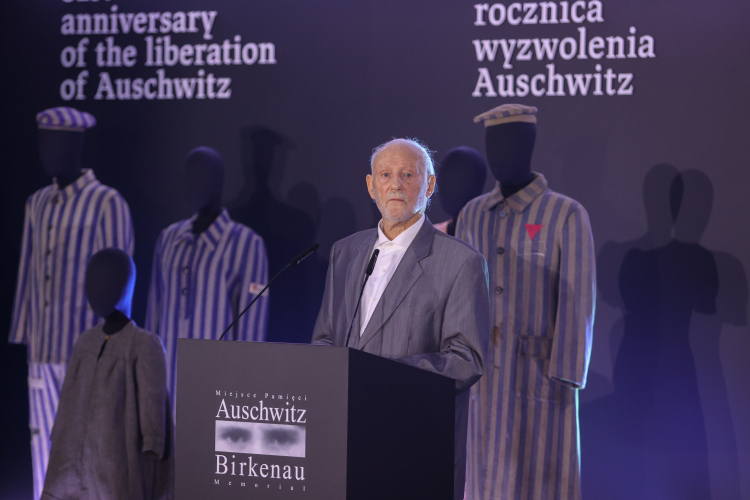
Ocalały z Zagłady Bernard Offen podczas głównych obchodów Międzynarodowego Dnia Pamięci o Ofiarach Holokaustu na terenie byłego KL Auschwitz II-Birkenau w Brzezince. Fot. PAP/Jarek Praszkiewicz


Ocalały Bernard Offen: droga ku przyszłości prowadzi nie przez zemstę, ale empatię

szf/ aszw/ mhr/


Droga ku przyszłości nie prowadzi przez zemstę i gniew, ale empatię i dostrzeganie wartości człowieka – mówił ocalały z Zagłady Bernard Offen podczas ceremonii upamiętniającej przypadającą we wtorek 81. rocznicę wyzwolenia niemieckiego obozu Auschwitz.

W głównej części obchodów, które odbyły się w budynku tak zwanej Centralnej Sauny w byłym niemieckim obozie Auschwitz II-Birkenau, uczestniczyło 21 byłych więźniów, prezydent RP Karol Nawrocki, minister kultury Marta Cienkowska, a także przedstawiciele społeczności żydowskiej i romskiej oraz dyplomaci.

97-letni Bernard Offen urodził się w Krakowie. Był więźniem getta i pięciu niemieckich obozów, w tym Auschwitz. W Holokauście stracił rodziców i siostrę. Przeżyli jego dwaj bracia, którzy walczyli pod dowództwem gen. Władysława Andersa. Po wojnie się spotkali, wyemigrowali z Polski. Bernard kilka lat temu powrócił do rodzinnego miasta. Jak podkreślił: „Kraków stał się jednym z najbardziej przyjaznych i bezpiecznych miejsc do życia dla Żyda”.

Offen mówił, że patrząc na współczesny świat, widzi „odradzającą się nienawiść”. – Widzę przemoc, która znów zaczyna być usprawiedliwiana. Widzę ludzi, którzy wierzą, że ich gniew ma wartość większą niż życie drugiego człowieka. Mówię to dlatego, że jestem starym człowiekiem, który widział, do czego prowadzi obojętność. I mówię to także, ponieważ wierzę – naprawdę wierzę – że możemy dokonać innego wyboru – powiedział.

Apelował, by pamięć nie była ciężarem, ale stała się światłem, które poprowadzi nas w ciemności. – My, świadkowie, wkrótce odejdziemy, lecz wierzę, że to światło pozostanie z wami – mówił.

Podkreślił zarazem, że droga ku przyszłości nie prowadzi przez zemstę i gniew, nawet wobec zbrodni takich, jak Holokaust, ale przez empatię i dostrzeganie wewnętrznej wartości każdego człowieka na ziemi.

W imieniu darczyńców Fundacji Auschwitz-Birkenau, która dba o zabezpieczenie finansowe prac konserwatorskich w Miejscu Pamięci Auschwitz, by zachować dla przyszłych pokoleń jego autentyzm, przemówił Yossi Matias, wiceszef Google’a. Jak mówił, obecnie „przechodzimy do epoki pamięci historycznej z epoki pamięci żywej”. – Pojawia się zagrożenie powrotu ciszy. To moment, gdy głosy świadków nieuchronnie miękną i cichną. Nasza praca nie polega wyłącznie na zachowaniu danych i dokumentów, ale także na tym, by wiedza była dostępna dla wszystkich i to wszędzie. To klucz do zachowania pamięci o Zagładzie – podkreślił.

Matias zwrócił uwagę, że technologia może być potężnym narzędziem, które promuje edukację i upamiętnienie. Zaznaczył, że hasło „nigdy więcej” nie jest „bierną nadzieją”, a „czynnym imperatywem”. Przypomniał, że 15 lat temu zainicjował i współprowadził działania na rzecz digitalizacji dokumentów dotyczących Zagłady oraz ich udostępniania we współpracy z muzeami na całym świecie – od Instytutu Yad Vashem do Muzeum Auschwitz-Birkenau. Podkreślił zarazem, że jego celem jest, by „historia została zachowana dla przyszłych pokoleń, żeby nigdy nie została zapomniana”.

Dyrektor Muzeum Auschwitz, Piotr Cywiński, zwrócił się do Ocalałych. – Wasze doświadczenie, drodzy, tak bardzo bolesne i trudne, tak okrutne i trudno wyobrażalne stało się fundamentem naszej pamięci. Jest więc dziś, w wichurze dzisiejszych wyzwań i zagrożeń, naszym skarbem, drogowskazem, podpowiedzią, ostrzeżeniem. Jest naszą potęgą: indywidualną i społeczną. Dlatego każdy dzień powinien zaczynać się od poczucia wdzięczności, naszej dla was – Ocalałych – mówił.

Cywiński wskazywał, że w czasach szybkich zmian, niestabilności wszyscy szukamy punktów odniesienia w pamięci. – To pamięć jest naszą ostoją, wsparciem, źródłem ocen najtrudniejszych sytuacji. To z niej wynika potrzeba i hierarchia naszych kroków i czynów. Pamięć jest potęgą, dokładnie tak, jak doświadczenie. Pamięć i doświadczenie to w istocie bliźniacze pojęcia. (…) Są jak skarby, jak drogowskazy, jak podpowiedzi i ostrzeżenia – powiedział.

Podczas uroczystości w miejscach symbolicznych w byłym Birkenau zapalone zostały znicze. W imieniu Ocalałych prezydent Karol Nawrocki zapalił jeden z nich na pomniku ofiar obozu. Minister Marta Cienkowska oraz dyrektor Muzeum Auschwitz Piotr Cywiński postawili znicz przy ruinach krematorium IV. Symboliczna lampka została zapalona też przy pozostałościach po prowizorycznej komorze gazowej, tak zwanym białym domku.

Ceremonię zwieńczyła wspólna modlitwa Żydów i chrześcijan.

27 stycznia 1945 roku żołnierze Armii Czerwonej otworzyli bramy obozu. Skrajnie wyczerpani więźniowie, których było w nim jeszcze kilka tysięcy, w tym kilkaset dzieci, witali ich jako wyzwolicieli.

KL Auschwitz stał się symbolem dokonanej przez Niemców zagłady Żydów. Zamordowanych zostało w nim około 1 mln Żydów. To także miejsce kaźni Polaków, Romów i osób innych narodowości.


27 stycznia obchodzony jest na świecie jako Międzynarodowy Dzień Pamięci o Ofiarach Holokaustu. (PAP)


Zawartość publikowanych artykułów i materiałów nie reprezentuje poglądów ani opinii Reunion’68,
ani też webmastera Blogu Reunion’68, chyba ze jest to wyraźnie zaznaczone.
Twoje uwagi, linki, własne artykuły lub wiadomości prześlij na adres:
webmaster@reunion68.com

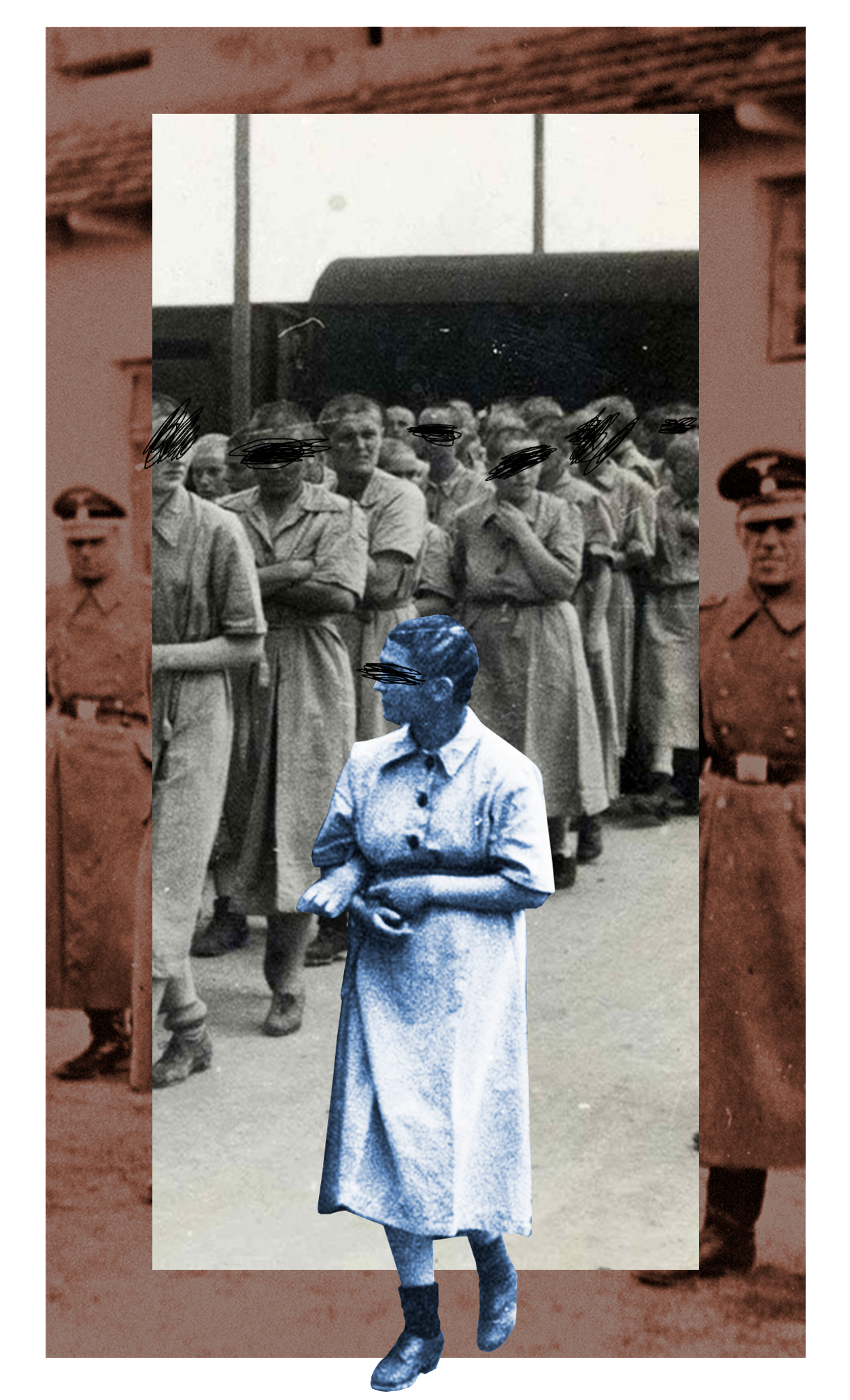

The Missing Stories of Sexual Abuse During the Holocaust


The Missing Stories of Sexual Abuse During the Holocaust

Esther Dror and Ruth Linn


Two Israeli researchers uncover Nazi crimes that targeted their victims because of their gender, and the postwar narrative of suspicion that ensured their continuing silence

Tablet Magazine

We were liberated from the camp by the Red Army—it was horrible. The soldiers were like wild horny animals—no girl and no woman were safe. My friends and I found a place to hide in barracks full of former prisoners, all men. The men who stayed in that barracks were tired and therefore incapable to rape us, and the Soviet soldiers didn’t look for us in that barracks.

This confession reached us in 2016. On the other side of the phone was Anna, an Israeli citizen, a woman who introduced herself as a Holocaust survivor who had just read our book in Hebrew, titled How Did You Survive.

We were not surprised. Anna wanted to assure us that although war was a dangerous time for girls, she nevertheless “succeeded in escaping its gender’s fate.”

Why was it so important for Anna to share with us a narrative of a spotless past?

We chose to answer this enigmatic question by listening to the stories of 23 women and three men, all Holocaust survivors and Israeli residents aged 75 to 93. As Israeli academics and researchers of people in stressful situations, we were quite familiar with the horrors of war and with the specifics of World War II. Yet, we were not aware of the war against the suspicion that these women had been fighting ever since they set foot in their homeland—Israel.

At the time, even though little was known about the Holocaust, suspicions prevailed: “If you survived that terrible war, you must have been violated. You must have used your body, or you have merely been raped.” The most beautiful female survivors could not escape this hidden blame.

Similar suspicions emerged in postwar Israeli literature, poems, and artworks. Notable in this regard is the poem by Yitzhak Sadeh, the mythological commander of the Palmach (the major Jewish resistance organizations of the Yishuv, the pre-1948 Jewish population of Israel), which he titled “My Sister on the Beach.” In it, Sadeh depicts an encounter with a young female Holocaust survivor, real or imaginary, who had found her way to Israel from Europe via an illegal refugee boat:

Darkness. On wet sand my sister stands: Dirty, barefoot, her clothes are ripped and her head is down as she stands and weeps.

I know that a tattoo is imprinted on her flesh; For officers only.

While Sadeh probably intended to raise empathy and compassion toward this poor immigrant, one wonders if he would be so suspicious regarding a survivor’s past if the subject of his poem was not a female survivor, but a male. In his poem, Sadeh provides the woman an opportunity to defend herself: “Am I worthy that young healthy boys risk their lives for me? No, there is no place for me in the world. I should not live.”

We listened carefully to the response that Sadeh placed in the girl’s mouth. One of us, Ester Dror, is a daughter of an Auschwitz woman survivor. The second, Ruth Linn, is a daughter of Israeli pioneers, who served under Sadeh. We both recalled how cautiously our teachers in school discussed the rules of war—and how little was said, if at all, about women’s fate during the ancient wars depicted in the Bible, and about the fact that the winning soldiers were permitted to marry the conquered and abused women.

Ruth Bondy, a writer and a survivor of the Terezin Ghetto, thus describes her experience as a new immigrant in Israel immediately after the war: “Here in Israel the Jews also wished to know: How did you stay alive? What did you have to do to survive? And in their eyes a spark of suspicion shone: a capo? a prostitute?”

Similar feelings are shown by the American author Ruth Kluger, who survived the Holocaust as a child of 12. Kluger emphasizes the endless struggle of women against what was sometimes required of them in order to survive, both during the war and in light of the postwar “collective narrative” of suspicion:

And there were, in fact, both men and women with whorehouse fantasies who wanted to know whether I had been raped. Like the college doctor who saw the Auschwitz number on my left arm and called sundry nurses and colleagues, as if, now that I had washed up on these shores, the natives could invade my privacy at will. I was shaken but I’d answer, no, not raped: they merely wanted to kill me. I’d explain the concept of Rassenschande, the rule against miscegenation Aryan style, because I found it interesting that a malicious idea could serve as protection (albeit not a foolproof one) against sexual abuse.

In his movie Stalags (a Hebrew nickname for concentration camps), the journalist and filmmaker Ari Libsker claims that the suspicious attitude toward female Holocaust survivors is largely a result of the notorious Israeli popular booklets of the ’60s which carry the same name. The Stalags booklets described the erotic sadistic-masochistic abuse inflicted by a German woman commander on American male inmates. Libsker explains that these ideas of sexual abuse popped into his mind already as a child, during his visit with his grandmother in Haifa. There, he happened to hear about a neighbor, a childless woman Holocaust survivor who used to scream during her sleep. The gossip was that she had probably lost her mind because she was forced by the Germans into prostitution. “How easy it was back then to attach this stereotype to women survivors who were beautiful and childless,” he concludes.

Yet even if we agree that these are exclusively fabricated tales, they are probably not fully detached from the suffering of actual women during the Holocaust. However, for many years, most researchers preferred not to contaminate their research with topics related to sexuality that might be judged by the public as improper. The few who dared to do so faced hostile academic responses.

When Joan Ringelheim first presented her data on the sexual vulnerability and agency of Jewish women during the Holocaust, for example, she was accused of disrespecting the victims’ memories, serving the purposes of Holocaust deniers. Similarly, when Sonja Hedgepeth and Rochelle Saidel, two noted American scholars, presented similar data, they were scolded by a famous Holocaust researcher present at their conference (whom they refused to name): “You are not allowed to talk about it [sexual abuse of Jewish women] if you have no proof.” Other scholars reported that they were often ridiculed for not knowing that “Jewish women always knew how to protect their bodies.”

A common obstacle to studying this topic was the Nuremberg Laws, which officially forbid intercourse between Aryans and Jews. As expressed by the scholar Gideon Grief:

It is inconceivable that brothels, which did exist in the different camps, employed Jewish prostitutes. Utterly inconceivable, because it contradicts the most basic thing upon which The Third Reich was established: that the Jewish race is inferior. It does not belong to the family of man and it is inconceivable that there would be a physical sexual relationship between the Aryan and the “Unter Menchen,” the Jewish sub-human.

The reluctance of formal historians to study women’s sexual abuse during the Holocaust was supported by the fears of survivors themselves. Both groups feared that certain testimonies would eroticize the extermination. As Ruth Bondy observes:

Everything in me is outraged at the mention of this concept … The theme of sexuality during the Holocaust has been blown out of all proportion, dating from the time of Ka Tzetnik. This subject attracts far more attention than that of the slaughter but is inconsequential compared with all that happened. If 2 million Jewish women were murdered during the Holocaust, sexual molestation was the lot of a few, but violence was the lot of the many. They faced cruel choices connected to annihilation, which is soul-searing, whereas the coupling of sex and destruction makes for more striking headlines

Shoshana, an Auschwitz Birkenau survivor whom we met, related:

We were naked over there, at Mengele’s [during the selection] and all around us were SS soldiers, guarding us … and this young beautiful woman offered to sell herself. She actually shook her breasts in front of the soldiers who guarded us. She may have thought she would save herself and indeed, she was taken, perhaps for this purpose. She never came back, and I told no one, even not to her husband whom I met after the war. I didn’t want to tarnish her memory.

“But I didn’t do that,” emphasized Shoshana, quietly, like the other survivors that we met, when our discussion reached its end. “She [the woman who offered herself to the guards] was already married. She may even have had a propensity … I also could offer myself, but it never occurred to me to do so: I was unmarried and a virgin. I was brought up in a religious family—I’d rather die.”

Like many other survivors whom we met and whose diaries we had read, Shoshana not only asserted that it didn’t happen to her, but also that it couldn’t have happened to her under any circumstances, since she was both young and a virgin, and lacked the necessary knowledge about sex due to her strict upbringing in an Orthodox Jewish family. Shoshana’s well-armored words lead us to wonder further how the patriarchy narrows down the options available for women in order to present a proper narrative that will be easily accepted by the wider public. In the words of Ruth Kluger: “Women have no past or aren’t supposed to have one. A man can have an interesting past, a woman only an indecent one.”

Tragically, when it comes to sex, it seems as there are no extenuating circumstances for women. Patriarchy expects us, women, to guard our innocence and the entirety of our bodies, even at the price of our lives during the Holocaust. In this spirit, the rabbinical establishment in Israel succeeded in convincing several municipalities to name streets and public gardens in memory of 93 girls from Bais Yaakov (an Orthodox seminar in Krakow), who, according to a story published after the war, committed group suicide in order to avoid being raped by German officers. Although no hard evidence exists of this event, the religious establishment highlights the 93 girls as a symbol of modesty.

The women we interviewed were eager to leave us with the proper stories that they were forced to construct since they first set foot in Israel. Like the young survivor in Sadeh’s poem “My Sister on the Beach,” they wanted to be remembered as women who were worthy of being saved, worthy of getting married, and worthy of the right to continued presence in this world. When we talked to them, 60 years after the Holocaust, they were already long-term Israeli citizens, mothers, grandmothers, and even great-grandmothers. They, and the historians alike, knew that “it did happen.” Yet they also whispered to us upon departure: “But I did not do it.”


Dr. Esther Dror is a lecturer on family education and gender at Kinneret College. She wrote her Ph.D. dissertation under the supervision of Prof. Linn.

Ruth Linn is the former Dean of the faculty of Education at the University of Haifa and the author of five books.


Zawartość publikowanych artykułów i materiałów nie reprezentuje poglądów ani opinii Reunion’68,
ani też webmastera Blogu Reunion’68, chyba ze jest to wyraźnie zaznaczone.
Twoje uwagi, linki, własne artykuły lub wiadomości prześlij na adres:
webmaster@reunion68.com


Holocaust Denial Is Best Predicted by Belief in Other Conspiracy Theories, New Research Shows


Holocaust Denial Is Best Predicted by Belief in Other Conspiracy Theories, New Research Shows

Jack Elbaum


White supremacist Nick Fuentes with a crowd of supporters after speaking at the America First Political Action Conference 4 outside of Huntington Place in in Detroit, Michigan, on June 15, 2024, after he and his supporters were ejected from the Turning Point USA ”People’s Convention.” Photo: Dominic Gwinn/ZUMA Press Wire via Reuters Connect

The best predictor of Holocaust denial is belief in other conspiracy theories, which is driven by low trust in institutions, according to newly published research.

The report, released by The Center for Heterodox Social Science and written by Canadian professor Eric Kaufman, is titled, “Recreational Racists and Performative Antisemites? A Profile of Right-Wing Audiences from Fuentes to Carlson.”

In the report, Kaufman explores the audiences of far-right podcasters, including Tucker Carlson, Nick Fuentes, and Candace Owens. He also extensively goes through a recent Manhattan Institute report that included findings on antisemitism and other forms of hate.

“Fuentes and others are infotainers, with very little impact on public opinion,” the professor states. “First, Fuentes’ audience is no larger than Alex Jones. My new survey shows that just 2-3 percent of US adults and 7 percent of [US President Donald] Trump voters under 35 tune in regularly.”

And while Kaufman found in the data that the audiences of Carlson and Owens are larger, “There are few white nationalists among Fuentes or Tucker Carlson’s followers. Only 10-20 percent of Fuentes & Carlson’s regular viewers back zero immigration or say you have to be white to be a ‘true American.’”

In his article on the report for Compact Magazine, the researcher argued, “It’s time to press pause on the panic about antisemitic and racist influencers taking over young conservatism. We should worry more about how a collapse in trust is fueling nihilistic conspiracy theories.”

He goes on to explain that the audiences of many of these podcasters are not particularly ideologically or consistently hateful. For example, “Holocaust denial is linked to other conspiracy theories but not as clearly to attitudes toward Jews, with only 22 percent of Holocaust deniers saying that Jews are given too much support and favorable treatment in American society.”

Instead, “Their racism is superficial, transgressive, and performative,” and it is driven by a form of nihilism that expresses itself in conspiracy theories.”

“Researchers find that an important predictor of belief in conspiracy theories is low trust,” Kaufman writes. “After all, conspiratorial thinking is predicated on a lack of trust in powerful elites and institutions, notably mainstream media, and a suspicion that one’s fellow citizens have had the wool pulled down over their eyes.”

On that note, he notes in a summary of his findings on social media that “the strongest predictor of Holocaust denial is believing in other conspiracy theories (i.e. moon landings, 9/11 an inside job). This is even more predictive than identifying as an antisemite!”

He continues, “Similar pattern for beliefs about ‘Israel’s supporters’ controlling the media. The more conspiratorial accounts (Jones, Fuentes, Tucker, Owens, Bannon) are twice as likely to believe this.”

“The strongest predictor of Jewish conspiracism is general conspiracism,” he writes.

The consequences of his findings, Kaufman explains, is that “the right-wing cultural ecosystem faces a dilemma. A degree of populist disruption, mistrust, and skepticism is necessary to reform established institutions and challenge the power of special interests, entryism, and ideological capture.”

However, “the challenge,” Kaufman argues, “is to permit all theories to be advanced in the public square, but have commentators dismantle those which are ungrounded in systematic evidence.”

He sees this as a dilemma that needs to be solved to prevent his concern over “the emergence of a floating ‘conspiracy vote,’ leaning young and nonwhite, which could shape the political and cultural direction of today’s unprecedentedly low-trust America.”


Zawartość publikowanych artykułów i materiałów nie reprezentuje poglądów ani opinii Reunion’68,
ani też webmastera Blogu Reunion’68, chyba ze jest to wyraźnie zaznaczone.
Twoje uwagi, linki, własne artykuły lub wiadomości prześlij na adres:
webmaster@reunion68.com