Jonathan S. Tobin
Liberal Jews are rallying behind the partisan effort to use the death of Renee Good to end the enforcement of immigration laws. That isn’t defending Jewish interests or values.
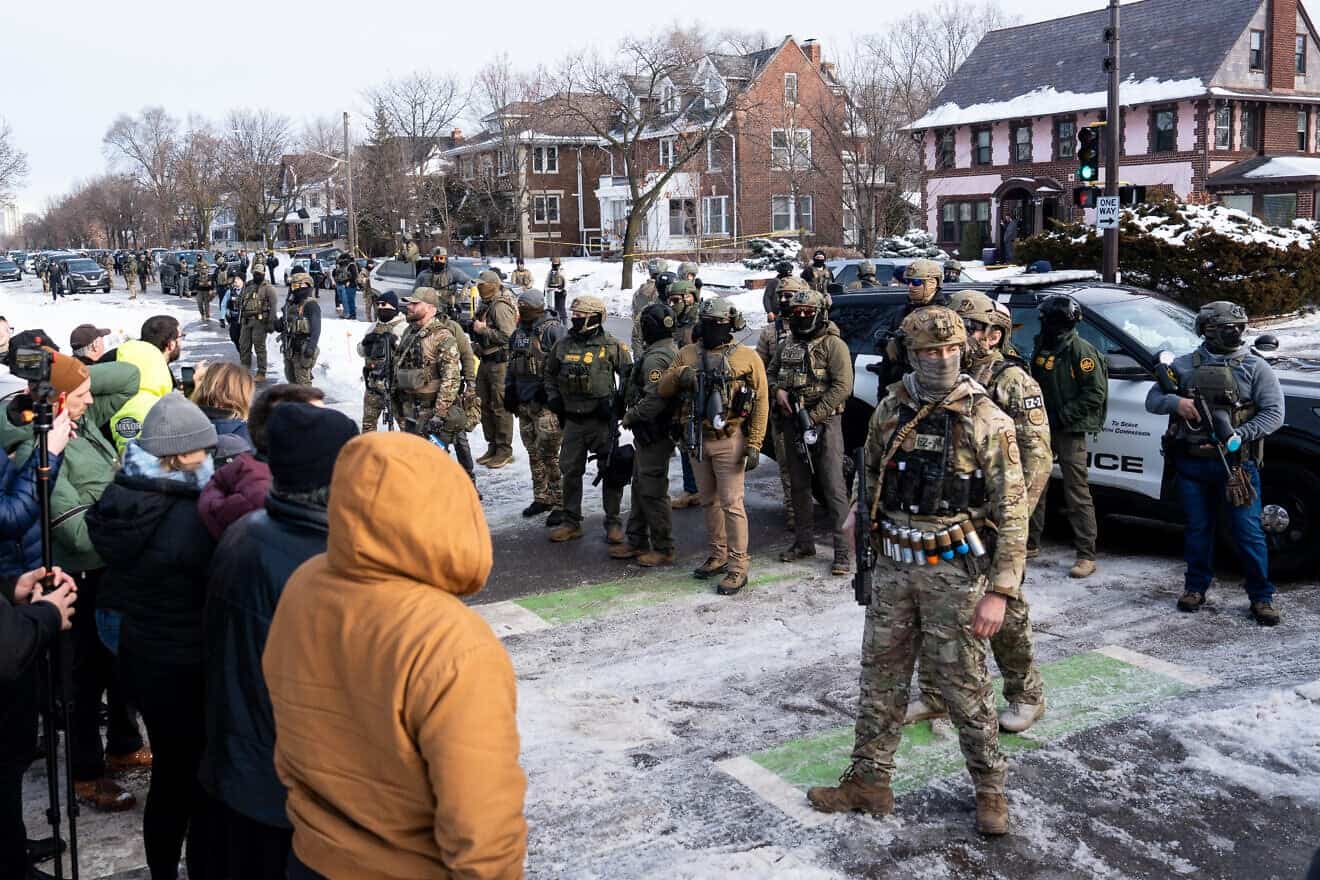 Portland Avenue and 34th Street in South Minneapolis, where an ICE agent shot a woman leaving an immigration protest by car, later identified as 37-year-old Renee Good, Jan. 7, 2026. Credit: Chad Davis Photography/Flickr via Wikimedia Commons.
Is it 2020 in America all over again? To some extent, the fatal shooting of Renee Good in Minneapolis by an agent of the U.S. Immigration and Customs Enforcement (ICE) on Jan. 7 has become a rerun of the events that followed the killing of George Floyd by a police officer in the same city on May 25, 2020. While the cases are very different, both tragic deaths almost immediately became fodder for an emotional national argument that transcends or even obscures the particular details of the incidents.
What happened to Good on a street in Minneapolis has fomented an angry dispute not only about whether the agent who fired on her had a reason to shoot, but also has become a referendum on President Donald Trump’s determination to use ICE to enforce immigration laws. As such, reactions to the incident are a Rorschach test about opinions on not just Trump, but whether the agency’s arrests of illegal immigrants are sound public policy. Inevitably, liberal and left-wing Jewish groups have been weighing in on the controversy in the wake of Good’s death, joining the calls for the abolition of ICE and ending the enforcement of immigration laws.
Demonizing ICE
This position is a reminder of the demands for defunding the police that were widespread after Floyd’s killing. But while the national reaction to the death of a 37-year-old mother has not reached the same level of hysteria as it did over Floyd, it has provoked a loud and divisive politicized debate. Since last year, pundits, politicians and protesters have used language to describe ICE’s conduct to bolster the argument that the policy being pursued by the government was not just misguided but something far worse.
The issue of what to do about illegal immigration is one about which reasonable people can differ. The problem is that many on the political left now treat any concern about the issue as illegitimate or proof of racism and xenophobia.
The massive flood of several million migrants into the United States without permission during the four years of the Biden administration had seemed to shift the discussion on the issue. The harmful impact of what amounted to an invasion of illegals lowered working-class wages, raised housing costs and overwhelmed the social service agencies of many communities. As such, it was a major factor in Trump’s 2024 re-election and caused many Democrats to mute their previous support for amnesty for illegals and/or support for government benefits for them.
The spectacle of ICE agents carrying out raids since Trump returned to the White House a year ago, however, has been portrayed in much of the liberal media as not only an abuse of government power but an authoritarian policy aimed at arresting innocent people.
The agency’s actions are part of an effort to make good on Trump’s promise to deport at least some of what may be as many as 20 million to 30 million people, rather than the 11 million to 14 million figure usually cited in the media (a 2018 Yale University study showed that the number then was more than 22 million—a number undoubtedly boosted by the invasion of illegals that happened on President Joe Biden’s watch).
Inappropriate analogies
Democratic politicians like Minnesota Gov. Tim Walz have called ICE “Trump’s modern-day Gestapo.” Gov. JB Pritzker of Illinois, who is Jewish and ought to know better, told NPR last September that due to ICE’s actions, the United States is “essentially” becoming “Nazi Germany.” The use of this kind of inflammatory rhetoric has only gotten worse since Good’s death, as, among others, various New York Times columnists have called the agency a “secret police,” as well as a fascist force whose main intent is to silence political dissent against Trump.
This is being echoed by a collection of leftist Jewish groups not merely to condemn Good’s killing, but to call for the abolition of ICE and a return to Biden’s lawless “open borders” policy. Not coincidentally, some of these same groups, like T’ruah, have been in the forefront of those attacking Israel’s efforts to defend itself since the Hamas-led Palestinian Arab attack on Oct. 7, 2023. The Jewish Council on Public Affairs, a coalition of liberal community-relations councils, has not only joined the ranks of those mourning Good but attacked ICE for encouraging racism and militarizing communities.
This is hardly surprising, given the way that liberal Jews and some of their organizations have treated the issue of illegal immigration. Most American Jews, like most Americans, in general, are the descendants of immigrants. Still, the effort to portray the current dilemma as no different from the situation in the early or mid-20th century is both unpersuasive and disrespectful to the past.
For several years, the use of inappropriate analogies between illegal migrants in the United States and Holocaust victims has become commonplace. Actress Natalie Portman, who portrayed Anne Frank on Broadway as a teenager, compared the Holocaust diarist to those seeking to evade American law enforcement. She wasn’t alone. In 2023, Biden also spoke of the flood of illegals coming into the country on his watch as akin to the victims of the Shoah.
Such analogies are both outrageous and divorced from the facts. While conditions in Central America or other nations, whose citizens have sought to cross into the United States without going through the legal process, may not be good, very few of these millions of illegals are in the position Jews were in the Europe of the 1930s and ’40s, literally fleeing for their lives because they were members of a group marked for death.
While sympathy for immigrants may be understandable, no matter how they entered, it’s not an issue where order should be tossed aside; that only shows contempt for the rule of law and for Americans harmed by this policy.
The Reform movement came perilously close to counseling its congregations not to cooperate with federal agents if they sought to search synagogues for lawbreakers, while still claiming that they were not giving legal advice. The Conservative movement joined in a lawsuit brought by a variety of liberal faith groups that sought to make their institutions the moral equivalent of medieval European cathedrals, where those on the run from the law could claim “sanctuary.”
This effort to demonize ICE seems to be rooted in a viewpoint that regards laws against illegal immigration as invalid—in essence, an effort to declare that the United States, alone among the nations, has no right to determine who may or may not enter and under what circumstances. It also reflects a highly selective and hypocritical attitude toward the question of whether it is appropriate to harass or even attack law-enforcement officers when they are carrying out their duties.
When police shoot protesters
One day before the Minneapolis shooting was the anniversary of the Capitol riot on Jan. 6, 2021. Those events five years ago quickly morphed from a disgraceful incident into one in which Trump acted recklessly, turning it into a political weapon his opponents then tried to employ to discredit all who had voted for him and to brand half of the country as opponents of democracy. Politics aside, Jan. 6 was an example of what happens when activists think that they have the right to ignore or abuse law enforcement.
The beatings of Capitol Police who attempted to stop the rioters from entering the halls of Congress are frequently cited as a great crime that should not be forgotten. But it’s also important to remember that, misleading news reports notwithstanding, the only person actually killed that day was not one of the policemen but one of the rioters, 35-year-old Air Force veteran Ashli Babbitt. A conspiracy theorist, she was in the process of breaking the law by illegally entering the Capitol and deserved to be punished for that.
Babbitt was unarmed, though, and posed no immediate physical threat to the Capitol Police officer who shot her dead. Had that officer killed a BLM protester under such circumstances, he would probably have been prosecuted and convicted of murder, like Floyd’s killer. Instead, he evaded accountability and was praised for carrying out his duties by the same people now comparing the agent who killed Good to Hitler’s murderers.
The circumstances of Good’s death are also highly controversial, and the question of whether the ICE agent broke the law has not been clarified by the various videos of the incident that have been released. Even if he was wrong to fire his weapon at her, that doesn’t mean he had no reason to fear for his life. Nor does it obscure the fact that she and others had been actively seeking to prevent ICE agents from obeying lawful orders to arrest illegals.
That ought not to be interpreted as a license by officers to fire when they should not. That’s true even if the officer in question had previously been the victim of an incident in which he was dragged by a felon—seeking to avoid arrest—behind the wheel of a car. Yet the notion that she was merely an innocent bystander or protester who was murdered by Trump’s “Gestapo” is to ignore both the facts and the context of the situation. Whatever their motives or intentions, when people impede law enforcement, it’s bound to lead to unfortunate results, no matter what government agents do.
Just as Floyd’s killing became fodder for a national moral panic about race that was largely unjustified, Good’s death is also being inappropriately employed for political purposes.
However horrific Floyd’s death was, the incident was seized upon as proof that the unjustified killings of blacks in America by police were a routine event and that the United States was still an irredeemably racist nation more than half a century after the triumph of the civil-rights movement. That was a myth rooted in falsehoods. But it didn’t stop many on the political left from using this widespread belief, fueled by media misinformation, as justification for advocacy for defunding the police. It led to a summer of demonstrations that rocked major cities, with millions participating, as well as hundreds of “mostly peaceful” riots that led to the deaths of at least 19 people and as much as $2 billion in damage to property, including federal, state and municipal buildings.
The response to Good’s death has not been as extreme. But it is also being interpreted as justifying the rhetoric about Trump being a fascist and ICE as his Storm Troopers.
That, too, is unjustified.
The images coming from ICE raids may disturb anyone sympathetic to illegal immigrants. But the reason for them is that for decades, under both Democratic and Republican presidents, illegal immigration was allowed to continue, and millions evaded the law with impunity. As with any act of law enforcement, the case of each individual can be argued on its own. Nevertheless, the notion that it is wrong for officials to arrest those who have evaded deportation orders or are flouting the law is simply untenable. It would not be applied to any other form of law-breaking. The reason in this case is that the issue has become a political football for Trump’s opponents.
The rule of law is a Jewish value
Those who say that the efforts of ICE violate Jewish values are misinterpreting those beliefs. Sympathy for the stranger is part of the Jewish tradition. So, too, is the concept of obeying the laws of the nation where Jews reside.
There is nothing in Judaism or Jewish history that ought to dictate whether the United States should have open borders or that those who enter it illegally should do so with impunity, regardless of the deleterious impact this has on most Americans. Illegal immigration does not harm corporations that rely on it to depress working-class wages. Nor does it bother members of the country’s credentialed elites (Jews among them) who rely on such workers to perform menial tasks at wages lower than they would have to pay U.S. citizens. But that is not a reason to view those living outside the law as being no different from those who fled the Nazis.
That said, non-enforcement of immigration laws does harm Jews in other ways.
The unregulated torrent of people over the border (before Trump effectively halted the flood of illegals) raised questions about the flow of not merely illegal drugs and sex trafficking but also terrorists, especially at a time of rising antisemitism. Similarly, ICE’s efforts to arrest those who had violated the terms of their visas by taking part in illegal pro-Hamas protests and acts of intimidation aimed at Jews are also part of Trump’s campaign against campus antisemitism. Abolishing ICE wouldn’t just mean open borders; it would facilitate the way Marxist and Islamist mobs seek to make it an open season on American Jews.
Left-wing Jews are, like everyone else, free to advocate for a return to Biden’s lax policies or to change the laws to give amnesty for illegals or to make it easier for migrants to enter the country. But what happened to Renee Good is no reason to end efforts to enforce existing laws. Nor should anyone rush to judgment about the circumstances of her death in a way that creates a precedent that legitimizes efforts to obstruct law enforcement that no sensible person should wish to set.
Equally important, it is wrong to treat this issue as one even remotely comparable to what happened in Nazi Germany to 6 million Jews, who were legal, productive citizens of the European countries in which they lived. Doing so doesn’t just dishonor the Holocaust. It undermines the rule of law, which is, in America and elsewhere, essential to Jewish security.
 Jonathan S. Tobin is editor-in-chief of the Jewish News Syndicate, a senior contributor for The Federalist, a columnist for Newsweek and a contributor to many other publications. He covers the American political scene, foreign policy, the U.S.-Israel relationship, Middle East diplomacy, the Jewish world and the arts. He hosts the JNS “Think Twice” podcast, both the weekly video program and the “Jonathan Tobin Daily” program, which are available on all major audio platforms and YouTube. Previously, he was executive editor, then senior online editor and chief political blogger, for Commentary magazine. Before that, he was editor-in-chief of The Jewish Exponent in Philadelphia and editor of the Connecticut Jewish Ledger. He has won more than 60 awards for commentary, art criticism and other writing. He appears regularly on television, commenting on politics and foreign policy. Born in New York City, he studied history at Columbia University.

 Powolna i cicha islamska transformacja Zachodu