Jonathan S. Tobin
The Pennsylvania governor’s shocking story about Kamala Harris’s aides asking him if he was an Israeli double agent is the first shot fired in a battle to save his party’s soul.
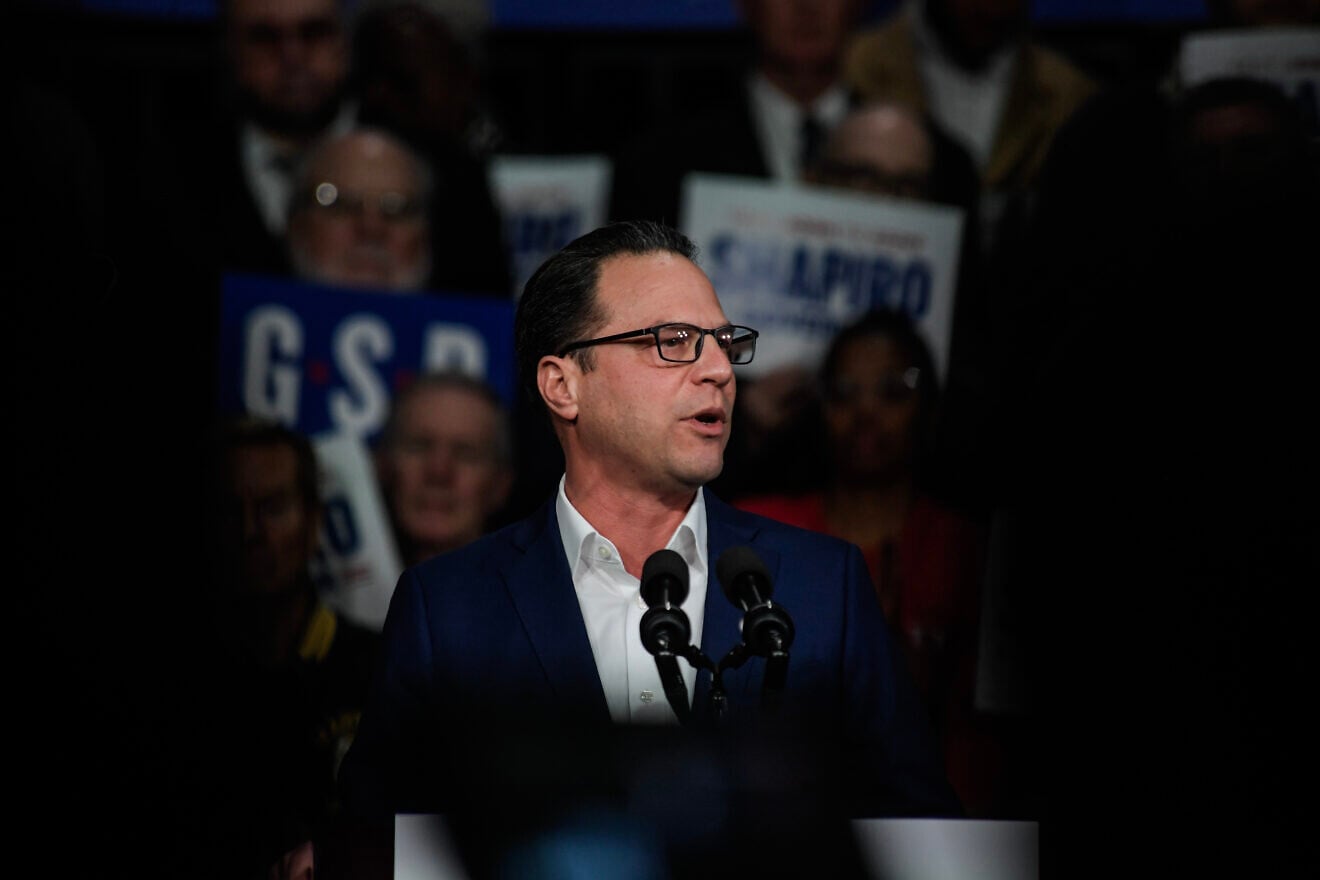 Pennsylvania Gov. Josh Shapiro speaks to supporters at a rally announcing his re-election bid, at the Alan Horwitz “Sixth Man” Center in Philadelphia, on Jan. 8, 2026. Photo by Matthew Hatcher/Getty Images.
The news that a potential presidential candidate has written a book is as unsurprising as that candidate’s public unwillingness to say that he is running in 2028. But one tidbit that has been leaked about Pennsylvania Gov. Josh Shapiro’s soon-to-be-published attempt at keeping his name in the news wasn’t just a bid for publicity. It’s one of the first shots fired in the 2028 Democratic presidential race, which he hopes will kneecap a potential rival in former Vice President Kamala Harris. But more than that, it’s an attempt to pre-emptively disarm those in his party who think that his identity as a Jew and a supporter of Israel, albeit often a half-hearted one, means that he is someone who can’t be nominated by Democrats in 2028.
The story was broken by The New York Times, which obtained a copy of the forthcoming Shapiro memoir, titled Where We Keep the Light, which was obviously leaked to the newspaper by the governor’s staff or his publisher. In a Jan. 18 article, it was reported that the book includes a passage with details of Shapiro’s vetting by staff of then-Vice President Harris, when she was considering him as her running mate.
Too Jewish to be nominated?
It was already well known that the meeting between Harris and Shapiro didn’t go well, and that the two clearly rubbed each other the wrong way. Even then, it was fairly obvious that her decision not to tap the popular governor of a key toss-up state who could have helped her win and instead choose a far less impressive politician—Minnesota Gov. Tim Walz—was not just caused by the clash of two healthy egos. As I noted at the time, the “unmaking” of Shapiro as a potential vice president had more to do with the way their party had come to be dominated by a left-wing faction that opposed the State of Israel and was, at best, soft on antisemitism.
Shapiro may have spent the previous year tripping over himself to show that he opposed Israeli Prime Minister Benjamin Netanyahu and had concerns about the post-Oct. 7 war against Hamas in Gaza. He was clearly worried about running afoul of fashionable elite opinion about the Middle East. But he was too undeniably Jewish and too much a traditional normative centrist supporter of the Jewish state to appeal to his party’s intersectional base, which falsely believes that Israel is a “genocidal” and “apartheid” state.
Still, Shapiro’s memoir backs up the suspicion that Israel played a key role in Harris’s thinking about him.
He says the vetting session, which every veep candidate goes through, focused intensely on his views about Jerusalem. More than that, he says he was asked “if he had ever been an agent of the Israeli government.” The book describes his incredulous response to a question that he rightly described as “offensive,” but was told, “Well, we have to ask.”
The excerpt says those words were repeated: “Have you ever communicated with an undercover agent of Israel?”
Questioner Dana Remus, a former White House counsel, continued, according to Shapiro, who recounted: “If they were undercover, I responded, how the hell would I know?” Not unreasonably, the governor concluded that the fact that he was even asked such a question “said a lot about some of the people around the VP.”
But the fallout of this story goes beyond an attempt to make a potential 2028 opponent—Harris seems on track to run in 2028, along with a number of other Democrats—look bad. The context is a Democratic debate about Israel that had already turned sour months before Harris decided to choose a running mate who wound up being a liability, rather than one as strong as Shapiro might have been.
The Democrats’ antisemitism problem
The Democrats had cleared the field for Biden’s re-election effort; however, the one problem was the fact that many left-wing Democrats were so unhappy with his equivocal support for Israel’s war against Hamas that they had dubbed him “genocide Joe.” So concerned was he about Arab-American voters in Michigan that he sent Jon Finer, his deputy national security director, and a delegation of other officials to plead for the support of Abdullah Hammoud, the pro-Hamas mayor of Dearborn, Mich.
Throughout the campaign, both Biden and especially Harris made it clear that they were not interested in contradicting the blood libels about Israel and the raw antisemitism being vented by many members of their party in the wake of the Hamas-led Palestinian Arab attack on southern Israel on Oct. 7, 2023.
Harris was apparently anxious about the possibility that Shapiro would hurt her among anti-Israel voters. He was asked during the vetting process whether he would “apologize” for speaking out against incidents of antisemitism that took place at the University of Pennsylvania post-Oct. 7, one of the campuses where pro-Hamas mobs targeted Jewish students for intimidation. The suggestion was itself outrageous, and Shapiro refused. In his book, he wrote that he believed he was being singled out in this manner, as well as being queried about possibly being an Israeli double agent because he was Jewish. He was clearly right to think so.
Harris was riding high in August 2024, when Shapiro’s vetting took place. A coup by various leading Democrats succeeded in forcing the ailing President Joe Biden to drop his bid for re-election after already winning his party’s nomination. Biden’s disastrous performance in a debate with President Donald Trump on June 27 had made his cognitive decline, which leading Democrats and the liberal press had spent years covering up, too obvious to ignore. Rather than conduct a competitive process that might have helped them win, Democrats decided that it was impossible to bypass Harris, a woman of color in a party where identity politics now reigns supreme, and simply acclaimed her as their candidate without letting it be contested.
Relieved to no longer have to pretend that Biden was competent, Democrats and their liberal media cheering section embraced Harris. And for a few weeks, that brief burst of euphoria about her nomination seemed to put her in a strong position to beat Trump. Though she and her apologists subsequently complained that she didn’t have enough time on the campaign trail to win, the truth was just the opposite. The more Americans learned about her—and had an opportunity to see and hear her—the less they thought of her.
A stronger vice-presidential candidate than Walz might have helped, though nothing Shapiro could have done would have made much of a difference. In his book, he now claims that after his disastrous meetings with Harris and her staff, he was disgusted with the process and pulled his name out of consideration. He also says that his wife opposed the move. But he claims that the staffer he communicated this news to said Shapiro would not be allowed to personally convey his decision to Harris because “the VP would not handle bad news well and that I shouldn’t push.”
Shapiro was lucky he wasn’t picked. Staying off the ticket allowed him not only to avoid being part of an epic campaign disaster but also to depict himself as a moderate who wouldn’t repeat Harris’s mistake of tilting to the left in 2028.
The leak of this excerpt is, however, more than an attempt by Shapiro to get even for what sounds like an awful experience that he was put through by Harris and her aides.
It’s also an effort to pre-empt the efforts of left-wing Democrats to label him as someone who is too Jewish and too pro-Israel to lead a party where the majority of voters are, as polls make clear, against the Jewish state. In that sense, he’s not only engaging in a battle to gratify his own outsized ambitions but to save the soul of a party that has been badly compromised by Jew-hatred since Oct. 7.
A party that is too woke
The Democratic base has, in large part, gone woke in recent years. Belief in the toxic myths of critical race theory, intersectionality and settler-colonialism has made it seem as if openly anti-Zionist and anti-Jewish politicians, such as New York City Mayor Zohran Mamdani, are more representative of the opinions of Democratic voters than a conventional liberal like Shapiro. Indeed, the Pennsylvania governor may not like Netanyahu. And he has backpedaled on his youthful enthusiasm for Israel’s security imperatives. But he is too connected to the Jewish community, as well as nominally pro-Israel, to fly with a party base that has fully embraced the left-wing congressional “Squad” and those with views akin to Mamdani.
It’s possible to argue that Shapiro is simply running in the wrong party at the wrong time, when the partisan split over Israel remains too great. Still, if Republicans nominate Vice President JD Vance in 2028 and continue to treat a platformer of Jew-hatred like former Fox News host and current podcaster Tucker Carlson as if he is a party luminary, then it creates an opening for Democrats. The sad truth is that both parties now have a serious antisemitism problem, even if it is more widespread among Democrats than in the GOP.
If nothing else, Shapiro’s memoir is a reminder to Democrats that they shouldn’t be so beguiled by identity politics and support for the woke catechism of diversity, equity and inclusion (DEI) that they once again choose a disastrous candidate like Harris. It also raises the possibility that he will spend the prelude to the 2028 race running as an opponent of his party’s intersectional Jew-haters and anti-Zionists rather than just another hapless politician trying to appease them.
If so, then his candidacy will—win or lose—be a positive contribution to American political culture, rather than just an exercise in egotism on the part of a long-shot candidate with little chance of becoming the nation’s first Jewish president.
 Jonathan S. Tobin is editor-in-chief of the Jewish News Syndicate, a senior contributor for The Federalist, a columnist for Newsweek and a contributor to many other publications. He covers the American political scene, foreign policy, the U.S.-Israel relationship, Middle East diplomacy, the Jewish world and the arts. He hosts the JNS “Think Twice” podcast, both the weekly video program and the “Jonathan Tobin Daily” program, which are available on all major audio platforms and YouTube. Previously, he was executive editor, then senior online editor and chief political blogger, for Commentary magazine. Before that, he was editor-in-chief of The Jewish Exponent in Philadelphia and editor of the Connecticut Jewish Ledger. He has won more than 60 awards for commentary, art criticism and other writing. He appears regularly on television, commenting on politics and foreign policy. Born in New York City, he studied history at Columbia University.

 Druga fala iluzji, czyli Zachód i jego plan dla Gazy