Archive | August 2026

Palestinians’ Preferred Leaders: A Convicted Fatah Terrorist or Hamas


Palestinians’ Preferred Leaders: A Convicted Fatah Terrorist or Hamas

Bassam Tawil


  • The survey, conducted by the Palestinian Center for Policy and Survey Research (PSR) in the West Bank and Gaza Strip between August 5 and 8, 2026, reveals that… the fundamental political attitudes that have plagued Palestinian society for decades remain largely intact. Hamas remains a major political force; convicted terrorists and Hamas leaders remain popular candidates for the Palestinian Authority (PA) presidency; overwhelming majorities oppose the unconditional disarmament of Hamas; and Iran, Hezbollah, and the Houthis in Yemen continue to enjoy remarkably high approval ratings.
  • Asked who is most suitable to succeed PA President Mahmoud Abbas, 39% chose imprisoned Fatah leader Marwan Barghouti… An Israeli court convicted him in 2004 of five counts of murder stemming from three terrorist attacks.
  • Barghouti was sentenced to five consecutive life terms plus 40 years.
  • Yet this is the man whom a majority of likely Palestinian voters would like to see as their next president.
  • The second-place candidate is the head of Hamas.
  • The PA parliamentary elections are scheduled for November 28, 2026, with presidential elections expected in early 2027. The PSR poll offers a warning of what those elections could produce.
  • Hamas could still win another Palestinian Authority election (as it did in 2006).
  • An overwhelming 72% say Hamas should not disarm before Israel completely withdraws from the Gaza Strip.
  • US envoy Jared Kushner recently met Hamas leader Khalil al-Hayya and other Hamas officials in Cairo as part of US efforts to advance President Donald J. Trump’s Gaza peace plan.
  • Whatever the administration’s intentions, such meetings provide Hamas with something it has sought for years: international legitimacy.
  • When representatives of the world’s leading superpower sit directly with Hamas leaders, Hamas can present the encounter to Palestinians, Arabs, and Muslims as evidence that its strategy has succeeded.
  • The message is that terrorism pays. If you carry out attacks, take hostages, retain your weapons and survive long enough – eventually the Americans will negotiate with you.
  • These figures are difficult to reconcile with claims that Palestinian society is undergoing a transformation toward moderation.
  • What exactly are these elections expected to accomplish?
  • Elections are not automatically synonymous with democracy, moderation, or peace.
  • The PA held a parliamentary election in 2006. Hamas participated and won. A year later, Hamas violently seized control of the Gaza Strip.
  • Now the Palestinians may be heading toward another election in which Hamas could again emerge as the largest faction….
  • Why, then, should the international community rush toward elections that could legitimize extremists and terrorists rather than marginalize them?
  • Before elections, Palestinians need real political reform. The Palestinian Authority needs accountable institutions, independent courts, freedom of expression, an end to corruption, and, most importantly, a political culture that does not glorify terrorists or treat armed groups as legitimate alternatives to government.
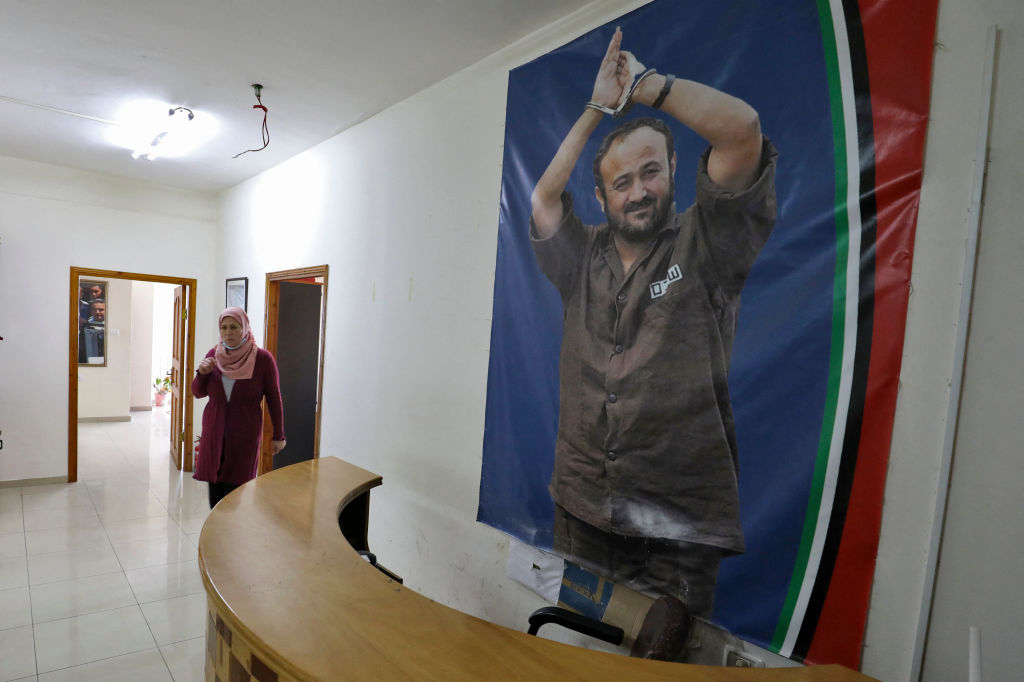
Pictured: A poster of Barghouti in prisoner’s uniform, in a campaign office in Ramallah on March 3, 2021. (Photo by Abbas Momani/AFP via Getty Images)

Nearly three years after Hamas’s October 7, 2023 massacre in Israel and following the devastating war in the Gaza Strip, one might have expected a fundamental change in Palestinian public opinion.

Palestinians might have turned away from Hamas, terrorism, and the Iran-backed “Axis of Resistance.” Palestinians also might have demanded new leaders committed to democracy, reform, an end to corruption, and peaceful coexistence.

The latest Palestinian public opinion poll, however, presents a disturbing picture.

The survey, conducted by the Palestinian Center for Policy and Survey Research (PSR) in the West Bank and Gaza Strip between August 5 and 8, 2026, reveals that although support for Hamas has declined, the fundamental political attitudes that have plagued Palestinian society for decades remain largely intact. Hamas remains a major political force; convicted terrorists and Hamas leaders remain popular candidates for the Palestinian Authority (PA) presidency; overwhelming majorities oppose the unconditional disarmament of Hamas; and Iran, Hezbollah, and the Houthis in Yemen continue to enjoy remarkably high approval ratings.

Perhaps the most alarming finding concerns the identity of the Palestinians’ future leaders.

Asked who is most suitable to succeed PA President Mahmoud Abbas, 39% chose imprisoned Fatah leader Marwan Barghouti. Hamas leader Khalil al-Hayya came second with 16%, followed by former Fatah official Mohammed Dahlan with 15%.

In a hypothetical presidential election involving Abbas, Barghouti, and al-Hayya, Barghouti would receive an astonishing 54% of the votes among likely voters. Al-Hayya would receive 26%, while Abbas would receive only 14%.

Who is Marwan Barghouti?

He is not some imprisoned Palestinian political dissident. An Israeli court convicted him in 2004 of five counts of murder stemming from three terrorist attacks.

He was also convicted of attempted murder and membership in a terrorist organization. Barghouti was sentenced to five consecutive life terms plus 40 years.

Yet this is the man whom a majority of likely Palestinian voters would like to see as their next president.

The second-place candidate is the head of Hamas. That alone should cause alarm in Washington, Brussels and other Western capitals that continue to talk about Palestinian elections as though voting, by itself, will magically produce moderation and democracy.

The PA parliamentary elections are scheduled for November 28, 2026, with presidential elections expected in early 2027. The PSR poll offers a warning of what those elections could produce. If legislative elections were held today, Fatah would receive 32% of the votes and Hamas’s “Change and Reform” list would receive 29%. In the Gaza Strip, Hamas would actually come first, with 34% compared to 30% for Fatah.

In other words, Hamas could still win another Palestinian Authority election (as it did in 2006).

This is the same Hamas that carried out the October 7 massacre. Yet after everything that has happened since then, the terrorist group remains within striking distance of Fatah in an election.

True, Hamas has lost some support. Overall identification with Hamas has dropped from 35% ten months ago to 24%. Satisfaction with Hamas’s performance during the Gaza war has fallen from 60% to 42%.

These changes should not be ignored. Moreover, they should not be confused with a Palestinian repudiation of Hamas or its ideology.

When Palestinians are asked which faction is most deserving of representing and leading them, Hamas still beats Abbas’s Fatah: 28% to 21%. An encouraging 44% say neither faction deserves to lead, but Hamas nevertheless remains a major political player and retains the support of nearly one-quarter of the population.

Even more revealing is what Palestinians say about Hamas’s weapons.

An overwhelming 72% say Hamas should not disarm before Israel completely withdraws from the Gaza Strip. Only 20% support disarmament before a full Israeli withdrawal. Opposition to disarming Hamas reaches 79% in the West Bank and 62% in Gaza.

This is crucial. The problem, therefore, is not whether Palestinians approve or disapprove of Hamas’s performance. The issue is whether they believe Hamas should be allowed to retain its weapons and continue functioning as an armed organization.

The answer from nearly three-quarters of the respondents is clear: Yes, at least until Hamas’s condition of a full Israeli withdrawal is met.

This should be of particular concern to the Trump Administration and anyone expecting Hamas to disarm as part of the latest Gaza arrangements. Hamas is not operating in a political vacuum. It knows that a large majority of Palestinians oppose requiring it to surrender its weapons before an Israeli withdrawal.

The poll also shows why direct American engagement with Hamas is dangerous.

US envoy Jared Kushner recently met Hamas leader Khalil al-Hayya and other Hamas officials in Cairo as part of US efforts to advance President Donald J. Trump’s Gaza peace plan.

Whatever the administration’s intentions, such meetings provide Hamas with something it has sought for years: international legitimacy.

When representatives of the world’s leading superpower sit directly with Hamas leaders, Hamas can present the encounter to Palestinians, Arabs, and Muslims as evidence that its strategy has succeeded.

A US-designated terrorist organization that perpetrated the October 7 massacre is no longer merely being pressured to surrender; its leaders are sitting across the table from senior American representatives.

The message is that terrorism pays. If you carry out attacks, take hostages, retain your weapons and survive long enough – eventually the Americans will negotiate with you.

This perception is particularly dangerous just months before Palestinian elections. Instead of politically isolating Hamas, direct high-level engagement helps portray the terrorist group as an indispensable regional actor.

The PSR poll contains another warning: Palestinian admiration for Iran and its terrorist proxies remains extraordinarily high.

Satisfaction with the Houthis in Yemen stands at 61%. Hezbollah and Iran each receive 50%. Moreover, when Palestinians were asked where they stood during the recent US-Iran war, 45% said they sided with Iran, compared to only 12% who opposed Iran.

These figures are difficult to reconcile with claims that Palestinian society is undergoing a transformation toward moderation.

The Houthis have attacked Israel, Saudi Arabia and international shipping. Hezbollah has long functioned as Iran’s heavily armed proxy in Lebanon. Iran has funded and armed terrorist groups throughout the Middle East, including Hamas and Palestinian Islamic Jihad.

Yet these are among the regional actors receiving the highest Palestinian satisfaction ratings.

There are, admittedly, some encouraging findings in the poll. Support for armed struggle as the most effective strategy has fallen from 41% to 27%, while support for negotiations has increased from 36% to 44%. These are significant changes.

Yet even here, caution is required. Half of Palestinians still reject the proposition that armed resistance has failed to protect Palestinians or end the conflict despite the destruction suffered in Gaza and parts of the West Bank. Moreover, 36% still support a return to confrontations and an armed intifada (uprising) against Israel.

The Palestinian Authority, meanwhile, faces its own crisis of legitimacy.

Seventy-nine percent of Palestinians want Abbas to resign. Eighty-three percent believe there is corruption in PA institutions. Sixty-five percent say the PA has become a burden on the Palestinian people rather than an achievement. Only 20% are satisfied with Abbas’s performance.

This raises a question Western governments should answer before celebrating the announcement of new Palestinian elections: What exactly are these elections expected to accomplish?

Elections are not automatically synonymous with democracy, moderation, or peace.

The PA held a parliamentary election in 2006. Hamas participated and won. A year later, Hamas violently seized control of the Gaza Strip.

Now the Palestinians may be heading toward another election in which Hamas could again emerge as the largest faction – or close enough to remain a dominant political player. Meanwhile, the leading candidate for PA president is serving five life sentences in an Israeli prison, and his principal Islamist rival is the leader of Hamas.

Why, then, should the international community rush toward elections that could legitimize extremists and terrorists rather than marginalize them?

Before elections, Palestinians need real political reform. The Palestinian Authority needs accountable institutions, independent courts, freedom of expression, an end to corruption, and, most importantly, a political culture that does not glorify terrorists or treat armed groups as legitimate alternatives to government.


Bassam Tawil is a Muslim Arab based in the Middle East. His work is made possible through the generous donation of a couple who wish to remain anonymous. Gatestone is most grateful.


Zawartość publikowanych artykułów i materiałów nie reprezentuje poglądów ani opinii Reunion’68,
ani też webmastera Blogu Reunion’68, chyba ze jest to wyraźnie zaznaczone.
Twoje uwagi, linki, własne artykuły lub wiadomości prześlij na adres:
webmaster@reunion68.com



Hamas Uses Gaza Hospital for Torture, Interrogation of Palestinians, IDF Says


Hamas Uses Gaza Hospital for Torture, Interrogation of Palestinians, IDF Says

Algemeiner Staff


Members of Hamas cracking down on Gazans. Photo: Screenshot from X account of Ahmed Fouad Alkhatib

Hamas has been using Nasser Hospital in the southern Gaza city of Khan Younis to torture and interrogate Palestinians, according to Israeli authorities.

The Israel Defense Forces (IDF) and the Shin Bet security agency released a joint statement on Thursday saying they can now reveal intelligence showing that Hamas “conducts security interrogations and torture” at the hospital.

According to the statement, Hamas “sees an erosion in its support among the residents of the Gaza Strip and fears that it will lose its grip on the population,” causing the Palestinian terrorist group to ramp up its efforts to intimidate Gazans and crush any dissent. 
.

.
Hamas, which fully ruled Gaza before its Oct. 7, 2023, invasion of and massacre across Israel that launched the ensuing war, now controls roughly 40 percent of the enclave, in accordance with an October 2025 ceasefire that left the Israeli military in control of more than half the territory. Most of the Palestinian enclave’s population lives in the part under Hamas’s rule.

“According to the information we have, in the Yassin building, on the second floor of the hospital’s outpatient clinics, investigations are being conducted by Hamas’s internal security and military intelligence. Moreover, Hamas exploits the hospital as a center of government, regardless of its medical function, for interrogations, torture, and the collection of funds,” the Israeli statement said.

“Nasser Hospital continues to serve as Hamas’s main military infrastructure in the southern Gaza Strip,” the IDF and Shin Bet added. “Hospital patients and staff witness the regular presence of Hamas operatives, some of them masked, in various areas of the hospital compound.”

The statement came months after the international humanitarian group Doctors Without Borders publicly acknowledged in January that armed individuals — many of them masked — were present inside the large compound of Nasser Hospital, citing intimidation of patients, arbitrary arrests, and suspected weapons movement as reasons for halting some of its work there.

The admission appeared to corroborate claims long asserted by Israeli authorities about the use of medical facilities by Hamas and Palestinian Islamic Jihad (PIJ), an allied terrorist group, during the conflict in Gaza.

For many months, the Israeli government and military have claimed that Hamas and other armed groups used hospitals — including Nasser — as shelter and operational bases, allegations that Palestinian authorities and many humanitarian organizations have rejected. In February 2024, IDF Spokesman Daniel Hagari said the military had “credible intelligence” that Hamas held Israeli hostages at Nasser Hospital at one point and that there may have been bodies of hostages currently hidden there.

The Algemeiner has previously documented claims acknowledged by the Palestinian Authority that Hamas summoned Gazans to the Nasser compound for interrogations and that militants threatened hospital staff.

Terrorists from both Hamas and PIJ have confessed that they took over hospitals across the enclave, using the medical facilities to hide military activities, launch attacks, and hold hostages kidnapped during their Oct. 7 attack.

The latest Israeli statement comes as the US seeks to move forward to the next phase of last year’s ceasefire, an effort that would require Hamas to disarm and relinquish control of Gaza.

However, Hamas has repeatedly refused to give up its weapons and taken advantage of the pause in fighting by tightening its control over civilian life while simultaneously rebuilding its military capabilities behind the scenes.

As part of this effort, the Palestinian terrorist group has been gradually reestablishing its civilian governance structures across the war-torn enclave, through checkpoints, strict regulation of goods, and control over key public institutions, including hospitals.

Hamas has also been reactivating internal security mechanisms to enforce day-to-day order, while conducting extensive intelligence operations aimed at identifying alleged “collaborators with Israel” and suppressing any opposition.

In June, armed Hamas operatives arrested Gazans in the streets and rounded up others at hospitals as the Islamist group moved to suppress planned protests calling for an end to its rule.

“The IDF warns the residents of the Gaza Strip – Hamas is afraid of losing control of the Gaza Strip, and therefore uses hospitals, schools and other civilian facilities for its own needs and harms them in areas intended to serve them,” the military and Shin Bet said in Thursday’s statement.

Last week, the Palestinian Center for Policy and Survey Research, an independent Palestinian polling and research institute, released a survey showing a significant decline in support for Hamas in both Gaza and the West Bank.


Zawartość publikowanych artykułów i materiałów nie reprezentuje poglądów ani opinii Reunion’68,
ani też webmastera Blogu Reunion’68, chyba ze jest to wyraźnie zaznaczone.
Twoje uwagi, linki, własne artykuły lub wiadomości prześlij na adres:
webmaster@reunion68.com


Największy błąd, jaki Żydzi popełniają w myśleniu o Izraelu

Zdjęcie: Cole Keister/Unsplash


Największy błąd, jaki Żydzi popełniają w myśleniu o Izraelu

Joshua Hoffman


Problem nie polega na tym, że Izraelowi nie udało się być doskonałym. Problem w tym, że od początku oczekiwaliśmy od niego doskonałości.


Przez niemal 2000 lat Żydzi marzyli o powrocie do Izraela.

Potem zrobiliśmy coś znacznie trudniejszego: naprawdę wróciliśmy.

Wskrzesiliśmy język. Osuszyliśmy bagna. Zbudowaliśmy miasta, uniwersytety, szpitale, gospodarstwa rolne, firmy, jedną z najpotężniejszych armii świata, bezwzględną demokrację i gospodarkę o globalnych ambicjach. Przyjęliśmy Żydów wypędzonych z krajów arabskich, ocalałych z Holokaustu, Żydów radzieckich, Żydów etiopskich oraz imigrantów z niemal każdego zakątka ziemi.

Przekształciliśmy pradawne pragnienie w sprawnie funkcjonujące państwo. I gdzieś po drodze – być może dlatego, że Izrael dokonał czegoś tak nieprawdopodobnego – zaczęliśmy oczekiwać, że dokona niemożliwego.

Oczekiwaliśmy od Izraela, że zapewni Żydom bezpieczeństwo. Oczekiwaliśmy, że położy kres antysemityzmowi. Oczekiwaliśmy, że zjednoczy naród żydowski. Oczekiwaliśmy, że da Żydom tożsamość. Oczekiwaliśmy, że sprawi, iż świat będzie nas szanował. Oczekiwaliśmy, że będzie postępował bardziej moralnie niż każdy inny naród, a jednocześnie przetrwa w obliczu wrogów dążących do jego unicestwienia. Oczekiwaliśmy, że będzie schronieniem, potęgą militarną, centrum duchowym, liberalną demokracją, biblijną ojczyzną, technologicznym supermocarstwem, dyplomatycznym cudem i fizycznym ucieleśnieniem żydowskiej moralności.

A potem, gdy Izrael nie zdołał w sposób doskonały spełnić wszystkich tych oczekiwań, Żydzi zaczęli pytać, co jest z Izraelem nie tak.

Być może to niewłaściwe pytanie. Być może oczekiwaliśmy od niego zbyt wiele.

Wielką obietnicą współczesnego syjonizmu nigdy nie było to, że Izrael wyeliminuje każde zagrożenie stojące przed narodem żydowskim. Współczesny syjonizm obiecywał coś znacznie skromniejszego, a zarazem znacznie bardziej rewolucyjnego: Żydzi nie będą już całkowicie zależni od innych, jeśli chodzi o własne przetrwanie.

Przez większą część żydowskiej historii Żydzi mogli błagać królów, prezydentów, rządy i sąsiadów o ochronę. Mogliśmy mieć nadzieję, że otaczające nas społeczeństwa pozostaną tolerancyjne. Mogliśmy wnosić nieproporcjonalnie duży wkład w ich gospodarki i kultury. Mogliśmy dowodzić swojej lojalności. Mogliśmy się asymilować. Ostatecznie jednak, gdy zmieniał się klimat polityczny, bezpieczeństwo Żydów zależało od tego, czy ktoś inny uzna, że Żydzi zasługują na to, by nadal być bezpieczni.

Syjonizm zmienił tę zależność. Po raz pierwszy od niemal 2000 lat ponownie istniał żydowski rząd zdolny bronić żydowskiego życia przy pomocy żydowskich żołnierzy. Nie uczyniło to Żydów nietykalnymi. Uczyniło ich odpowiedzialnymi za własny los. To dwie zupełnie różne rzeczy.

Izrael nigdy nie był obietnicą, że 7 października nie może się wydarzyć. Izrael był powodem, dla którego po 7 października żydowscy żołnierze ruszyli do walki, by chronić żydowskie społeczności, zamiast pozostawić je bezradnie czekające, aż ktoś inny przyjdzie im na ratunek. To bolesne rozróżnienie, ale ma ono ogromne znaczenie. Istnienie Izraela nie zniosło żydowskiej podatności na zagrożenia. Zniosło żydowską bezsilność. Pomyliliśmy jedno z drugim.

A ponieważ je pomyliliśmy, każda izraelska tragedia zaczęła być odbierana jako dowód, że syjonizm w jakiś sposób zawiódł. Skoro Żydzi nadal mogą być mordowani, to po co Izrael? Skoro Izraelczycy nadal potrzebują schronów przeciwbombowych, to po co Izrael? Skoro antysemityzm nadal istnieje, to po co Izrael?

Ale żaden poważny ruch narodowy nie obiecuje, że jego naród już nigdy nie będzie cierpiał. Francja nie może zagwarantować, że żaden obywatel Francji nigdy nie zostanie zaatakowany. Ameryka nie może zagwarantować, że żaden Amerykanin nigdy nie zostanie zabity. Ukraina nie może zagwarantować, że jej granice nigdy nie zostaną naruszone. Suwerenność narodowa nie eliminuje zagrożeń. Daje narodowi możliwość reagowania na nie. 

Izrael dał Żydom sprawczość. Już samo to stanowiło jedną z największych przemian w żydowskiej historii. Ale na tym nie poprzestaliśmy. Oczekiwaliśmy również, że Izrael rozwiąże problem antysemityzmu. Pierwsi syjoniści, co zrozumiałe, wierzyli, że żydowska suwerenność może znormalizować żydowską kondycję. Gdyby Żydzi stali się narodem takim jak wszystkie inne narody, być może patologiczna obsesja na ich punkcie w końcu by zniknęła.

Historia miała jednak inne plany. Żyda nienawidzono, gdy nie miał własnego państwa; potem zaczęto go nienawidzić za to, że je ma. Żydów oskarżano niegdyś o to, że nie chcą się asymilować; dziś oskarża się ich o nacjonalizm. Oskarżano ich o bycie wykorzenionymi kosmopolitami; dziś oskarża się ich o nadmierne przywiązanie do konkretnego skrawka ziemi. Oskarżano Żydów o tchórzostwo; dziś Izrael oskarża się o nadmierną siłę militarną.

Żydowska słabość nie zadowalała naszych wrogów. Żydowska siła również ich nie zadowala. Niewygodna lekcja jest taka, że antysemityzm nigdy nie dotyczył zachowania Żydów. Dotyczył potrzeb antysemitów. Izrael nie mógł rozwiązać problemu psychologicznego, religijnego i politycznego zjawiska, które bez końca wymyśla na nowo uzasadnienia dla nienawiści do Żydów.

Oczekiwaliśmy również, że Izrael weźmie na siebie ciężar żydowskiej tożsamości. Być może jest to jeden z najbardziej brzemiennych w skutki błędów popełnionych przez Żydów. Przez dziesięciolecia Izrael stał się najłatwiejszą formą żydowskiej tożsamości. Mogłeś wiedzieć bardzo niewiele o Torze. Mogłeś rzadko chodzić do synagogi. Mogłeś nie mówić po hebrajsku. Mogłeś przestrzegać niewielu żydowskich tradycji. Mogłeś niemal w ogóle nie rozumieć żydowskiej historii. Ale mogłeś popierać Izrael.

I dla milionów Żydów, szczególnie w diasporze, to zaczęło wystarczać. Izrael stał się drogą na skróty do żydowskości. Niebiesko-biała flaga mogła czasem zastąpić znajomość żydowskiej tradycji i kultury. Podróż do Izraela mogła zastąpić lata żydowskiej edukacji. Zaangażowanie polityczne mogło zastąpić praktykowanie judaizmu. Popieranie Izraela miało znaczenie. Nadal ma ogromne znaczenie. Ale Izrael nigdy nie miał wykonywać pracy, która należy do judaizmu.

Państwo żydowskie nie może stworzyć żydowskiej tożsamości dla Żydów, którzy nie wiedzą, co znaczy być Żydem. Izrael może chronić żydowską cywilizację, ale nie może jej zastąpić. Izrael może inspirować Żydów, ale nie może kształcić ich na odległość. Izrael może zapewnić ojczyznę, ale nie może uczynić domu żydowskim. Izrael może dać Żydom suwerenność, ale nie może nadać każdemu Żydowi poczucia celu.

I to pomaga wyjaśnić jedno z najdziwniejszych zjawisk we współczesnym życiu żydowskim: niektórzy Żydzi głęboko zaangażowali się w sprawy Izraela, nie angażując się równie głęboko w judaizm.

A potem, gdy Izrael stał się politycznie skomplikowany, skomplikowała się również ich żydowska tożsamość. Jeśli nasza więź z narodem żydowskim opiera się przede wszystkim na tym, czy aprobujemy politykę danego izraelskiego rządu, wówczas każde wybory stają się kryzysem teologicznym. Każdy premier staje się referendum nad judaizmem. Każda operacja wojskowa staje się referendum nad żydowską tożsamością.

To ciężar niemożliwy do udźwignięcia przez jakiekolwiek państwo.

Izraelem rządzą politycy. Politycy popełniają błędy. Rządy zawodzą. Polityka się zmienia. Koalicje się rozpadają. Przywódcy nas rozczarowują. Nie jest to dowód na to, że Izrael poniósł porażkę. Jest to dowód na to, że Izrael jest państwem.

Często mówimy, że Izrael powinien być traktowany jak każde inne państwo, ale sami Żydzi czasami mają z tym trudność. Oczekujemy, że Izrael będzie zachowywał się jak państwo, a jednocześnie żądamy, by funkcjonował jako symbol moralny. Każda izraelska decyzja musi w jakiś sposób reprezentować sam judaizm. Każdy izraelski żołnierz staje się przedstawicielem żydowskiej etyki. Każdy izraelski polityk staje się rzecznikiem narodu żydowskiego. Każda izraelska porażka staje się porażką żydowską.

Żadne inne państwo nie dźwiga takiego ciężaru.

Kiedy australijski rząd postępuje źle, nikt nie ogłasza, że australijska cywilizacja jest nieprawomocna. Kiedy argentyński prezydent podejmuje złą decyzję, nikt nie twierdzi, że Argentyńczycy powinni porzucić ideę argentyńskiej suwerenności. Kiedy Wielka Brytania prowadzi kontrowersyjną wojnę, nikt nie zaczyna zastanawiać się, czy brytyjskie samostanowienie było historycznym błędem.

Tymczasem Izrael jest nieustannie zmuszany do uzasadniania nie tylko tego, co robi, lecz także tego, dlaczego w ogóle istnieje.

I czasami sami Żydzi przyswajają ten standard. Zaczynamy bronić Izraela tak, jak gdyby jego prawo do istnienia zależało od jego doskonałości. Nie zależy. Izrael nie musi być niemal doskonały, aby zasługiwać na istnienie. Nie musi nawet być wyjątkowy. Naród żydowski ma prawo do narodowego samostanowienia dokładnie z tego samego powodu, dla którego mają do niego prawo inne narody: ponieważ jesteśmy narodem.

Izrael nie potrzebuje humanitarnego wyjątku od historii. Nie musi być najbardziej demokratycznym państwem na Bliskim Wschodzie, aby uzasadniać swoje istnienie. Nie musi wynajdywać technologii zmieniających świat. Nie musi leczyć chorób. Nie musi zdobywać Nagród Nobla. Nie musi dostarczać światu moralnej inspiracji. Wszystko to jest wspaniałe, ale stanowi wartość dodatkową. Izrael ma prawo istnieć nawet w swoim najgorszym dniu.

Być może najbardziej niebezpiecznym oczekiwaniem, jakie nałożyliśmy na Izrael, było przekonanie, że stworzenie państwa żydowskiego pozwoli reszcie żydowskiego świata odetchnąć. Izrael zajmie się przetrwaniem Żydów; Żydzi w diasporze będą mogli zająć się całą resztą. Izraelczycy będą służyć w wojsku. Izraelczycy będą mówić po hebrajsku. Izraelczycy będą podtrzymywać żydowską kulturę narodową. Izraelczycy będą prowadzić wojny. Izraelczycy będą przyjmować zagrożone społeczności żydowskie. Izraelczycy będą utrzymywać żydowską cywilizację przy życiu w skali całego państwa.

Tymczasem społeczności żydowskie w innych miejscach mogły stopniowo stawać się coraz słabsze i oczekiwać, że Izrael to zrekompensuje. Taki układ nigdy nie był możliwy do utrzymania. Izrael nie może być zewnętrznym działem obsługi żydowskiej tożsamości. Przyszłość narodu żydowskiego wymaga silnego Izraela i silnych społeczności żydowskich poza Izraelem. Nie jednego albo drugiego. Jednego i drugiego.

Izrael potrzebuje Żydów, którzy rozumieją, dlaczego Izrael ma znaczenie wykraczające poza geopolitykę. Diaspora potrzebuje Izraela, ponieważ żydowska tożsamość pozbawiona związku z żydowską wspólnotą narodową z czasem staje się niebezpiecznie abstrakcyjna.

Ale ta relacja musi dojrzeć. Izrael nie jest naszym rodzicem. Izrael nie jest naszą polisą ubezpieczeniową. Izrael nie jest substytutem judaizmu. I Izrael nie jest maszyną zaprojektowaną do produkowania żydowskiej dumy na żądanie. Izrael jest narodowym domem narodu żydowskiego. To bardziej ograniczone ale i głębsze znaczenie.

Wielkim osiągnięciem Izraela nie jest to, że rozwiązał problem żydowskiej kondycji. Wielkim osiągnięciem jest to, że Izrael ją zmienił.

Przed powstaniem Izraela Żydzi byli narodem z historią, ale bez suwerenności; dziś jesteśmy zarówno cywilizacją, jak i narodem. Przed powstaniem Izraela żydowskie przetrwanie często zależało całkowicie od łaski innych; dziś Żydzi posiadają zdolność do obrony samych siebie. Przed powstaniem Izraela hebrajski należał przede wszystkim do modlitwy i starożytnych tekstów; dziś dzieci kłócą się po hebrajsku z rodzicami, komicy opowiadają po hebrajsku dowcipy, naukowcy prowadzą po hebrajsku badania, a żołnierze wykrzykują po hebrajsku rozkazy. Przed powstaniem Izraela Jerozolima była przede wszystkim kierunkiem, w którym Żydzi zwracali się podczas modlitwy; dziś można tam utknąć w korku.

Jest w tej przemianie coś głęboko żydowskiego: na powrót przekształciliśmy mitologię w geografię, a pamięć – w życie. To powinno było wystarczyć. Zamiast tego sukces wypaczył nasze oczekiwania, ponieważ Izrael dokonał rzeczy niezwykłej: zaczęliśmy domagać się cudów.

Chcieliśmy, aby Izrael położył kres żydowskiemu poczuciu zagrożenia, ale żydowska historia może nigdy nie zapewnić pełnego bezpieczeństwa. Chcieliśmy, aby Izrael położył kres antysemityzmowi, ale nienawiści nie da się uleczyć przez zalecanie, żeby ofiara zachowała się jak ofiara. Chcieliśmy, aby Izrael uczynił Żydów Żydami, ale tożsamości nie można zlecić komuś innemu. Chcieliśmy, aby Izrael zjednoczył naród żydowski, ale jedność wymaga wysiłku Żydów na całym świecie. Chcieliśmy, aby Izrael stał się dowodem, że historia ostatecznie rozwiązała kwestię żydowską, ale nie istnieje żadne ostateczne rozwiązanie kwestii żydowskiej.

Istnieje jedynie nieustannie udzielana żydowska odpowiedź: budować, uczyć się, bronić, tworzyć, pamiętać, wychowywać żydowskie dzieci, wzmacniać żydowskie społeczności, wzmacniać Izrael i rozumieć, że żadna z tych odpowiedzialności nie może zastąpić pozostałych. Izrael nie zwalnia nas z odpowiedzialności za budowanie żydowskiego życia; sprawia, że możemy realizować tę odpowiedzialność na skalę, jaką nasi przodkowie z trudem potrafiliby sobie wyobrazić.

Być może kolejny etap syjonizmu wymaga od Żydów, aby przestali pytać, co Izrael może zrobić dla żydowskiej tożsamości, a zaczęli pytać, co żydowska tożsamość musi zrobić dla Izraela. Powinniśmy oczekiwać od Izraela, że będzie bronił swoich obywateli. Powinniśmy oczekiwać, że jego rząd będzie ponosił odpowiedzialność za swoje działania. Powinniśmy oczekiwać, że jego instytucje będą się doskonalić. Powinniśmy krytykować błędy i domagać się kompetencji. Powinniśmy jednak przestać oczekiwać od Izraela, że odkupi żydowską historię. Żadne państwo nie jest w stanie tego zrobić.

Izrael nigdy nie miał uczynić Żydów niezwyciężonymi; miał uczynić nas suwerennymi. Nigdy nie miał wyeliminować antysemityzmu; miał sprawić, że antysemici nie będą już mieli ostatniego słowa. Nigdy nie miał zastąpić judaizmu; miał dać żydowskiej cywilizacji miejsce, w którym mogłaby w pełni żyć we własnym języku, własnej kulturze i własnym czasie.

I nigdy nie miał dopisać ostatniego rozdziału żydowskiej historii. W istocie Izrael dał nam coś znacznie cenniejszego: możliwość dalszego uczestniczenia w niej i angażowania się w nią.


Link do oryginału:

Future of Jewish
The Biggest Mistake Jews Make About Israel
Future of Jewish is the ultimate newsletter by and for people passionate about Judaism and Israel. Subscribe to better understand and become smarter about the Jewish world…

Zawartość publikowanych artykułów i materiałów nie reprezentuje poglądów ani opinii Reunion’68,
ani też webmastera Blogu Reunion’68, chyba ze jest to wyraźnie zaznaczone.
Twoje uwagi, linki, własne artykuły lub wiadomości prześlij na adres:
webmaster@reunion68.com


At the site of a Nazi massacre, the Jews are forgotten


At the site of a Nazi massacre, the Jews are forgotten

Fiamma Nirenstein


Former Italian Prime Minister Giuseppe Conte invokes Gaza at Sant’Anna di Stazzema while ignoring the antisemitic hatred behind the Oct. 7 massacre.

Former Italian Prime Minister Giuseppe Conte participates in the “Truth Day” event of the newspaper La Verità at the Roman Aquarium, June 23, 2026, in Rome, Italy. Photo by Simona Granati-Corbis/Corbis via Getty Images.

Former Italian Prime Minister Giuseppe Conte’s speech at Sant’Anna di Stazzema shows how the Palestinian cause is becoming a political and moral rallying point for parts of the European left.

Conte is an especially interesting case in the antisemitic tsunami now engulfing much of the world. The former prime minister and current leader of the left-wing populist Five Star Movement is a key ally of Democratic Party leader Elly Schlein and a potential candidate to lead Italy again. Italian media are already portraying his political moves with an eye toward a future contest for leadership of the left-wing coalition.

Increasingly, Conte appears to be using the Palestinian cause as a moral glue for the electorate he hopes to assemble, much as New York politician Zohran Mamdani has done in the United States.

That is what made his appearance this week at Sant’Anna di Stazzema so significant.

Sant’Anna is not simply another Italian village with a tragic wartime history. It is one of the most powerful symbols of Nazi-Fascist barbarism in Italy.

On Aug. 12, 1944, soldiers of the 16th SS Panzergrenadier Division “Reichsführer-SS,” aided by Italian Fascist collaborators, descended on the Tuscan village and surrounding hamlets and massacred hundreds of civilians. The official commemoration on Wednesday marked the 82nd anniversary of the slaughter, in which 560 people were killed, including more than 100 children.

Women, old people and children were slaughtered. The youngest victim, Anna Pardini, was just 20 days old. What was ostensibly an operation against partisans became a bloodbath of defenseless civilians.

Italian writer Adriano Sofri has compared the massacre to Srebrenica. The comparison is understandable.

But there is another massacre, far closer to us in time, that should have been impossible to ignore at Sant’Anna: Oct. 7, 2023.

On that day, Hamas terrorists invaded southern Israel and carried out a mass slaughter of Jews in kibbutzim, towns and at a music festival, murdering some 1,200 people and abducting 251 to the Gaza Strip.

Why should Oct. 7 have been remembered at Sant’Anna?

Because the defining ideological crime of Nazism was the persecution and extermination of the Jewish people. The SS did not merely terrorize Europe. It was a central instrument in the machinery that murdered 6 million Jews.

On Oct. 7, an ancient ideological hatred appeared once again in its most bloodthirsty form: the mass murder of innocent Jews, accompanied by an explicit determination to destroy their state.

Yet Conte, who delivered the official commemorative address at Sant’Anna on Wednesday, did not make that connection.

Instead, he spoke of the need to fight Nazi-Fascist ideology as the enemy of democracy, constitutional government and equality. That is, of course, legitimate. Sant’Anna is rightly regarded in Italy as a symbol of the values on which the postwar republic and its Constitution were built.

But something essential was missing.

Conte forgot—or chose not to remember—that antisemitism and the extermination of the Jews stood at the heart of the Nazi project.

And when Jews did enter his speech, they appeared not as the quintessential victims of Nazi ideology, but in the form of Israeli soldiers accused of perpetrating atrocities.

Speaking at the site of the Nazi-Fascist massacre, Conte declared that opposing fascism today requires condemning what he called the “horror” in Gaza, where, he claimed, “over 20,000 defenseless children have been massacred by the Israeli army.”

These are not isolated words.

Conte has repeatedly used Gaza and accusations against Israel in parliament and on the campaign trail. His rhetoric has turned increasingly sweeping and accusatory, presenting Israel not simply as a country whose government or military policies may be criticized, but as an engine of war, horror and extermination.

And now this propaganda has been brought to Sant’Anna di Stazzema.

That is what gives this very Italian story a much broader meaning.

Across the West, the Palestinian cause has increasingly become a political identity marker, particularly on the left. Politicians have discovered that attacking Israel can serve as a shorthand for moral virtue and as a means of mobilizing a particular political constituency.

But at Sant’Anna, the contradiction is especially grotesque.

Here was a politician standing at a place soaked in the blood of victims of an army belonging to a regime whose defining racial obsession was the destruction of the Jews—and using the occasion not to recall the latest mass murder of Jews, but to portray the Jewish state as the perpetrator of contemporary horror.

Memory is not merely about remembering that a crime occurred. It is about understanding what produced it.

If we commemorate Nazi-Fascist massacres while removing antisemitism and the attempted annihilation of the Jews from the center of the Nazi worldview, then we are not preserving history. We are reshaping it for present political purposes.

Sant’Anna deserves better.

Was this really how its victims should have been commemorated—as another opportunity to hunt for pro-Palestinian votes, whatever the cost?


Fiamma Nirenstein is an Italian-Israeli journalist, author and senior research fellow at the Jerusalem Center for Security and Foreign Affairs (JCFA). An adviser on antisemitism to Israel’s Ministry of Foreign Affairs, she served in the Italian Parliament (2008-2013) as vice president of the Foreign Affairs Committee. A founding member of the Friends of Israel Initiative, she has written 15 books, including October 7, Antisemitism and the War on the West, and is a leading voice on Israel, the Middle East, Europe and the fight against antisemitism.


Zawartość publikowanych artykułów i materiałów nie reprezentuje poglądów ani opinii Reunion’68,
ani też webmastera Blogu Reunion’68, chyba ze jest to wyraźnie zaznaczone.
Twoje uwagi, linki, własne artykuły lub wiadomości prześlij na adres:
webmaster@reunion68.com


Keeping Israelis out: The new antisemitic boycott reaches Italy’s airports


Keeping Israelis out: The new antisemitic boycott reaches Italy’s airports

Fiamma Nirenstein


Anti-Israel activists are targeting Israeli travelers at airports, turning freedom of movement into the latest front in the campaign to ostracize the Jewish state.

A Ryan Air passenger jet at Alghero Airport in Cagliari, Italy. Photo by EyesWideOpen/Getty Images.

There is a pack of fanatics in Italy that wants to take control of airports for the purpose of excluding Israel from international air routes.

They organize protests so that Israeli men, women and children arriving for an innocent vacation encounter a hostile and aggressive presence designed to frighten them and, ultimately, discourage Israelis from coming to Italy at all.

Israelis? Well, of course, the message goes further. It is meant to discourage Jews in general from traveling—those hated Zionists. Let them stay home. Better yet, let them remain shut inside their homes.

According to the familiar antisemitic narrative that now pursues Jews at school, at university, on vacation and at work, they are all part of a clique of genocidal murderers who carry out ethnic cleansing and shoot children for fun.

One can imagine where the activists get their information: antisemitic social media and television panels that take their news from the Qatar-based television network, Al Jazeera.

A group called Giovedì Bianco (“White Thursday”) has for some time been active at Cagliari Airport, where tourists arriving from Tel Aviv are greeted with shouts of “Free Palestine” and followed by hateful chants as they collect their luggage and make their way through the terminal, while children tremble.

Israelis adore Italy. Yet today, Thursday, Giovedì Bianco is calling for protests at the airports of Verona, Cagliari, Milan Linate, Rome Fiumicino and Venice, targeting Israeli travelers and denouncing the government for insisting on the “maintenance of air routes with Israel.”

The times and descriptions of the planned actions are public. But the objective goes well beyond airports. It is part of the effort to erase Israel from the international arena—from sports, culture, music, medicine and now travel—and, ultimately, to make Israel and Jews disappear from public life.

They are not the first to try.

Targeting air travel attacks something fundamental: the freedom of movement, education and exchange on which the free world is built. Apparently, however, those freedoms are not meant to apply to Jews.

Airports have already been transformed by decades of Palestinian and Islamist terrorism, subjected to stringent security measures intended to protect travelers from attack. Now comes another form of aggression against Jews, violating a basic principle of international coexistence.

And one final question: The boycott website lists telephone numbers connected to these activities. Might those numbers perhaps make it possible to identify the people behind this brilliant idea?


Fiamma Nirenstein is an Italian-Israeli journalist, author and senior research fellow at the Jerusalem Center for Security and Foreign Affairs (JCFA). An adviser on antisemitism to Israel’s Ministry of Foreign Affairs, she served in the Italian Parliament (2008-2013) as vice president of the Foreign Affairs Committee. A founding member of the Friends of Israel Initiative, she has written 15 books, including October 7, Antisemitism and the War on the West, and is a leading voice on Israel, the Middle East, Europe and the fight against antisemitism.


Zawartość publikowanych artykułów i materiałów nie reprezentuje poglądów ani opinii Reunion’68,
ani też webmastera Blogu Reunion’68, chyba ze jest to wyraźnie zaznaczone.
Twoje uwagi, linki, własne artykuły lub wiadomości prześlij na adres:
webmaster@reunion68.com