Archive | August 2024

CENTCOM Chief in Mideast to Mobilize Against Iranian Attack

CENTCOM Chief in Mideast to Mobilize Against Iranian Attack

by JNS.org


Illustrative: File photo: A F/A-18E Super Hornet fighter, USS Dwight D. Eisenhower, Red Sea, February 13, 2024. Photo: REUTERS/Hamad I Mohammed

Gen. Erik Kurilla, commander of US Central Command (CENTCOM), arrived in the Middle East on Saturday amid sky-high tensions as Israel prepares for an imminent attack by Iran and its terrorist proxies.

The trip by the general in charge of American forces in the region was already planned. However, in light of Tehran’s pledge to retaliate for the targeted killing of Hamas terrorist leader Ismail Haniyeh on its soil on July 31, his visit will focus on building a multilateral defensive alliance similar to the one that fended off the vast majority of the more than 300 missiles and explosive drones Iran fired at the Jewish state in mid-April.

Hezbollah, Iran’s Lebanese terror proxy, has separately vowed revenge for the targeted killing of senior member Fuad Shukr in Beirut on July 30.

Israel took responsibility for the Shukr killing, which occurred after Hezbollah murdered 12 children on a soccer field in the Druze Golan town of Majdal Shams on July 27. Jerusalem has not commented on the Haniyeh hit.

Kurilla is expected to visit several Gulf states, Jordan and Israel. Amman is an important stop because King Abdullah II played a pivotal role during the April 13 onslaught.

Jordan’s Foreign Minister Ayman al-Safadi will visit Tehran on Sunday to discuss the security escalation in the Middle East following the Haniyeh assassination, the Qatari newspaper Al-Arabi Al-Jadid reported.

US increases defense posture in the region

Meanwhile, the Pentagon said on Friday that the US is boosting its defense posture in the Middle East in preparation for an expected attack against Israel by Iran and its terror proxies in Lebanon, Syria, Iraq and Yemen.

Defense Secretary Lloyd Austin “has ordered adjustments to US military posture designed to improve US force protection, to increase support for the defense of Israel, and to ensure the United States is prepared to respond to various contingencies,” the Pentagon statement from deputy press secretary Sabrina Singh said.

Austin ordered the USS Abraham Lincoln carrier strike group to replace the USS Theodore Roosevelt carrier strike group. In addition, destroyers and cruisers capable of ballistic missile defense will be sent to the Eastern Mediterranean and Middle East.

“The secretary has also ordered the deployment of an additional fighter squadron to the Middle East, reinforcing our defensive air support capability,” said Singh.

CENTCOM forces destroy Houthi missile and launcher

CENTCOM reported on Saturday that its forces had destroyed a missile and launcher of Iran’s Yemen proxy the Houthis in an area of Yemen controlled by the terrorist group.

“It was determined these weapons presented an imminent threat to US and coalition forces, and merchant vessels in the region. These actions were taken to protect freedom of navigation and make international waters safer and more secure,” CENTCOM said.

Iran planning larger attack

The Houthis could join the Iranian attack along with Tehran’s other regional terror proxies, with US officials expecting an attack “potentially larger in scope” than in April.

Three US and Israeli officials who talked to Axios reporter Barak Ravid said they expect Iran to attack Israel as early as Monday.

Iranian Supreme Leader Ali Khamenei ordered a direct attack on Israel following the killing of Haniyeh in Tehran, The New York Times reported on July 31.

Iranian officials said that the drones and missiles would aim for “military targets in the vicinity of Tel Aviv and Haifa, but would make a point of avoiding strikes on civilian targets,” the Times reported.

However, Tehran said on Saturday that it expects Hezbollah to expand its scope beyond just military targets.

“We expect … Hezbollah to choose more targets and [strike] deeper in its response,” Iran’s mission to the United Nations said, as quoted by the official IRNA news agency.

“Secondly, that it will not limit its response to military targets.”

Report: Mossad hired Iranian agents to kill Haniyeh

Israel’s Mossad intelligence agency hired Iranian agents to plant explosive devices in the room where Haniyeh was staying in Tehran for the inauguration of President Masoud Pezeshkian, according to Iranian sources who spoke to British newspaper The Daily Telegraph.

According to the report, the original plan was to kill Haniyeh in May when he visited Tehran for the funerals of Iran’s President Ibraham Raisi and Foreign Minister Hossein Amirabdollahian, who died in a helicopter crash on May 19. However, that plan was postponed after a large crowd gathered in the building where Haniyeh was staying.

Instead, the Mossad hired two Iranian agents who planted explosives in three rooms where Haniyeh was expected to stay at an IRGC guesthouse in the north of the capital, according to the report.

The agents, who were captured on CCTV entering and leaving the room, immediately fled the country, but left behind a source in Iran, according to the Telegraph. The regime in Tehran arrested dozens of suspects in connection with Haniyeh’s death, the Times reported on Saturday, including senior intelligence officers, military officials, and staff workers at the guesthouse.

“They are now certain that Mossad hired agents from the Ansar al-Mahdi protection unit,” an IRGC official told the Telegraph from Tehran, referring to the IRGC unit responsible for protecting high-ranking officials.

A second IRGC official told the Telegraph that “this is a humiliation for Iran and a huge security breach.”

“It’s still a question for everyone how it happened, I can’t make sense of it. There must be something higher up in the hierarchy that no one knows about,” the second official said.

“There is now an internal blame game taking over the IRGC, with different sectors accusing each other of the failure,” the first official said, adding that Quds Force commander Esmail Ghaani has been summoning people for questioning, arrests and possible execution.

“The breach has humiliated everyone,” said the IRGC official. “The supreme leader has summoned all the commanders several times over the past two days, he wants answers. For him, addressing the security breach is now more important than seeking revenge,” he added.


Zawartość publikowanych artykułów i materiałów nie reprezentuje poglądów ani opinii Reunion’68,
ani też webmastera Blogu Reunion’68, chyba ze jest to wyraźnie zaznaczone.
Twoje uwagi, linki, własne artykuły lub wiadomości prześlij na adres:
webmaster@reunion68.com


Państwo „Palestyna” i marzenie o ostatecznym rozwiązaniu

Image: MEMRI


Państwo „Palestyna” i marzenie o ostatecznym rozwiązaniu

Andrzej Koraszewski


Polska uznała „państwo palestyńskie” w 1988 roku. O ile mi wiadomo, po upadku komunizmu nikt nie proponował cofnięcia tego kroku. Ponad 140 istniejących państw uznaje nieistniejącą „Palestynę”, czasem dodając, że ma to być państwo w granicach sprzed czerwca 1967 roku, a czasem nie precyzując, gdzie ta „Palestyna” właściwie leży. Uznający „Palestynę” to głównie byłe kraje sowieckiego bloku i kraje, które były pod wpływem ZSRR. Ostatnio dołączyły do tego grona trzy kraje Europy Zachodniej mające w swojej historii szczególnie silne karty wściekłego antysemityzmu – kraj Inkwizycji, kraj Quislinga i kraj świętego Patryka.

Twierdzenie, że niemieckiego nazizmu i IRA (Irish Republican Army) nie łączyło nic poza niechęcią do Anglików jest daleko idącym błędem. Poza ideologią narodowego szowinizmu, łączył te kraje antysemityzm. Irlandia, aspirująca do roli pierwszej córy Watykanu, piła kielich antysemickiego jadu przy każdej mszy świętej, a buntując się w końcu przeciw tyranii Kościoła katolickiego, zręcznie zachowała starą tradycję, zmieniając ją na współczucie dla Palestyńczyków, którym Izraelczycy utrudniają zabijanie Żydów.      

Hiszpańskie „współczucie dla Palestyńczyków” ma wspaniałą i jak się wydaje jeszcze silniejszą tradycję, również solidnie zakotwiczoną w teologii katolickiej, która tak gładko przechodzi w marksistowsko-leninowską teorię współczucia ubogim, których opór należy wzmocnić i wyposażyć w sprawiedliwość.     

Norwegia jest protestancka, a dokładniej luterańsko-marksistowską, dziś nawet bardziej marksistowska niż luterańska, chociaż niektórzy zauważają, że w tym ich marksizmie jest sporo  pozostałości starej miłości do nazizmu. 

22 maja 2024 r. Norwegia, Irlandia i Hiszpania ogłosiły, że uznają Państwo Palestyńskie. (Kilka innych krajów zachodnich daje do zrozumienia, że prawdopodobnie pójdą w ich ślady.)      

Jak  pisze Steven Stalinsky:

„Norwescy politycy zaczęli zapraszać przedstawicieli Hamasu w 2006 r., nawet po 7 października 2023 Norwegia odmówiła nazwania Hamasu organizacją terrorystyczną. W Republice Irlandii Sinn Fein, która jest obecnie największą partią w Irlandii Północnej, utrzymuje od dziesięcioleci relacje z Hamasem. Ponadto wysocy rangą urzędnicy hiszpańscy wyrazili poparcie dla palestyńskiego „prawa do oporu” i dla Palestyny ‘od rzeki do morza’.”

Jest zupełnie zrozumiałe, że Hamas ucieszył się z tego uznania „państwa Palestyna” przez trzy zachodnie państwa i to bardziej niż go cieszy 140 pozostałych uznających to „państwo”. W oficjalnym oświadczeniuHamas powiedział:

„Z zadowoleniem przyjmujemy uznanie Państwa Palestyny przez Norwegię, Irlandię i Hiszpanię i postrzegamy to jako ważny krok w kierunku realizacji naszych praw na naszej ziemi i ustanowienia naszego niepodległego państwa palestyńskiego ze stolicą w Jerozolimie. Wzywamy kraje na całym świecie do uznania naszych uzasadnionych praw narodowych i wsparcia walki naszego narodu palestyńskiego o wyzwolenie i niepodległość oraz o zakończenie syjonistycznej okupacji naszych ziem”.

Przedstawiciel Hamasu w Katarze, Husam Badran, nie krył również, że on i jego towarzysze zdają sobie sprawę, że to uznanie jest wynikiem operacji pod kryptonimem „Potop Al-Aksa”, czyli orgii barbarzyństwa 7 października 2023 r..     

Steven Stalinsky pisze:

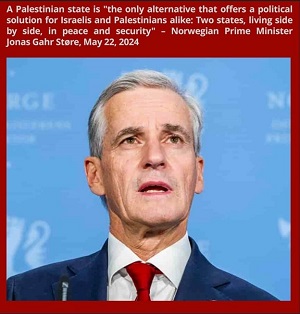
W swoim wystąpieniu z okazji ogłoszenia uznania „państwa Palestyna” 22 maja br. norweski premier Jonas Gahr Støre nazwał państwo palestyńskie „jedyną alternatywą, która oferuje rozwiązanie polityczne zarówno dla Izraelczyków, jak i Palestyńczyków: dwa państwa żyjące obok siebie, w pokoju i bezpieczeństwie”. Dodał: „Trwająca wojna w Strefie Gazy jasno pokazała, że osiągnięcie pokoju i stabilizacji musi opierać się na rozwiązaniu kwestii palestyńskiej”.

Czy jest możliwe że norweski premier nie wie, co stanowi Karta Hamasu, czy może nie wiedzieć o wypłatach nagród za zabijanie Żydów, które pochłaniają poważną część budżetu Autonomii Palestyńskiej Mahmouda Abbasa, czy może uczciwie wierzyć, że Palestyńczycy pod rządami Hamasu i Fatahu chcą i mogą uznać Izrael i żyć w pokoju ze swoim izraelskim sąsiadem? Osobiście wykluczam taką możliwość. Zdecydowanie bardziej prawdopodobne jest poparcie dla ostatecznego rozwiązania kwestii żydowskiej przez tego polityka i jego kolegów z norweskiego rządu.

Warto zwrócić uwagę na fakt, że zarówno norweski premier jak i norweska minister spraw zagranicznych po 7 października 23 r. odmówili nazwania Hamasu organizacją terrorystyczną, żeby „pozostawić otwarte drzwi do rozmów z Hamasem”.    

Irlandzki premier, Simon Harris, ogłaszając decyzję o uznaniu „państwa Palestyna” powiedział: „podjęliśmy ten krok wraz z Hiszpanią i Norwegią, aby utrzymać cud pokoju przy życiu”. Wezwał irlandzki premier premiera izraelskiego do powstrzymania katastrofy humanitarnej, a Unię Europejską do nałożenia sankcji na Izrael, zaś jego rząd przyłączył się do wysuniętych przez RPA oskarżeń Izraela o ludobójstwo. Poprzedni premier Irlandii, Leo Varadkar 12 października 2023 r. oświadczył, że Izrael stosuje „karę zbiorową” w Strefie Gazy.     

Rządząca w Irlandii partia Sinn  Fein była niegdyś politycznym skrzydłem Irlandzkiej Armii Republikańskiej, w wyniku porozumienia pokojowego wyrzekła się przemocy, a IRA (dokładniej Prowizoryczna IRA) została zlikwidowana w 1998 roku.

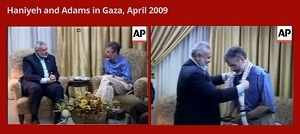
Sinn Fein od dziesięcioleci utrzymuje bardzo bliskie związki z Hamasem. W 2006 roku ówczesny przywódca Sinn Fein Gerry Adams spotkał się z liderami Hamasu w Gazie, a kolejne spotkanie z Haniją było w 2009 roku.     

Przedstawiciele Hamasu byli również wielokrotnie goszczeni w Irlandii. (Mniej oficjalna była współpraca w zakresie szkoleń terrorystów Hamasu przez irlandzkich instruktorów.) Na polu politycznym często podkreślano „historyczne podobieństwo”.  

grudniu 2016 roku Declan Kearney, wówczas członek parlamentu, stał na czele delegacji parlamentarnej na spotkaniu z przywódcami Hamasu w Stambule. Z wdzięcznością przyjął od reprezentującego Hamas Moussy Abu Marzouka, kefiję oraz mapę Palestyny od rzeki do morza, jak również klucz będący symbolem  palestyńskiego prawa powrotu.  

Jeszcze raz Stalinsky:

„Zaraz po 7 października przedstawiciele Sinn Fein wyrazili solidarność z Palestyńczykami, a jednocześnie, (podobnie jak reszta lewicy w Irlandii), nie skrytykowali okrucieństwa Hamasu, pomimo nacisków na przemyślenie swojego stanowiska. Rzecznik partii ds. zagranicznych Matt Carthy potrzebował tygodnia, aby wydać oświadczenie, w którym stwierdził, że nie ma uzasadnienia dla zabijania cywilów po żadnej ze stron, a liderce partii Mary Lou McDonald zajęło kilka dni, aby ‘bezwarunkowo’ potępić atak Hamasu. W lipcu 2024 r. pani McDonald nadal miała palestyńską flagę na swoim profilu X.”

W Irlandii sympatie dla Hamasu wydają się być ponad podziałami partyjnymi. Być może powinniśmy się dziwić, że czekali z uznaniem „państwa Palestyna” na Potop Al-Aksa.   

Hiszpania wydaje się jednak jeszcze ciekawsza. Muzułmanie nie kryją swojego marzenia o powrocie do Andaluzji, ale Hiszpanie są pełni sympatii do imperialnych planów zarówno szyitów, jak i sunnitów. Powiedzenie, że Niemcy nigdy nie wybaczą Żydom tego, co im zrobili w okresie nazizmu, w Hiszpanii należy cofnąć do czasów Izabeli i Ferdynanda. (Kilka organizacji żydowskich zwróciło się niedawno z prośbą do władz hiszpańskich, żeby z oficjalnego słownika wycofać najbardziej antysemickie hasła, np. takie jak określenie Żyda jako człowieka chciwego, lichwiarza.) Dziś neonazizm wydaje się w Hiszpanii odżywać szybciej niż w innych krajach, ale króluje marksistowska lewica. Władzę sprawuje Hiszpańska Socjalistyczna Partia Robotnicza. W dniu ogłoszenia decyzji o uznaniu „Państwa Palestyna”, hiszpańska wicepremier ogłosiła, że „Palestyna będzie wolna od rzeki do morza”, nie pozostawiając żadnych wątpliwości o jaki pokój zabiega jej rząd.  Premier ogłosił to uznanie „historyczną decyzją”,  palestyńskie flagi są w tym kraju wszechobecne, zarówno na zawodach sportowych, jak i podczas walk byków.

Niedawne badanie przeprowadzone przez hiszpański think tank wykazało, że 78% Hiszpanów opowiada się za uznaniem państwa palestyńskiego. Nauczyciel UNRWA z Gazy powiedział Al-Dżazirze: „Solidarność Hiszpanii z nami była niesamowita – czy to poprzez uznanie państwowości Palestyny, czy wsparcie RPA w jej sprawie przeciwko Izraelowi przed Międzynarodowym Trybunałem Sprawiedliwości”. Dodał: „Możemy zobaczyć, jak bardzo hiszpańscy kibice są [w sprawie Gazy] zafascynowani, gdy machają palestyńską flagą podczas meczów piłki nożnej”.

Dla marksistowskiej lewicy sojusz z islamistami jest sojuszem przeciw kapitalizmowi, dla islamistów, to sojusz na rzecz niepodzielnej władzy Allaha. Zarówno w meczecie Al–Aksa, jak i tysiącach innych meczetów słyszymy wezwania do podboju Jerozolimy i reszty świata. Tak, Izrael musi być pierwszy, ale Al-Andalus, Rzym, Paryż i Waszyngton są w dalszej kolejności. Jak mówił w listopadzie 2020 r. uczony w islamie szejk Ahmad Al-Chatwani, nadchodzi państwo islamskie, które będzie mobilizować swoje armie, by podbić Rzym i odzyskać Al-Andalus, aby rządzić Ziemią za pomocą islamu. 

Może to jakaś donkiszoteria, ale premier Pedro Sánchez i jego towarzysze robią, co w ich mocy, by te marzenia nie były tylko pustymi słowami.   


Zawartość publikowanych artykułów i materiałów nie reprezentuje poglądów ani opinii Reunion’68,
ani też webmastera Blogu Reunion’68, chyba ze jest to wyraźnie zaznaczone.
Twoje uwagi, linki, własne artykuły lub wiadomości prześlij na adres:
webmaster@reunion68.com

The Ottoman American Empire

The Ottoman American Empire

Tony Badran


The Obama-Biden blueprint after Gaza.

Tablet Magazine

According to U.S. Secretary of State Antony Blinken, Israel has “effectively lost sovereignty” over the north of its own country thanks to Hezbollah rocket attacks that have sent 80,000 Israelis fleeing from their homes and set at least 20,000 acres of Israeli land on fire. Blinken made his comments before the Hezbollah rocket attack that killed 12 children in the Israeli Golan Heights community of Majdal Shams, in the wake of which Washington signaled that it would be working to “contain the fallout” from the attack. In both cases, the Biden White House was closely following its existing blueprint for how it expects the eastern Mediterranean will work following the cease-fire it is attempting to enforce on Israel in Gaza, leaving Hamas in charge of the strip as the prelude to formally establishing a U.S.-recognized Palestinian state.

There is nothing secret about the administration’s plan for how it will administer the Levant, which it first unveiled in October 2022 in the form of the Israel-Lebanon maritime border deal brokered by White House emissary Amos Hochstein and signed by the then caretaker prime minister, Yair Lapid, in the waning days of his government. According to the U.S. blueprint, the United States and Iran will jointly administer a set of Levantine provinces, including Israel; a future Palestinian state; and Lebanon. Jordan, which is also part of the local geography, is configured as an American protectorate to balance out Syria, which was recognized by Barack Obama, publicly in 2015 and privately in his letters to Ali Khamenei, as an Iranian regional “equity” and will therefore apparently be administered solely by Iran. Whatever problems may arise between the three Levantine provinces and their local subdivisions are to be adjudicated jointly by the U.S.-Iran condominium, with local governing entities being free to plead their cases in Washington but powerless to take independent action without taking on both the global superpower and its regional partner.

The U.S.-Iranian understanding has governed and constrained Israeli action since the beginning of the Oct. 7 war. By ruling out any major military action against either Hezbollah or Iran and declaring the establishment of a Palestinian state to be a necessary outcome of the end of the Gaza war, it has bound the Israeli war effort in a straitjacket of strategic futility that Prime Minister Benjamin Netanyahu and his government have tried their best to wriggle out of. While the tactical successes of the past few days—in which Israel targeted the upper echelons of the Iranian network in successive strikes in Beirut and Tehran—smartly turned the power vacuum in the White House to Israel’s advantage, it is unclear what, if any, strategic significance they will have past November.

In the last two days of May, the Obama-Biden team again put forward its vision for the joint U.S.-Iranian administration of the region in two back-to-back announcements laying out how the Gaza endgame will work. Front and center in these announcements was the U.S. plan for Gaza and the Palestinians, which came with the public imprimatur of Barack Obama himself, the leader of the ruling party in Washington. The Obama plan, which begins with ending Israel’s military operation against Hamas, includes international engagement and investment in Gaza, and the formalization of the status of the Palestinian Territories as a proto-state under American management.

To understand the dynamics of the American-Iranian blueprint for Israel-Palestine-Lebanon, we need to look to the late Ottoman Empire and its relationships with the Great Powers of Europe.

The day before the proclamation on the Palestinians, Team Obama-Biden rolled out its plan for Israel’s northern neighbor, Lebanon. The president’s senior adviser, Hochstein, laid out a parallel multiphase plan for the Hezbollah-run country, which likewise features increased international engagement and cover, supplementing the United States’ substantial existing investments in so-called Lebanese state institutions, whose job is to run cover and provide support for Hezbollah.

What was original in the May announcements was the explicit connection that was made between the two plans, by both Washington and Hezbollah, the Iranian-led militia that rules Lebanon and acts as Iran’s local regent. The Lebanese plan would go into effect along with the Gaza plan, i.e., once Israel agrees to a cease-fire, with the Gaza plan being patterned on the Lebanese model. Biden and his team asserted that Israel has already agreed to the framework of the U.S. plan, signaling that Jerusalem, like Hezbollah, has signed on to Washington’s demands, just as it signed on to the Lebanese maritime deal—though, to be fair, it’s hard to see how the Israelis could turn Washington down in the middle of a war.

Hamas has not yet agreed to a cease-fire, though. Here, the United States appears to be faced by something of a logical conundrum. By granting Hamas victory in its war with Israel in the form of a cease-fire, followed by continuing control of the Gaza Strip, followed by a U.S.-backed state, the United States has in fact removed the motivation for Hamas to make any reciprocal concessions whatsoever. Why should it? Which is likely why the United States has engaged in only muted criticism of Israel’s military maneuvers in Rafah, which are the only form of leverage the United States has left to get the ball rolling on its regional blueprint.

So what does that blueprint consist of? It starts with U.S. investment and government grants to both countries that dwarf anything that the United States put into Gaza before the war. For Tehran, such investment is a subsidy; for the United States, it is a way of “containing the fallout” from any pesky rocket attacks, since Israel will be naturally constrained from bombing anything built with U.S. money or housing U.S. personnel. Then, there is active U.S. training and equipment for Lebanese and Palestinian armed forces, which in turn serve as shields and auxiliaries for much larger and more powerful terrorist armies that dominate both societies. Funding these (fictional) entities is like creating a large, heavily armed version of UNRWA, the supposed U.N. “relief agency” that funded Hamas and its tunnels before Oct. 7. Except the human shields these entities deploy will now be American military trainers.

What gives the Lebanon model its legs though, is not just that it joins the U.S. interest to the interests of the most powerful groups in Lebanese and Palestinian societies—namely, terrorist armies controlled by Iran. It extends beyond the shared particulars of international investment and engagement to a much older regional template with deep historical and geographical underpinnings. Perhaps the most relevant iteration of this template dates back to the mid-19th century. To understand the dynamics of the American-Iranian blueprint for Israel-Palestine-Lebanon, we therefore need to look to the late Ottoman Empire and its relationships with the Great Powers of Europe.

In the early 19th century, while the Ottomans continued to control the eastern Mediterranean, the rise of Egypt under Muhammad Ali led to the reemergence of a familiar pattern in the Levant, which is the rise of a set of fractured territories that functioned as a buffer zone between rival centers of power. Only now, there was a twist. European power was now a major factor that the weakened Ottoman Empire not only couldn’t circumvent but also depended on. Most notable among this power were the British, whose intervention was critical in repelling Egypt from Beirut and Acre in 1840.

In turn, European industrial and military strength forced the Ottomans to grant competing European powers concessions and privileges in the Ottoman realm, especially in the Levant, where European consuls played a considerable active commercial and political role. By then, the Sick Man of Europe, as the Ottoman Empire was known, had become an important square on the European chessboard of power.

As a consequence of this regional and international intrigue, the sectarian bloodletting that broke out, especially in Lebanon in 1841, following Egypt’s retreat, led to the creation of a special administrative arrangement in Mount Lebanon—a compromise between the French, British, and Ottomans brokered by Austrian Chancellor Klemens von Metternich. The arrangement replaced the abolished French-supported Emirate of Mount Lebanon, which had become a vassal of Egypt, and established two kaymakam’s, or sub-governorates, one Druze and one Maronite.

The sub-governorate system was marked by increased sectarian hostilities, culminating in the massacres of 1860, which led to another European military landing in Beirut, this time led by the French. Moreover, it resulted in the creation of a new arrangement in Mount Lebanon, negotiated between the Ottomans and the Great Powers of Britain, France, Russia, Austria, and Prussia: a special province (mutasarriflık). The idea of the special province was proposed by British diplomat Lord Dufferin. The province would be under European supervision and administered by a non-Arab Ottoman Christian governor chosen by the Sublime Porte, who would be advised by a local administrative council of sectarian notables. The province would have only a gendarmerie, trained by the French.

The province’s economy—silk monoculture—was dependent on the European market. European (and, by 1840, American) religious, educational, and health institutions as well as trade investments, concessions, and infrastructure projects (railways and port installations) were already well established in Beirut, the center of a separate administrative division (vilayet), which served as the base for the activities of the participants in Mount Lebanon’s affairs and for French influence in the region.

This complex arrangement remained in place until World War I. The war changed the calculus of the Great Powers toward the Ottoman Empire, which entered the war on the side of the Central powers. The Ottomans picked the wrong side, and after more than 500 years, their empire was finished.

According to the new local arrangements ratified by the League of Nations following the San Remo Conference, the Special Province of Mount Lebanon was replaced with a French mandate. Meanwhile, the Special Province of Jerusalem, created by the Ottomans 11 years after the Special Province of Mount Lebanon, albeit with different calculations, was replaced with the British mandate for Palestine, which was quickly partitioned into two districts, Transjordan (now the Hashemite Kingdom of Jordan) and Palestine (now Israel, with an asterisk).

I am hardly suggesting that the brain trust of the Obama-Biden team has sat down and poured over 19th c. Levantine history in search for a historical precedent and a set of maps to underpin its policy. Rather, stumbling into the Lebanese model of the special province is, for one, a testament to the enduring structures of the Levant and its interaction with imperial powers. As it happens, the same structural elements that lent themselves to the Ottoman carve-up lend themselves naturally to the vision driving policy in Washington since Barack Obama’s first term: the realignment with Iran and the reconfiguration of the regional order. In that regard, the Obama-Biden policy represents at once a massive expansion of the special province model as well as its inversion, in some key ways.

Whereas European intervention was driven by competing interests, which necessitated upholding a declining empire and managing its holdings while keeping rivals in check, Obama’s division of the region is intended to elevate a regional middle power and inflate its status across the region while orchestrating regional and international investment in its territories so that it can “do its job” as a U.S. partner. The 19th-century Mount Lebanon special province was a compromise between direct Ottoman rule and the revival of a French-sponsored principality. In Obama’s conceptual universe, the special province is recognized as an Iranian satrapy ruled directly by the Islamic Revolutionary Guard Corps and its local legion—with an accepted American presence, whose function is to provide protection and direct investment, both of which serve in turn to prop up Tehran.

Refracted through this lens, the Obama-Biden team’s policy in Lebanon offers a sketch of its adapted special province model, which it plans to implement in the Palestinian Territories following the end of Israel’s monthslong incursion into Gaza.

Underscoring the privileged place the Lebanese special province holds in Team Obama-Biden’s regional configuration is the American physical headquarters in the tiny country: the U.S. embassy. The second smallest Arab country is host to the second largest U.S. embassy on earth (the largest is in Iraq)—a 43-acre, $1 billion mammoth.

The new US embassy complex in Beirut under construction
US Embassy in Beirut/Twitter

The obvious question one might ask in response to hearing these numbers (the architectural renderings of this behemoth are even more startling), is: Why would America make that kind of investment in a pseudo-state run by Iran’s local representative? The answer is, precisely because it is Iranian territory.

The purpose of large-scale U.S. investment in Lebanon and its state institutions, as well as the building of an embassy that resembles a LEED-certified version of the Crac des Chevaliers in the hills overlooking Beirut, is not to attempt a hostile takeover or, to use the insufferable jargon of Washington hands, to “compete” with Iran. The last time there was perceived hostility in the American involvement in Lebanon, Iran blew up the U.S. embassy and the Marine barracks and kidnapped and murdered U.S. citizens in Beirut throughout the 1980s. No, the U.S. involvement is understood by all to be friendly and beneficial, aimed not at undermining the Iranian domain but at consolidating it in a joint venture. Much like the British with the Ottomans, American involvement in the Iranian realm is that of a patron—only not for the purpose of managing a declining empire, but for the inverted goal of consolidating the realm of an artificially inflated middle power that will administer the region under America’s aegis, for a price.

If the colossal embassy is the physical marker of the American investment in the Special Province of Lebanon, the principal avenue for U.S. involvement has been in the training and equipping of the security forces. Although they’re called the Lebanese Armed Forces, internally, the special province’s army performs gendarmerie functions; national security and defense policy and actual military functions are the domain of the Iranian court and its local military force, Hezbollah.

In recent years, however, the Obama-Biden team incorporated the LAF into the American counterterrorism enterprise, which has defined U.S. involvement in the region over the past quarter century. That enterprise is another facet of the American-Iranian partnership. Centering U.S. investment in the LAF on a target acceptable and beneficial to Iran is intended to reassure Tehran as to the shared nature of the force’s mission.

As another token of reassurance, the LAF is deployed along the border with Israel. In addition to playing a support role to Hezbollah in the area, positioning the U.S.-sponsored force in between Israel and the Iranian force means that an Israeli attack would have to target an American asset.

The same model is now being reproduced for the Special Province of Palestine. An ongoing Team Obama-Biden project is to stand up a Palestinian analogue to the LAF—let’s call it the PAF, an enterprise that began well before Oct. 7 under the supervision of the Obama-Biden team’s security coordinator in the Palestinian Territories, Lt. Gen. Michael Fenzel. Fenzel is also the administration’s point man in its campaign targeting Jews in Judea and Samaria—the flip side of the PAF policy, both of which are designed to consolidate a nascent Palestinian Special Province.

The Obama team sees Jewish sovereignty as a destabilizing factor in the regional arrangement with Iran, which therefore must be constrained, if not out outright abolished.

Initially, Fenzel was said to have been standing up a 5,000-strong force trained and equipped by the United States. The objective of Fenzel’s force is to sharply curtail IDF operations in Judea and Samaria, setting the stage for full Palestinian control of the West Bank under American supervision.

Like its Lebanese counterpart, the PAF has been folded into the U.S. counterterrorism framework. Being designated a U.S. counterterrorism partner force is code for both guaranteed perpetual American investment and reassurance to Iran that the force will safeguard, not subvert, Tehran’s realm. The PAF’s job is not to go after Iranian forces, such as Hamas or Palestinian Islamic Jihad, but to act as an auxiliary force and, by virtue of American sponsorship, as a constraint on IDF activity.

Since Oct. 7, Washington’s plans for the PAF have gone into overdrive. Like the LAF up north, the PAF features prominently in Team Obama-Biden’s “Day After” plan—that is, the formalization of the Palestinian Special Province, with its dual jurisdictions (or kaza, in keeping with Ottoman terminology). Within a couple of months since Oct. 7, the administration was already putting out talkers about the need to “strengthen” and “beef up” Fenzel’s nascent PAF. After a meeting between Fenzel and Palestinian Authority Intelligence Chief Majed Faraj in late 2023, chatter about guaranteeing funding (including salaries) for the force started to pop up in D.C.—again, following the LAF template. It’s said that during a meeting between Fenzel and the commander of the PA’s National Security Forces, Nidal Abu Dukhan, they also discussed U.S. salaries for the PAF.

In Lebanon, the Obama-Biden team has already deployed American trainers and special forces personnel. In fact, the U.S. military routinely docks naval vessels in Lebanese ports and uses an airstrip in the Hezbollah-controlled Bekaa to land airlifts of equipment for the LAF—turning all of these places into infrastructure that is ostensibly part of America’s global counterterrorism efforts.

In Gaza, the U.S.-made pier was intended to fulfill a related function and convey a similar signal. Though it might have been swept away by the sea and had to be temporarily relocated to avoid being washed out to sea again before it was finally decommissioned after failing to deliver the humanitarian supply surge that was its supposed function, the salient point is the persistence of the Obama-Biden team in rebuilding it over two months, at a cost of over a quarter of a billion in taxpayer money. In other words, at every level, administration messaging is persistently laying the groundwork for an ever-deepening level of direct management in the Palestine Special Province. In addition to Fenzel, the Obama-Biden team is said to be considering appointing a U.S. official to serve as the top civilian adviser who would be “based in the region” and would “work closely with the commanding officer” of a postwar security force in Gaza (which the State Department prefers to describe as a “gendarmerie”).

According to a recent report, the Biden administration “is coalescing around plans for an interim ‘Palestinian Council’ to govern Gaza and a security coalition in which the U.S. military will play a major role.” It’s perhaps a little on the nose, within the scope of the Ottoman analogy, for the United States to set up an “administrative council” for the Palestine mutasarrifate, but there it is. As with the “government of Lebanon,” the point of a council, whether it’s packed with notables or “technocrats,” is to provide cover for the Iranian clients who will continue to wield real power, propping up the American sick man of the Middle East.

In the Lebanese Special Province, the United States has assembled a consultative group with the ambassadors of four other nations (France, Egypt, Qatar, and Saudi Arabia) to manage the selection of a new “president”—a post that’s been vacant since 2022. The administration’s public pronouncements emphasize the importance of a new “president” for Lebanon. In reality, the administration’s point man on Lebanon, Special Adviser Hochstein, deals with Hezbollah through its ally, Shiite militia leader and “Speaker of Parliament,” Nabih Berri, among other cutouts, like former Director of General Security Abbas Ibrahim. The Lebanese government is a facade, an official channel to funnel U.S. aid and to cover for the fact that the administration is dealing as directly as possible with Hezbollah.

In fact, that’s precisely what the administration did in 2022 when it imposed its maritime boundary agreement, which in reality functioned as an official American designation of the Special Province of Lebanon as a U.S. protectorate, thereby discouraging Israeli military operations in that territory. Hochstein, then as now, talked as directly as he could with Hezbollah and advanced Iran’s interests, which he then pressed a client minority prime minister in Israel to accept in their entirety. One measure of the authority of this designation is that Israeli operations in Lebanon still haven’t happened, despite the “loss of sovereignty” declared by the U.S. secretary of state—who apparently gets to declare such things without the Israelis feeling able to say “boo.” Even after the Majdal Shams slaughter, Hochstein reportedly told Defense Minister Yoav Gallant that the United States opposed a strike on Beirut.

Intensified U.S. meddling in Israeli domestic affairs as well as the direct interference in Israel’s foreign and security policy since the maritime deal was sealed provide insight into where the state of Israel fits in the Obama-Biden team’s regional architecture alongside the joint U.S.-Iranian special provinces. Israel is a troublesome client, to be managed when possible by the U.S.-aligned Herodian faction inside the country, combined with external pressure like having Israel’s prime minister declared a war criminal by the International Criminal Court.

In the same vein, Washington’s framing of Iran’s April 13 direct missile and drone attack against Israel is instructive. Israel was constrained from retaliating against the Iranians. Instead, the United States made clear that the only legitimate defensive arrangement is one by the American-led integrated regional missile defense, which will effectively calibrate the “hit” that Israel is required to take, while ruling out of bounds any Israeli response to being attacked. That is to say, not only would Israel be denied the autonomous decision-making to go on the offensive, but also, even its defense would be contingent on what the United States deemed acceptable. Accordingly, following Hezbollah’s rocket attack on Majdal Shams, the administration reportedly listed targets in Lebanon that it considers to be out of bounds for Israel, including Hezbollah’s stronghold in the southern suburbs of Beirut.

The Obama team sees Jewish sovereignty as a destabilizing factor in the regional arrangement with Iran, which therefore must be constrained, if not outright abolished. To fit in Obama’s “regional integration” vision, Israel has to be reduced to a province, with no sovereign control over its defense policy with regard to the Iranians and their holdings in the U.S.-managed regional architecture, in which you’ll have the subdivision, or kaza, of Gaza and the kaza of the West Bank united within a new mutasarrifate of Palestine. Jerusalem will be a special jurisdiction shared with Israel under international supervision. The Lebanon mutasarrifate will be in the north, and the Israel sanjak (in keeping with Ottoman terminology), minus Jerusalem, in the middle. Within these units, “administrative councils” will be the official governing bodies, which we will refer to as “governments” while actual power resides elsewhere.

In the Lebanon mutasarrifate Hezbollah, as Iran’s local mutasarrif, is the recognized ruler that the United States deals with through the administrative council. In the Palestine mutasarrifate, a council including notables, clans, bedouins, technocrats, and the PA will serve the same function, as Hamas retains its position as the de facto authority and representative of Iran. The U.S. envoy to the Palestine mutasarrifate will manage the former. In the Israel sanjak, a “unity government” and a strong judicial council will serve as the American clients answering to the U.S. proconsul and the security coordinator.

Any 19th-century Ottoman administrator, or French or British Middle East diplomat, would look at a map of these arrangements and smile at how familiar they are. Local rulers and potentates who are not familiar with Ottoman maps and who believe themselves to be the elected leaders of sovereign nations may have a surprise coming, though.


Tony Badran is Tablet’s news editor and Levant analyst.


Zawartość publikowanych artykułów i materiałów nie reprezentuje poglądów ani opinii Reunion’68,
ani też webmastera Blogu Reunion’68, chyba ze jest to wyraźnie zaznaczone.
Twoje uwagi, linki, własne artykuły lub wiadomości prześlij na adres:
webmaster@reunion68.com


Bella Hadid Apologizes for Adidas Campaign’s ‘Lack of Sensitivity’ in Referencing Munich Massacre

Bella Hadid Apologizes for Adidas Campaign’s ‘Lack of Sensitivity’ in Referencing Munich Massacre

Shiryn Ghermezian


Bella Hadid in a new Adidas campaign for the brand’s remake of its SL 72 sneaker. Photo: Adidas

Supermodel Bella Hadid broke her silence on Monday about being featured in a controversial Adidas campaign that referenced the 1972 massacre at the Munich Olympics, where 11 Israelis were murdered by Palestinian terrorists.

“For those of you that do not know my heart, I want to make sure you’re hearing directly from me about my recent campaign with Adidas,” she began by saying in a lengthy statement posted on her Instagram Story. The founder of the Orebella perfume, who is also an avid critic of the state of Israel, added that she “would never knowingly engage with any art or work that is linked to a horrific tragedy of any kind.”

“In advance of the campaign’s release, I had no knowledge of the historical connection to the atrocious events in 1972,” she explained. “I am shocked, I am upset, and I am disappointed in the lack of sensitivity that went into this campaign. Had I been made aware, from the bottom of my heart, I would never have participated. My team should have known, Adidas should have known, and I should have done more research so that I too would have known and understood, and spoken up.”

Earlier this month, Adidas released a new campaign, featuring Hadid, for its iconic SL 72 sneaker. The sneaker was originally released in 1972 and used that year by athletes at the Munich Olympic Games, where the Palestinian terrorist group Black September murdered 11 members of Israel’s Olympic team after taking them hostage.

Hadid has participated in anti-Israel rallies where she chanted “From the river to the sea, Palestine will be free,” which calls for the destruction of the Jewish state and for it to be replaced with a Palestinian state from the Jordan River to the Mediterranean Sea. She has previously accused Israel of “colonization, ethnic cleansing, military occupation, and apartheid over the Palestinian people.” She has advocated for a “Free Palestine,” and since the start of the Israel-Hamas war, she has repeatedly expressed solidarity with Palestinians in the Gaza Strip.

After Adidas was criticized for choosing the anti-Israel model as a face of the new campaign, the German sportswear company pulled her from the project. Adidas also issued two apologies regarding the matter — one directed at Hadid herself — and said it would “revise” its campaign. Hadid had not commented on the ordeal until Monday. She said in the statement on her Instagram Story that she “always will speak up for what I believe to be wrong.”

“While everyone’s intentions were to make something positive, and bring people together through art, the collective lack of understanding from all parties undermined the process,” she said of the Adidas campaign. “I do not believe in hate in any form, including antisemitism. That will never waiver, and I stand by that statement to the fullest extent.”

“Connecting the liberation of the Palestinian people to an attack so tragic is something that hurts my heart. Palestine is not synonymous with terrorism, and this campaign unintentionally highlighted an event that does not present who we are,” she continued. The model concluded by saying that she is a “proud Palestinian woman” who “will forever stand by my people of Palestine while continuing to advocate for a world free of antisemitism.”

“Antisemitism has no place in the liberation of the Palestinian people,” she said. “I will always stand for peace over violence, any day. Hate has no place here, and I will forever advocate for not only my people, but every person worldwide.”

Hadid’s sister is fellow model Gigi Hadid, her mother is Dutch former supermodel Yolanda Hadid and her father is Nazareth-born Jordanian real estate developer Mohamed Hadid, who has regularly made anti-Israel comments on social media.


Zawartość publikowanych artykułów i materiałów nie reprezentuje poglądów ani opinii Reunion’68,
ani też webmastera Blogu Reunion’68, chyba ze jest to wyraźnie zaznaczone.
Twoje uwagi, linki, własne artykuły lub wiadomości prześlij na adres:
webmaster@reunion68.com


Szepty i krzyki w salonie krzywych luster

Ayaan Hirsi Ali (Zrzut z ekranu wideo)


Szepty i krzyki w salonie krzywych luster
Andrzej Koraszewski

„Jeśli zastanawiacie się, dlaczego ja – kolorowa kobieta, Afrykanka, była muzułmanka, była osoba ubiegająca się o azyl i imigrantka – z takim strachem i drżeniem patrzę na wybryki dzisiejszych antyizraelskich i antyamerykańskich demonstrantów, pozwólcie mi to wyjaśnić.”

Tak zaczyna się fascynujący artykuł Ayaan Hirsi Ali na łamach magazynu „The Free Press”. Urodzona w 1969 roku w Somalii Autorka opisuje tragedię swojego kraju, do którego dotarły macki ZSRR. Komunistyczny eksperyment oznaczał ogromny rozlew krwi, masowy głód i tyranię. Normalne rozmowy zastąpiły szepty i nieustanny lęk.     

Ośmioletnia Ayaan przenosi się w 1977 roku z rodziną do innego afrykańskiego kraju, uwielbia książki, marzy o wolności. Przed przymusowym małżeństwem ucieka do Holandii, Tam robi studia, zostaje posłanką do parlamentu. Odrzuca dziedzictwo islamu, jest zafascynowana zachodnimi wartościami dającymi człowiekowi wolność. Jej otwarta krytyka islamu ściąga na nią nie tylko groźby śmierci ze strony muzułmańskich fanatyków, ale również wściekłość ze strony holenderskiej lewicy. Ostatecznie musiała porzucić Holandię i przenieść się do USA. Dziś ostrzega przez zagrożeniem, jakie niesie sojusz lewicowej, marksistowskiej lewicy z prawicowym, ekspansjonistycznym islamem.          

Jak poważne jest to zagrożenie tym koktajlem infantylnej lewicowości z morderczym religijnym fanatyzmem?

Większość ludzi na Zachodzie odmawiała wiary, że wyłania się jakieś zagrożenie samych podstaw demokratycznego systemu. Nieudane wybory, złe kierownictwo tej czy innej organizacji. Zły pomysł w tej lub innej sprawie. Prawdziwy problem pozostawał niewidoczny.

Autorka wraca do sprawy Georga Floyda i Covidu, to nie był jednak początek. 

Czy obserwujemy długoletnią działalność wywrotową, której nici prowadzą do ZSRR? Ayaan Hirsi Ali przywołuje obserwacje byłego agenta KGB Jurija Bezmenowa, który w 1970 roku uciekł z ZSRR i poświęcił się obnażaniu technik działania radzieckiego wywiadu. W wygłoszonym w 1983 roku wykładzie  Bezmenow wyjaśniał zasadę subwersji. Autorka cytuje:

Subwersja odnosi się do procesu, w wyniku którego wartości i zasady ustalonego systemu są zaprzeczane lub odwracane w celu sabotowania istniejącego porządku społecznego i jego struktur władzy, autorytetu, tradycji, hierarchii i norm społecznych. Obejmuje systematyczne próby obalenia lub osłabienia rządu lub systemu politycznego, często przeprowadzane przez osoby pracujące w tajemnicy od wewnątrz. Subwersja jest wykorzystywana jako narzędzie do osiągnięcia celów politycznych, ponieważ generalnie wiąże się z mniejszym ryzykiem, kosztami i trudnościami w porównaniu z otwartą wojowniczością. Akt działalności wywrotowej może prowadzić do zniszczenia lub uszkodzenia ustalonego systemu lub rządu. W kontekście subwersji ideologicznej celem jest stopniowa zmiana postrzegania i wartości społeczeństwa, co ostatecznie prowadzi do podważenia istniejących systemów i przekonań.

Ayaan Hirsi Ali pisze, że widziała jak to działa najpierw w Somalii, a potem w innych krajach afrykańskich, w których radzieckie wpływy stopniowo zmieniały kraj w komunistyczną dyktaturę. Początkowo zmienia się tylko polityczny klimat, dopiero po pewnym czasie dochodzi do gwałtownego wstrząsu i otwartego przejścia do totalitarnej dyktatury. Czy obecne bulgotanie to zapowiedź wybuchu wulkanu?

„Kiedy 8 października w całym świecie zachodnim wybuchły protesty na rzecz Hamasu – a nie zaatakowanej przez terrorystów demokracji – widziałam rewolucję. Kiedy patrzę na niedawny spektakl na uniwersytetach Columbii, Yale, UCLA, Harvard czy Stanford, jak studenci zrywają amerykańskie flagi i wieszają flagi palestyńskie; jak skandują po arabsku hasło ‘od rzeki do morza Palestyna będzie wolna’ – trudno nie przewidywać skutków tego długiego procesu. To samo słyszę, gdy tydzień po tygodniu na ulicach Londynu, Amsterdamu, Brukseli i Hamburga rozbrzmiewają okrzyki wzywające do ‘intifady’ lub otwarte żądania wprowadzenia kalifatu albo prawa szariatu w sercu Europy.”

Były agent KGB opisał to jako zaplanowany proces z czterema etapami:  demoralizacjadestabilizacjakryzys i wreszcie normalizacja nowego porządku. Bezmienow pisał, że proces demoralizacji wymaga cierpliwości i czasu, może trwać przez dziesięciolecia, do czasu wychowania nowego pokolenia. Uwaga skierowana jest na edukację, kulturę, media i religię. Trzeba zdyskredytować stare autorytety. Zaczyna się autodestrukcja, nie reforma, a całkowite odrzucenie własnej kultury.

Autorka wskazuje na dzisiejsze ataki na Jeffersona, na Kolumba, na stosowanie półprawd i wierutnych kłamstw, żeby wywołać wrażenie, że cała przeszłość to koncentrat zła. Mesjańskie (utopijne) dążenie do absolutu, do absolutnej sprawiedliwości i czystej szlachetności. Dążenie do tak szlachetnych celów wymaga ofiar, zniszczenia i śmierci. Trzeba wychować socjalistycznego człowieka, człowieka wierzącego w Słuszną Sprawę. Potem można przejść do drugiego etapu, przenikania do instytucji wspierających struktury społeczne. Są już kadry, które mają inną wizję praworządności, inną wizję praw człowieka, inną wizję działalności politycznej. Poszanowanie prawa przestaje być czymś ważnym, przeciwnie, lekceważenie prawa zaczyna być cnotą. Wymiar sprawiedliwości zaczyna być narzędziem w rękach polityków, sędziowie stają się urzędnikami państwowymi służącymi partii.   

Przejęte przez skutecznie zdemoralizowanych media głównego nurtu usłużnie produkują zdeformowany obraz świata. 

„W 2019 roku w Ameryce policja zastrzeliła 14 nieuzbrojonych czarnych mężczyzn – większość najwyraźniej w samoobronie. A jednak większość Amerykanów, którzy określili siebie jako „bardzo liberalni”, w ankietach oszacowała tę liczbę na 1000 lub więcej. Co piąty respondent był przekonany, że 10 000 lub więcej. Czy zamieszki w BLM były zatem jakąś niespodzianką?”

Oczywiście nie jest to tylko problem lewicy. Ten proces rezygnacji z uczciwości wpływa na całą scenę polityczną. Niszczy zaufanie wszystkich do wszystkich, skłania do radykalizacji i przejmowania metod przeciwnika. Demonizacja wroga staje się powszechną normą, a w walce wszystkie chwyty są dozwolone.  

Obok mediów szczególnym celem ataku są uniwersytety, instytucje kształcące elity, wolność akademicka doskonale służy do promowania tego, co na kolejnym etapie pozwoli na ograniczanie wolności akademickiej. To na uniwersytetach zaczyna zmieniać się język opisu rzeczywistości, a rewolucja przychodzi, kiedy kadry są zdominowane przez ludzi oddanych nowym ideom. Ayaan Hirsi Ali dostrzega to w ruchu DEI, w absurdalnym dekolonizowaniu nauki, w podważaniu tradycyjnej rodziny, które doprowadziło do tego, że dziś lwia część najmłodszego pokolenia w USA wychowuje się w rozbitych rodzinach, a państwo coraz częściej i głębiej ingeruje w życie osobiste obywateli i oczekuje poddania się „ekspertom”.   

Stopniowo zmienia się rozumienie moralności i stosunek do przemocy.  

„Kiedy młodzi ludzie mówią, że ‘opór jest uzasadniony’, wielu – jeśli nie większość – z nich wierzy, że po prostu stają w obronie uciskanych. Jednak głębsze implikacje tego stwierdzenia dotyczą usprawiedliwiania tego, co moralnie naganne. Jak inaczej wytłumaczyć, że na naszych najbardziej prestiżowych kampusach uniwersyteckich można spotkać studentów gloryfikujących terrorystów Hamasu i otwarcie wychwalających Koreę Północną?”

Nowa ideologia przenika z uniwersytetów do szkół i przedszkoli. Do organizacji społecznych i instytucji państwowych.  

„Doszliśmy do punktu, w którym trudno jest komukolwiek wyrazić sprzeciw ze strachu przed ściągnięciem na siebie gniewu zwolenników – świadomych lub nie tej działalności wywrotowej. Ludzie idą dalej, ze spuszczonymi głowami, starając się nie zwracać na siebie uwagi.”

To wszystko brzmi jak jakaś teoria spiskowa. Związku Radzieckiego dawno już nie ma. Jego upadek miał oznaczać koniec historii.

Inni autorzy upatrują prapoczątki tego przewrotu w paryskim maju 1968. Amerykański historyk, mediewista, Richard Landes pisze o ruchach milenijnych, przypomina początki chrześcijaństwa i islamu, historię komunizmu i nazizmu, kiedy mesjańskie ruchy porywały umysły i prowadziły do powszechnego fanatyzmu. Wielu przypomina rewolucję kulturalną w Chinach.

Poszukiwanie zewnętrznych aktorów prowadzących działalność wywrotową, mającą na celu destabilizację, jedni uważają za paranoję, inni przekonują, że byłoby dziwne, gdyby nikt w tym garnku nie mieszał. Marksizm nie narodził się w Rosji, ale jego polityczny sukces związany jest z historią ZSRR i Chin. Historia radzieckiej infiltracji zachodnich elit politycznych i kulturalnych jest dobrze udokumentowana. Zachodni marksizm XX wieku miał swoje stalinowskie i trockistowskie odmiany, (kiedy znalazłem się na szwedzkim uniwersytecie w początkach lat 70. ubiegłego wieku, wydział socjologiczny był kierowany przez dziekana maoistę, a tak żarliwej pochwały chińskiego komunizmu nigdy wcześniej nie spotkałem. Szokiem była informacja, że podczas gdy partia komunistyczny zdobywała w szwedzkich wyborach nieco ponad pięć procent głosów, miała poparcie 20 procent aktywnych dziennikarzy.)

Zdawało się, że upadek Związku Radzieckiego i rewolucyjne przejście do gospodarki kapitalistycznej w Chinach ostatecznie kończy nieudany eksperyment z budowaniem komunizmu. Skończyła się tamta zimna wojna, nie skończyła się walka o rząd dusz. Ludzie przekonani o zewnętrznym wspieraniu działalności wywrotowej przedstawiają dowody w postaci wielomiliardowych inwestycji krajów muzułmańskich w amerykańskie uniwersytety, pokazują działalność chińskich Instytutów Konfucjusza, trwające rosyjskie wpływy w zachodnich partiach komunistycznych.

Trudno o wątpliwości, że konkurentom Zachodu zależy na destabilizacji społeczeństw demokratycznych. Są dowody na to, że wspierają najbardziej absurdalne idee i ruchy, szukając sojuszników w społeczeństwach wroga. Prawdopodobnie jednak błędem byłoby upatrywanie głównej przyczyny w czynnikach zewnętrznych.   

Rewolucja informatyczna zwiększyła poczucie chaosu, chiński sukces gospodarzy obudził imperialne ambicje chińskich komunistów, Rosja i Turcja marzą o odzyskaniu dawnej świetności. Mieszkańcy Zachodu, jak się wydaje, utracili wiarę w sens obrony swoich wartości i przestali cenić swoją wolność.

Ayaan Hirsi Ali widzi to ze szczególną ostrością, na takie głosy nie zważa jednak ani lewa, ani prawa strona sceny politycznej. Na utopijne i samobójcze działania lewicy wyborcy coraz częściej reagują zwrotem w kierunku radykalnej prawicy. Powrót do nudnego pragmatyzmu i rządów prawa wydaje się chwilowo niemożliwy. Słowo „chwilowo” może być nadmiernym optymizmem, a końcowy apel Ayaan Hirsi Ali, abyśmy zjednoczyli się w walce o przywrócenie tego, co utraciliśmy, jest o tyle ważny, że tworzenie oaz sprzeciwu przeciw szaleństwu pozwala przetrwać i przechować pamięć o wolnościach, o których odbudowę w zmienionym świecie będą musiały walczyć kolejne pokolenia. Jedno wydaje mi się pewne, stosunek do islamskiego terroryzmu i kryjącej się za nim ideologii zmierzającej do podboju świata  jest zdumiewającym papierkiem lakmusowym pozwalającym odróżnić tych, dla których wolność jest nadal wartością. Radykalny islam mówi głośno to, co mówią ciszej inni śniący o wielkości, nie ukrywa się również z obcinaniem głów niewiernym, nawet jeśli wcześniej deklarowali miłość do obcinających głowy.


Andrzej Koraszewski – Publicysta i pisarz ekonomiczno- połeczny. Ur. 26 marca 1940 w Szymbarku, były dziennikarz BBC, wiceszef polskiej sekcji BBC, i publicysta paryskiej „Kultury”. Więcej w Wikipedii.


Zawartość publikowanych artykułów i materiałów nie reprezentuje poglądów ani opinii Reunion’68,
ani też webmastera Blogu Reunion’68, chyba ze jest to wyraźnie zaznaczone.
Twoje uwagi, linki, własne artykuły lub wiadomości prześlij na adres:
webmaster@reunion68.com