Archive | 2025/12/13

Syjonizm poza polityką: pamięć, która definiuje naród

Porucznik Hadar Goldin, którego ciało jest przetrzymywane w Strefie Gazy po tym, jak zginął walcząc w Strefie Gazy 1 sierpnia 2014 r.

Syjonizm poza polityką: pamięć, która definiuje naród

Anna Grabowska


Tunele w Gazie przez lata opisywano językiem technokratycznym jako “podziemną infrastrukturę”, “sieć operacyjną”, lub “korytarze bojowe”. Rzeczywistość okazała się jednak znacznie mroczniejsza. Były to w istocie rozległe, wielopoziomowe podziemia, podziemne miasto, w którym każdy metr betonu, każdy przewód, szyb i komora służyły logice śmierci. Konstrukcja przypominała raczej inżynierię wielkich koncernów energetycznych, ale te na szczęście nie zajmują się przetrzymywaniem zakładników, przerzutem broni i ukrywaniem uprowadzonych. W jednym z takich segmentów, rozbudowanym jak labirynt, po jedenastu latach odnaleziono ciało Hadara Goldina. Zginął podczas “humanitarnego rozejmu”, który miał chronić życie. Został porwany i ukryty w systemie korytarzy, który sam w sobie był zaprzeczeniem życia. Poszukiwania prowadzone latami często dosłownie ocierały się o właściwe miejsce, żołnierze schodzili w te same odcinki tuneli, bywali metr od właściwego zakamarka, ale rozgałęzienia i wielopoziomowość konstrukcji skutecznie ukrywały prawdę. Dopiero teraz udało się tę prawdę wydobyć. Dla bliskich Goldina nie była to abstrakcyjna informacja wojskowa, lecz odzyskanie ciała człowieka, którego historia nie mogła pozostać uwięziona w podziemnych korytarzach.

Na powierzchni dramat miał inną postać. W Be’eri, jednym z miejsc najbardziej dotkniętych masakrą 7/10, mieszkańcy znaleźli się w stanie pęknięcia między pamięcią a życiem. Ich domy, spalone, zniszczone, zmienione w miejsca kaźni, przestały być prywatnymi przestrzeniami, a stały się publicznymi świadectwami. Każda ściana niosła echo krzyku, każdy próg stawał się przypomnieniem o chwili, gdy życie zostało przerwane. W takiej przestrzeni trudno funkcjonować, bo człowiek zostaje zmuszony do jednoczesnego trwania w traumie i walki o przyszłość. Jednak ci, którzy tam pozostali, wiedzą, że jeśli zatrzymają się wyłącznie w cieniu ruin, stracą nie tylko wspomnienia, lecz także siebie. Życie potrzebuje ruchu, a ruch wymaga decyzji: wstawić okno na nowo, wnieść krzesło, wyznaczyć przestrzeń, która nie jest już tylko świadectwem tragedii, ale również próbą odzyskania własnej codzienności.

W tym samym czasie obserwować można zjawisko, które trudno pominąć, bo temat pojawia się nagminnie – współczesny antysemityzm przyjmuje nowe formy pozornie eleganckie, nierzadko opakowane w język praw człowieka. Antysyjonizm stał się w niektórych środowiskach swoistą modą intelektualną, łatwą, przewidywalną i pozbawioną związku z historycznymi faktami. Pojawia się też inny problem, coraz częściej syjonizm przedstawia się jako projekt wyłącznie prawicowy, ignorując jego lewicowe, emancypacyjne i wspólnotowe korzenie. W tej perspektywie aktualny rząd Izraela staje się dla wielu wygodnym skrótem myślowym, jakby jego polityka miała być definicją całego ruchu narodowego. Fenomen zupełnie przeze mnie niezrozumiały. Bo przecież fakt, że Izraelem rządzi obecnie prawica, nie zmienił syjonizmu w najmniejszym stopniu, syjonizm nie jest własnością żadnej partii, a sprowadzanie go do bieżącej polityki jest uproszczeniem, które, proszę mi wybaczyć, trudno uznać za intelektualnie poważne. Warto zauważyć, że ten sposób myślenia nie dotyczy jedynie krytyków zewnętrznych. Wśród niektórych wykształconych Żydów pojawiła się tendencja do przyjmowania antysyjonistycznej pozy, czasem jako wyraz moralnego dystansu wobec rządzących, czasem jako próba wpisania się w modny i globalny lewicowy dyskurs, w którym sprzeciw wobec własnej grupy uchodzi za gest wyrafinowania. Psychologicznie bywa to tłumaczone wstydem przed siłą; socjologicznie, chęcią odróżnienia się od tego, co uważane jest za nacjonalistyczne, natomiast filozoficznie, pokusą absolutyzowania ideału kosmopolitycznego. Proszę jednak zauważyć, że w każdym przypadku wspólnym mianownikiem pozostaje zupełne pomylenie kategorii: utożsamienie narodu z partią, historii z gabinetem oraz prawa do istnienia z polityką.

Ta intelektualna deformacja została wielokrotnie zauważona przez najważniejszych współczesnych myślicieli. Bernard-Henri Lévy też zwraca uwagę na to, że współczesny antysyjonizm działa jak “moralna dekoracja”, która przykrywa logikę starej nienawiści. Alain Finkielkraut też pisze, że demonizowanie syjonizmu jest “abdykacją rozumu”, polegającą na selektywnym zapomnieniu historii i własnych politycznych tradycji. Natomiast Ruth Wisse podkreśla, że antysyjonizm odwraca role – agresora przedstawia jako moralnego arbitra, a ofiarę pozbawia prawa do obrony. A są to przecież tylko trzy spośród wielu nazwisk; dziesiątki innych filozofów, eseistów i uczonych z rozmaitych środowisk – lewicowych, liberalnych, konserwatywnych, wskazują na te same mechanizmy: powtarzalność antysemickich tropów, ignorowanie historii i nadużywanie pojęć, które mają służyć nie analizie, lecz ideologicznemu komfortowi.

Dlatego pamięć – w Be’eri, w rodzinie Goldina, wśród tych, którzy przeszli przez tunelowe podziemia lub ruiny własnych domów – ma wymiar nie tylko emocjonalny, ale strukturalny. Bez niej łatwo zaakceptować fałszywe narracje, które próbują przeformułować historię, wartości i prawo do istnienia. Ale pamięć, jeśli ma mieć sens, nie może prowadzić do paraliżu. Musi iść w parze z odwagą życia, w przeciwnym razie zamieni się w pomnik, a pomniki się nie poruszają, nie oddychają i nikogo nie chronią. Pamiętać i iść. Tylko ta podwójność ocala zarówno zmarłych, jak i żywych. To ona pozwala zachować równowagę tam, gdzie wszystko wydaje się niestabilne: między tunelami a światłem dziennym, między ruinami a odbudową, między historią a przyszłością.


Photo: Wewnątrz tunelu w Rafah, w którym przetrzymywano ciało porucznika Hadara Goldina/IDF

Źródła:

https://www.motl.org/famed-french-philosopher-bernard…/

https://bernard-henri-levy.com/en/intellectual-warrior/

https://israelforever.org/inte…/blog/modern_anti-semitism/

https://archive.org/details/ifiamnotformysel0000wiss

https://en.wikipedia.org/wiki/If_I_Am_Not_For_Myself

https://jewishjournal.com/…/the-new-differend-how…/

https://www.reuters.com/…/hamas-armed-wing-hand-over…/

https://www.al-monitor.com/…/israel-receives-remains

https://www.pbs.org/…/hamas-hands-over-remains-israel

https://www.ynetnews.com/article/r17c52sg11g

https://www.ynetnews.com/opinions…/article/sybdnshg11g


Anna Grabowska – urodzona i mieszkająca we Francji wspaniała syjonistka z solidnymi polskimi i żydowskimi korzeniami. Autorka udzieliła pozwolenia na publikację niektórych wpisów z jej Facebooka w „Listach z naszego sadu”.


Zawartość publikowanych artykułów i materiałów nie reprezentuje poglądów ani opinii Reunion’68,
ani też webmastera Blogu Reunion’68, chyba ze jest to wyraźnie zaznaczone.
Twoje uwagi, linki, własne artykuły lub wiadomości prześlij na adres:
webmaster@reunion68.com

A Hanukkah Guide for the Perplexed


A Hanukkah Guide for the Perplexed

Yoram Ettinger


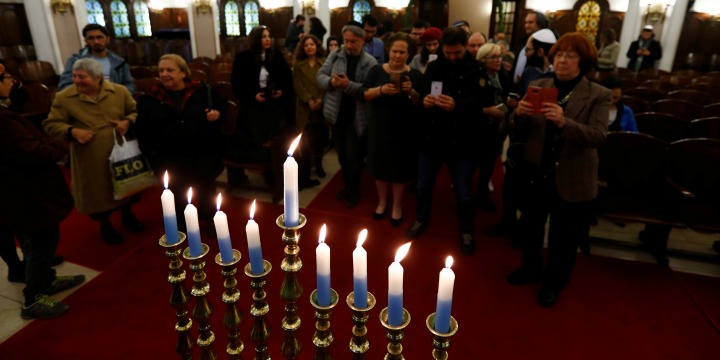
Members of Turkey’s Jewish community and visitors gather around a Hanukkah menorah during a celebration of the Jewish holiday of Hanukkah at Neve Shalom Synagogue in Istanbul, Turkey, Dec. 19, 2017. Photo: Reuters / Murad Sezer.

Ahead of this year’s celebration of Hanukkah, here are eight important facts about the holiday:

1. Hanukkah is the only Jewish holiday that commemorates an ancient national liberation struggle in the Land of Israel, unlike Passover, Sukkot/Tabernacles, and Shavuot/Pentecost, which commemorate the liberation from slavery in Egypt to independence in the land of Israel, and unlike Purim, which commemorates liberation from a Persian attempt to annihilate the Jewish people of Persia.

2. According to an NBC news report on December 13, 2022, “An ancient treasure trove of silver coins dating back 2,200 years, found in a desert cave in Israel, could add crucial new evidence to support a story of Jewish rebellion …. The 15 silver coins were hidden [during] the Maccabean revolt from 167-160 B.C., when Jewish warriors rebelled against the Seleucid [Syrian] Empire….”

3. In 1777, Hanukkah candles were lit by a Jewish soldier, during the Valley Forge encampment, the turning point of the Revolutionary War. Benjamin Rush, a signer of the Declaration of Independence and a player in the ratification of the US Constitution, wrote: “What shining examples of patriotism do we behold in Joshua, Samuel, the Maccabees and the illustrious princes and prophets among the Jews…”

4. According to Israel’s Founding Father, David Ben-Gurion: Hanukkah commemorates “the struggle of the Maccabees, which was one of the most dramatic clashes of civilizations in human history, not merely a political-military struggle against foreign oppression. … Unlike many peoples, the meager Jewish people did not assimilate. The Jewish people prevailed, won, sustained and enhanced their independence and unique civilization. … It was the spirit of the people, rather than the establishment, which enabled the Hasmoneans to overcome one of the most magnificent spiritual, political and military challenges in Jewish history…” (Uniqueness and Destiny, pp 20-22)

5. When ordered by Emperor Antiochus IV Epiphanes of the Seleucid region to end the Jewish “occupation” of Jerusalem, Jaffa, Gaza, Gezer, and Akron, Shimon the Maccabee responded: “We have not occupied a foreign land. … We have liberated the land of our forefathers from foreign occupation (Book of Maccabees A: 15:33).”

Hanukkah highlights the centrality of the Land of Israel in the formation of Judaism and the Jewish people. The mountain ridges of Judea and Southern Samaria (the West Bank) — the cradle of Jewish history, religion, culture and language — were the platform for the Maccabean military battles.

6. Hanukkah’s historical context is narrated in the Four Books of the MaccabeesThe Scroll of Antiochus, and The Wars of the Jews.

In 323 BCE, following the death of Alexander the Great (Alexander III, who held Judaism in high esteem), the Greek Empire was split into three independent and rival mini-empires: Greece, Seleucid/Syria, and Ptolemaic/Egypt.

In 175 BCE, the Seleucid/Syrian Emperor Antiochus (IV) Epiphanes claimed the Land of Israel. He suspected that the Jews were allies of his Ptolemaic/Egyptian enemy. The Seleucid emperor was known for eccentric behavior, hence his name, Epiphanes, which means “divine manifestation.” He aimed to exterminate Judaism and convert Jews to Hellenism. In 169 BCE, he devastated Jerusalem, attempting to decimate the Jewish population, and outlaw the practice of Judaism.

In 166/7 BCE, a Jewish rebellion was led by the non-establishment Hasmonean (Maccabee) family from the rural town of Modi’in, half-way between Jerusalem and the Mediterranean. The rebellion was led by the head of the family and his five sons, Yochanan, Judah, Shimon, Yonatan, and Eleazar, who fought the Seleucid occupier and restored Jewish independence. The Hasmonean dynasty was replete with external and internal wars and lasted until 37 BCE, when Herod the Great (a proxy of Rome) defeated Antigonus II Mattathias.

7. As was prophesized by the Prophet Hagai in 520 BCE, the re-inauguration of the Temple took place on the 25th day of the Jewish month of Kislev, which is the month of miracles, such as the post-flood appearance of Noah’s rainbow, the completion of the construction of the Holy Ark by Moses, the laying of the foundations of the Second Temple by Nehemiah, etc. The 25th Hebrew word in Genesis is “light,” and the 25th stop during the Exodus was Hashmona (the same Hebrew spelling as Hasmonean-Maccabees).

8. Hanukkah highlights the defeat of darkness, forgetfulness, disbelief, and pessimism, and the victory of light, commemoration, faith, defiance of odds, can-do mentality, and optimism. The first day of Hanukkah is celebrated when daylight hours are equal to darkness hours — and when moonlight is hardly noticed — ushering in brighter days.


The author is a commentator and former Israeli ambassador.


Zawartość publikowanych artykułów i materiałów nie reprezentuje poglądów ani opinii Reunion’68,
ani też webmastera Blogu Reunion’68, chyba ze jest to wyraźnie zaznaczone.
Twoje uwagi, linki, własne artykuły lub wiadomości prześlij na adres:
webmaster@reunion68.com


Stop Letting Israel’s Enemies Write the Dictionary


Stop Letting Israel’s Enemies Write the Dictionary

David E. Firester


The Western Wall and Temple Mount in Jerusalem. Photo: Wikimedia Commons.

When people chant “From the river to the sea,” they pair it with familiar phrases: “Palestinian” land, “occupied Palestinian territories,” “indigenous Palestinians,” and “settler-colonial Jews.”

Most people argue about the slogans and maps. Far fewer ask a prior question: Who wrote the dictionary that makes those slogans sound plausible?

For decades, Israel’s enemies have understood something many Jews and Israel-supporters have missed: if you control the language, you control the story. Define the key terms and you can turn an ancient indigenous people into supposed foreign invaders and recast repeated wars of annihilation against Israel as “anti-colonial resistance.”

To say that “Palestinian” is a political brand is not to deny that there are real Arabic-speaking people who today live under that name. The question is how this identity was framed and to what end.

During the latter half of the 20th century, “Palestinian” was carefully positioned as the indigenous victim of Zionist “intruders,” even though the Jewish people’s presence in the Land of Israel predates Islam, Arab nationalism, and the modern state system by millennia.

For centuries, under various empires, Jews and Arabs lived in the broader region that Europeans later (and briefly) called “Palestine.”

There was no sovereign “Palestinian” state and no distinct “Palestinian” nationality in the modern sense. Those constructs were shaped in the mid-20th century as part of a strategy to turn repeated Arab attempts to destroy the Jewish State into a moral story of dispossession.

“Palestinian” was not simply discovered; it was branded, a label that let Arab leaders and their allies invert reality: the side that tried, again and again, to wipe out the Jews of Israel would now be cast as the timeless victim of “foreign” Jews who supposedly have no home there at all.

How “occupied Palestinian territories” rewrites history

The phrase “occupied Palestinian territories” flows off the tongue so easily that people rarely ask what it means.

Before 1967, Judea and Samaria were annexed by Jordan, and the Gaza Strip was under Egyptian control. Neither Arab state created a sovereign “Palestinian” entity there.

Before that, the area was “owned” by the British Mandate, and before that, the Ottoman Empire. There has never been an independent “Palestinian” state whose recognized sovereign territory Israel is supposedly occupying.

Yet by repeating “occupied Palestinian territories,” these activists import a package deal: that there once was a “Palestinian” state; that the land in question is inherently and exclusively “Palestinian,” despite its deep Jewish history; and that Israel’s presence there is automatically illegal, regardless of how it came about or what the real legal debates are.

The phrase “occupied Palestinian territories” is not neutral; it is a weapon. It erases Jewish indigeneity to places whose Hebrew names — Judea and Samaria — tell their own story. It suggests that Jews crossing an invisible line on the western bank of the Jordan River are “settlers,” while Arabs are always “natives,” no matter when their families arrived. On campus and in much of the media, this vocabulary is treated as settled fact. But that’s not truth — it’s narrative.

From the seminar room to the street

Weaponized language does not stay confined to UN resolutions or academic journals. It shapes how ordinary people think and feel. When a student hears, year after year, that Israel is a “settler-colonial” project oppressing “indigenous Palestinians,” he or she is being given a moral script: Jews are the guilty party; Arab violence is an understandable reaction to “occupation”; and terrorism against Jews is justified “resistance.”

So what can be done? We cannot force hostile actors to abandon terms that serve their agenda. But we can stop doing their work for them.

First, we must recognize that words like “Palestinian,” “occupation,” and “settler-colonialism” are not neutral. They come packaged with stories about history, power, and morality. If those stories are false or one-sided, we have a responsibility to say so.

Second, we should speak accurately about the land itself. Instead of reflexively saying “West Bank,” we can talk about Judea and Samaria, or at least about disputed territories captured in a defensive war, rather than “occupied Palestinian territories.” Rather than treating “Palestinian” as a synonym for indigeneity, we can speak of Arab residents of Judea and Samaria and Arab Israelis, alongside Jewish communities with deep roots there. Third, we should unapologetically affirm Jewish indigeneity. Jews are not recent “European imports” into the Middle East. Our ancestral language, scriptures, and rituals are woven into the geography of Israel itself. The burden of proof should not rest on Jews to justify their presence in Jerusalem, Hebron, or Shiloh.

Finally, communal leaders, journalists, and educators must become more intentional about the language they use. It is not pedantic to insist on accurate terminology. It is strategic.

If we care about truth — and about the safety and legitimacy of the Jewish people — we cannot afford to keep speaking in our adversaries’ vocabulary. In every generation, Jews have had to push back against efforts to write us out of our own story. Today, that effort happens with hashtags, slogans, and selective “human rights” language, as much as with bullets and rockets.

We do not have to accept a dictionary written by those who want to annihilate us. We can tell the truth plainly: Jews are indigenous to the Land of Israel, and we will not surrender that reality to anyone’s branding campaign — no matter how sophisticated their propaganda might be.


David E. Firester, Ph.D., is the Founder and CEO of TRAC Intelligence, LLC, and the author of Failure to Adapt: How Strategic Blindness Undermines Intelligence, Warfare, and Perception (2025).


Zawartość publikowanych artykułów i materiałów nie reprezentuje poglądów ani opinii Reunion’68,
ani też webmastera Blogu Reunion’68, chyba ze jest to wyraźnie zaznaczone.
Twoje uwagi, linki, własne artykuły lub wiadomości prześlij na adres:
webmaster@reunion68.com