
Archive | April 2026

Why Qatar’s Al-Jazeera Should be Banned


Why Qatar’s Al-Jazeera Should be Banned

Bassam Tawil


  • Equally disturbing is the role of Al-Jazeera itself. Owned, funded, and controlled by the government of Qatar, Al-Jazeera, particularly its Arabic-language channel, has long provided a platform for Hamas and the Muslim Brotherhood movement. Its coverage frequently echoes Hamas and Muslim Brotherhood narratives, and amplifies anti-Israel propaganda and antisemitic rhetoric.
  • Reports by the Middle East Media Research Institute (MEMRI) have documented Al-Jazeera providing a platform for guests who assert that Jews are “enemies of Muslims and all humanity” or that they control global affairs.
  • “Among the Islamist terrorist organizations that Qatar and Al-Jazeera have supported over the years are the Muslim Brotherhood, Al-Qaeda, the Taliban, Hizbullah, the Al-Nusrah Front/ Hay’at Tahrir Al-Sham, ISIS, Hamas, and even the Shiite Iranian proxies in Yemen, Ansar Allah (the Houthis), which are currently engaged in direct conflict with the U.S. and other Western countries.” — Yigal Carmon, MEMRI, May 6, 2024.
  • “According to its website, Al-Jazeera has ‘over 70 bureaus around the globe’ and is ‘one of the largest and most influential international news networks in the world’…. Between 2004 and 2020, AJ+ Facebook videos had been viewed over 10 billion times, and it had amassed over 11 million followers on Facebook.” — Yigal Carmon, MEMRI, May 6, 2024.
  • “Al Jazeera just surpassed CNN and BBC as the world’s most-watched international news network. Its Arabic channel hit 400 million weekly viewers.” — Pakistani commentator Amna Kausar, March 2026.
  • “Since the October 7 attack… The network has been operating as a propaganda outlet in the service of Hamas 24/7, with hardly any coverage of other topics. The channel expresses unreserved support for Hamas, justifying the deadly attack, showing footage of it obtained from the body-cams of the terrorists, and celebrating it as a victory that has brought pride and honor to the Islamic nation.” — Yigal Carmon, MEMRI, May 6, 2024.
  • Given the mounting allegations of links between Al-Jazeera and terrorist organizations, policymakers should consider decisive steps, formally designating Al-Jazeera as an entity that supports terrorism.

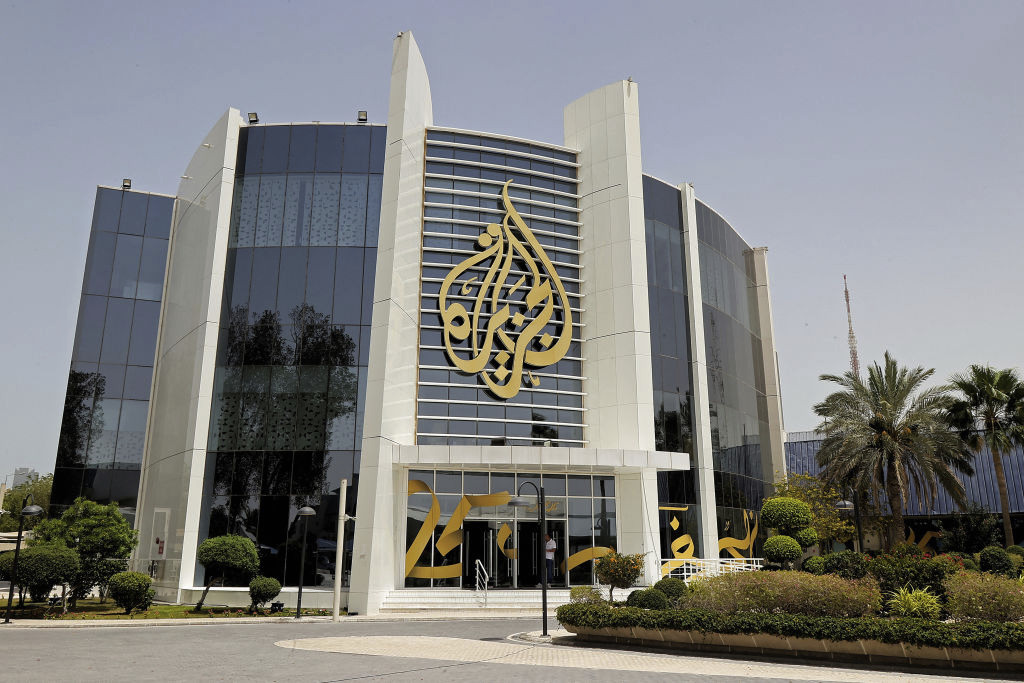
Given the mounting allegations of links between Al-Jazeera and terrorist organizations, policymakers should consider decisive steps, formally designating Al-Jazeera as an entity that supports terrorism. Pictured: The headquarters of Al-Jazeera in Doha, Qatar. (Photo by Karim Jaafar/AFP via Getty Images)

The death of another Palestinian “journalist” working for Qatar’s Al-Jazeera TV empire has once again triggered outrage and drawn condemnations from some in the international community. Yet those who rushed to denounce Israel for targeting the Gaza-based “journalist” are ignoring voluminous evidence that he and some of his Palestinian colleagues were, in fact, active members of terrorist organizations.

According to the Israel Defense Forces (IDF), Mohammed Wishah, an Al-Jazeera “reporter” killed in an April 8 Israeli airstrike, was not merely a media figure. He was a “key terrorist” in Hamas’s military wing, Izz a-Din al-Qassam, and was involved in weapons production, including rockets and drones, and actively planning attacks against Israeli soldiers and the State of Israel.

According to Israeli intelligence, Wishah exploited his job as a journalist as a cover, an operational shield that allowed him to move, gather intelligence, and advance terrorist activities under the protection of press credentials. In a statement on April 9, the IDF wrote:

“The terrorist contributed to Hamas’ force build-up efforts, was actively involved in planning attacks against IDF troops, and posed a concrete threat to forces in the area. Prior to the strike, steps were taken to mitigate harm to civilians, including the use of precise munitions, aerial surveillance, and additional intelligence.”

About two years ago, the IDF revealed that during a search at a Hamas base in northern Gaza, a laptop belonging to Wishah was seized. The laptop contained images and intelligence materials linking him to Hamas. An IDF spokesperson said at the time:

“Findings from the computer indicate that in addition to his role as a ‘journalist,’ Muhammad, born in 1986 from Al-Bureij, is a senior military operative in Hamas’ anti-tank missile array, and by the end of 2022 had moved to research and development of aerial weapons for the terrorist organization…. analysis of the computer found several weeks ago includes images linking him to his activity in Hamas”

Wishah is not the first terrorist to operate in the Gaza Strip under the guise of a “journalist.”

More than half of the Palestinian “journalists” killed in the Gaza Strip during the Israel-Hamas war, triggered by the October 7, 2023 Hamas-led invasion of Israel, were affiliated with terrorist organizations, according to a study by the Meir Amit Intelligence and Terrorism Center.

“An analysis of the identity of the 131 journalists revealed that least 78 (more than 59%) were active in or affiliated with a terrorist organization. Among them were 13 prominent members of a terrorist organization, Fatah or the Palestinian Authority. Of them 13 were overtly terrorist operatives belonging to Hamas, the Palestinian Islamic Jihad, the al-Aqsa Martyrs’ Brigades and the Popular Resistance Committees, the Popular Front for the Liberation of Palestine, the Democratic Front for the Liberation of Palestine, Fatah and the Palestinian Authority….

“Of the 78 journalists identified as having organizational affiliation, 44 were identified with Hamas…. Nineteen were affiliated with PIJ… One was an al-Aqsa Martyrs’ Brigades operative and another a Popular Resistance Committees operative. Two were affiliated with the Fronts, one with the Popular Front for the Liberation of Palestine and the other the Democratic Front for the Liberation of Palestine.”

Wishah was not the only Al-Jazeera terrorist masquerading as a journalist.

In August 2025, the IDF conducted a precise strike in Gaza City targeting Anas al-Sharif, a Hamas terrorist who posed as a journalist for Al-Jazeera. Al-Sharif, head of a Hamas terror cell, was responsible for facilitating and advancing rocket attacks against Israeli civilians and IDF forces. Intelligence and documents recovered in the Gaza Strip, including personal rosters, training lists, phone directories and salary records, confirmed his operational position within Hamas and his integration into the Al-Jazeera network.

Wishah and al-Sharif were not alone. Several Palestinian “journalists,” including some affiliated with Al-Jazeera, have in recent years been exposed as members of Hamas or PIJ. Among them:

    • Ismail Abu Omar, an Al-Jazeera “journalist” and Hamas operative who served as commander of the terror group’s Eastern Battalion;
    • Hossam Shabat, a Hamas sniper who exploited his role as an Al-Jazeera “journalist” and carried out terrorist attacks against IDF troops and Israeli civilians;
    • Ismail al-Ghoul, an Al-Jazeera “journalist” who served as an engineer in the Hamas Gaza City Brigade and took part in the October 7 massacre against Israelis and foreign nationals.

These cases demonstrate a disturbing pattern: the systematic exploitation of journalism by Palestinian terrorist groups. This cynical tactic endangers genuine journalists who risk their lives covering the Israeli-Palestinian conflict. When terrorists masquerade as journalists, they blur the line between civilian and combatant, making it more difficult to distinguish between the two.

Those who condemn Israel over the death of such “journalists” would do well to direct their outrage where it truly belongs: at Hamas and other terrorist organizations that deliberately exploit the protections afforded to journalists under international law. Those who genuinely care about press freedom should be the first to condemn its exploitation by terrorists.

Equally disturbing is the role of Al-Jazeera itself. Owned, funded, and controlled by the government of Qatar, Al-Jazeera, particularly its Arabic-language channel, has long provided a platform for Hamas and the Muslim Brotherhood movement. Its coverage frequently echoes Hamas and Muslim Brotherhood narratives, and amplifies anti-Israel propaganda and antisemitic rhetoric.

Reports by the Middle East Media Research Institute (MEMRI) have documented Al-Jazeera providing a platform for guests who assert that Jews are “enemies of Muslims and all humanity” or that they control global affairs.

In May 2024, MEMRI reported:

“Prime Minister Benjamin Netanyahu vowed to shut down the Qatar-funded Al-Jazeera channel’s operations in Israel, calling it a ‘terror channel,’ and Israel Communications Minister Shlomo Karhi said it would be shut down because it acts as ‘a propaganda arm of Hamas’ by ‘encouraging armed struggle against Israel.’ The outlet was shut down and taken off the air in Israel on May 5….

“Among the Islamist terrorist organizations that Qatar and Al-Jazeera have supported over the years are the Muslim Brotherhood, Al-Qaeda, the Taliban, Hizbullah, the Al-Nusrah Front/ Hay’at Tahrir Al-Sham, ISIS, Hamas, and even the Shiite Iranian proxies in Yemen, Ansar Allah (the Houthis), which are currently engaged in direct conflict with the U.S. and other Western countries….

“Al-Jazeera was the prime power for toppling the secular authoritarian regime in Egypt, when Qatar, by means of Al-Jazeera, supported the Muslim Brotherhood in ousting then Egyptian president Hosni Mubarak. Al-Jazeera, the single most significant platform for mainstreaming jihadi and Muslim Brotherhood ideology, was the power that accorded Mohamed Morsi his victory….

“According to its website, Al-Jazeera has ‘over 70 bureaus around the globe’ and is ‘one of the largest and most influential international news networks in the world….'”

“Between 2004 and 2020, AJ+ Facebook videos had been viewed over 10 billion times, and it had amassed over 11 million followers on Facebook.”

Pakistani commentator Amna Kausar wrote last month:

“Al Jazeera just surpassed CNN and BBC as the world’s most-watched international news network. Its Arabic channel hit 400 million weekly viewers.”

Al-Jazeera Arabic has repeatedly broadcast speeches by senior Hamas figures, such as Khaled Mashaal, Ismail Haniyeh, Saleh al-Arouri, Mohammed Deif and Khalil al-Hayya. They praised “resistance” (terrorism) and demanded continued armed struggle against Israel. On the very morning of the October 7, during the Hamas-led invasion of Israel, while terrorists were torturing and murdering more than 1,200 Israelis and others, and took more than 250 as hostages — Al-Jazeera provided Hamas military commander Mohammed Deif with an exclusive television appearance — to broadcast that this was just the “first strike” and incited Arabs inside Israel to “join the war , using all means in their possession – guns, knives, Molotov cocktails, and vehicles.”

Haniyeh issued a statement on Al-Jazeera in which he described the October 7 massacre as a “great triumph” and called to expand the operation to the West Bank and to within the pre-1967 borders of Israel. On the same day, Al-Jazeera broadcast a speech by al-Arouri, deputy chairman of the political bureau of Hamas, in which he threatened that “the storming of the Zionist settlements and bases in the Gaza Envelope will pale compared to what may happen to them [Israelis].”

During the Hamas-Israel war, Al-Jazeera not only reported and relayed Hamas’s announcements; according to the Meir Amit Intelligence and Terrorism Information Center, it became an integral part of the Hamas influence, propaganda, and psychological warfare machine:

“Across all its platforms, Al Jazeera spread the psychological warfare materials produced by the Combat Media Unit of Hamas’ Izz al-Din al-Qassam Brigades, which allegedly documented ambushes and attacks on IDF forces.”

In many cases, Hamas’s military wing even used Al-Jazeera Arabic to announce attacks on IDF troops, such as:

“Urgent – Al-Qassam Brigades: shortly… footage from the ‘Lion of al-Mantar’ ambushes of the enemy’s soldiers and vehicles in the al-Shuja’iyya neighborhood in eastern Gaza will be broadcast on Al Jazeera on 25-04-2025.”

Glorifying the October 7 massacre, the program “Ma Khafiya A’tham” (“What is Hidden is Greater”), hosted by journalist Tamer al-Mishal, dedicated to the October 7 massacre a series of episodes emphasizing Hamas propaganda, sometimes using videos provided exclusively to Al-Jazeera. One episode included a video of a disguised Hamas leader Yahya Sinwar, the mastermind of the massacre, conducting a field tour above ground. The episode also included pictures of Mohammed Deif, commander of the Hamas military wing, during the preparations for the October 7 attack. The program promoted the Hamas narrative that the massacre was a jihad justified by Islam, and that the “determination, heroism, and sacrifice” of the Palestinian people enabled the success of Operation Al-Aqsa Flood (the Hamas name for the October 7 attack).

MEMRI wrote in May 2024:

“Since the October 7 attack… The network has been operating as a propaganda outlet in the service of Hamas 24/7, with hardly any coverage of other topics. The channel expresses unreserved support for Hamas, justifying the deadly attack, showing footage of it obtained from the body-cams of the terrorists, and celebrating it as a victory that has brought pride and honor to the Islamic nation.”

For many years, Al-Jazeera hosted Islamist figures such as Yusuf al-Qaradawi his show “Sharia and Life,” where he issued fatwas (religious decrees) justifying Palestinian suicide bombings against Israel as a form of “jihad” and “defense.” In one interview, Qaradawi explained that in “legitimate martyrdom operations, people use their bodies to defend their country from occupiers.” He described suicide attacks as a form of divine justice, stating:

“Allah Almighty is Just; through His infinite Wisdom He has given the weak a weapon the strong do not have and that is their ability to turn their bodies into bombs as Palestinians do.”

Qaradawi also noted on his Al-Jazeera program in February 2013 that “If they [Muslims] had gotten rid of the apostasy punishment [death], Islam wouldn’t exist today.”

According to MEMRI:

“Al-Jazeera’s role in providing a platform for promoting extremist Islamist ideologies goes back decades. The case of promoting Al-Qaeda is of particular interest. Two months before 9/11, Al-Jazeera gave an Al-Qaeda spokesman, Sulaiman Abu Ghaith, free rein to speak uninterrupted for ten minutes, and to call for 12,000 mujahideen to join Al-Qaeda.

“Al-Jazeera employed a correspondent, Tayseer Allouni, who was sentenced in Spain to seven years in prison for transferring funds to Al-Qaeda – and Al-Qaeda even issued a public statement in his support. Al-Jazeera broadcast live the killing of a U.S. soldier by an Iraqi sniper – which could only have happened if the media network had coordinated with the perpetrators of the killing.

“As for ISIS – Al-Jazeera allowed a pledge of allegiance to its leader Abu Bakr Al-Baghdadi live on air. In the middle of a TV debate on Al-Jazeera’s flagship Arabic-language program, an Islamic scholar pledged allegiance to the leader of ISIS, the Emir of the Believers, while moderator Faysal Al-Qassem did nothing to stop him.”

In 2004, on Al-Jazeera, Anis al-Naqqash, a Lebanese militant and analyst, explicitly called for attacks against US oil companies and installations and labeled the US an enemy of humanity.

It is time for the US and other Western countries to undertake an urgent and thorough review of Al-Jazeera’s activities. Given the mounting allegations of links between Al-Jazeera and terrorist organizations, policymakers should consider decisive steps, formally designating Al-Jazeera as an entity that supports terrorism. 


Bassam Tawil is a Muslim Arab based in the Middle East.


Zawartość publikowanych artykułów i materiałów nie reprezentuje poglądów ani opinii Reunion’68,
ani też webmastera Blogu Reunion’68, chyba ze jest to wyraźnie zaznaczone.
Twoje uwagi, linki, własne artykuły lub wiadomości prześlij na adres:
webmaster@reunion68.com


Majority of Israelis Oppose Iran Ceasefire, Back Continued Campaign, Polls Find


Majority of Israelis Oppose Iran Ceasefire, Back Continued Campaign, Polls Find

Debbie Weiss


An Israeli air defense system intercepts a ballistic missile barrage launched from Iran to central Israel during the missile attack, March 1, 2026. Photo: Eli Basri / SOPA Images via Reuters Connect

A poll released ahead of Israel’s Holocaust Remembrance Day found that a majority of Israelis – 61 percent – oppose the ceasefire with Iran, despite nearly six weeks of missile fire, mass disruption, and repeated trips to shelters.

Some 73 percent of respondents in the poll conducted by the Institute for National Security Studies said they believe Israel will have to renew military action against Iran within the next year, while 76 percent said negotiations with the Islamic Republic would not accomplish the war’s stated aims of crippling Iran’s ballistic missile array, dismantling its nuclear weapons program, and bringing an end to the regime in Tehran

A separate survey by Agam Labs at the Hebrew University in Jerusalem pointed to even stronger opposition, with only 15 percent backing the ceasefire. Two-thirds said they oppose it. 

Two other polls, by Kan and Channel 13, suggested that only a minority of Israelis believe the US and Israel have won the war. In the Kan survey, roughly one-third said they view the outcome as a victory. In the Channel 13 poll, that figure fell to a quarter, while 40 percent said they do not know.

On Lebanon, more than 61 percent of Israelis said the truce with Iran should not be extended to include the fighting with Hezbollah, a condition Tehran has pushed in its talks with Washington, according to the Agam poll.

That was broadly in line with findings from the Israel Democracy Institute (IDI), which reported that four out of five Jewish Israelis believe Israel should continue its campaign against Hezbollah.

Arab Israelis, by contrast, stood well apart in all of the polling. They overwhelmingly indicated they support the ceasefire with Iran, and only a small minority, less than a fifth according to the IDI poll, back continuing the fighting against Hezbollah.

Although missile alerts have eased across much of Israel since the halt in launches from Iran, communities in the north are still coming under sustained fire, with sirens continuing around the clock. A Hezbollah rocket that was not intercepted struck Nahariya on Monday afternoon, causing heavy damage to a residential building and lightly injuring two people. Days earlier, rocket fire hit the remains of a 1,500-year-old Byzantine church in the northern Israeli city. 

The Lebanese and Israeli ambassadors to the United States are due to meet in Washington on Tuesday for discussions on the possibility of direct negotiations between the two countries. Hezbollah leader Naim Qassem called on Lebanon to cancel the meeting, accusing the Lebanese government on Monday of turning itself into “a tool for Israel.”

Israel’s former national security adviser Meir Ben-Shabbat warned that expectations for the talks should be limited, arguing that “security without an agreement is preferable to an agreement without security.” Ben-Shabbat, who now heads the Misgav Institute for National Security, warned that the Lebanese government is not capable of removing the threat posed by Hezbollah and would also be unable to grant Israel the operational freedom it would need to act independently. 

“The outcome of the negotiations may result either [in] an agreement lacking adequate security arrangements, or a crisis in which Israel is portrayed as refusing the demands of the Lebanese government,” he cautioned, adding that Israel should avoid making any security concessions before or during the talks.

The Israeli military said it had killed 250 Hezbollah operatives in a major operation in southern Lebanon in recent days, including more than 100 in the Bint Jbeil area alone, most of them in close-quarters combat. The Israel Defense Forces (IDF) said the battle for the southern Lebanese city, long considered a Hezbollah stronghold, was nearing its final stages. It added that some of the terrorists may have been preparing for an incursion into Israeli territory.

The IDF says the fighting has again exposed what it describes as Hezbollah’s entrenched use of civilian sites for military activity. According to the military, weapons are stored beneath homes and launchers are brought out into courtyards to fire toward Israel and then moved back inside. Israeli forces say they are working to identify those sites, destroy the weapons, and kill the operatives using them amid continuing clashes on the ground.

Bint Jbeil carries particular symbolic weight in the conflict. After Israel withdrew from southern Lebanon in May 2000, then-Hezbollah chief Hassan Nasrallah delivered a triumphal address at the city’s soccer stadium, using it as a stage to cast Israel as fragile and beatable.

“Israel has nuclear weapons and the most powerful air force in the region, but in truth, it is weaker than a spider web,” Nasrallah said at the time.

Brigadier General Guy Levy, commander of Division 98, addressed troops from the ruins of that same stadium, which was hit in the latest round of fighting: “In Bint Jbeil in 2000, someone made a speech here and bragged about spider webs. Today, that man does not exist, the stadium doesn’t either, and his words are worth nothing. Now our forces control the area, destroying terror infrastructure and dozens of terrorists.”

Writing on X, IDF Arabic-language spokesman Avichay Adraee said that “glory is not built with speeches, but with the impact of soldiers’ footsteps. Controlling the Bint Jbeil stadium is not merely a military achievement, but a dismantling of its arrogant symbolism.”


Zawartość publikowanych artykułów i materiałów nie reprezentuje poglądów ani opinii Reunion’68,
ani też webmastera Blogu Reunion’68, chyba ze jest to wyraźnie zaznaczone.
Twoje uwagi, linki, własne artykuły lub wiadomości prześlij na adres:
webmaster@reunion68.com


Assessing the ceasefire and the criticisms of Trump and Netanyahu


Assessing the ceasefire and the criticisms of Trump and Netanyahu

Alex Traiman


Pundits can claim that Iran and its terror proxies have won a war, even if it has no grounding in reality. If this is what Hamas, Hezbollah and Tehran consider a victory, then they should continue winning this way for the next 100 years.

Israeli Air Force and U.S. Air Force fighter jets fly together during a joint exercise. Credit: IDF Spokesperson’s Unit.

Despite pummeling Iran, the leaders of the world’s two strongest air forces are fending off criticism from political opponents amid a two-week ceasefire. Results on the battlefield appear to be taking a backseat to political machinations.

The analysis of wars is changing in the 24-hour media and social-media cycle. Tweets and press briefings can be more powerful weapons than missiles. How a particular post lands and reverberates can have just as powerful an influence on a war’s outcome.

Not so long ago, world leaders were not bombing via social media. This is particularly true of terror sponsors and their proxies. Public statements affect military posture. Wars—and, more importantly, the perception of wars—are judged mercilessly, minute-to-minute, by commentators without military experience and with limited understanding of how diplomacy actually works.

Pundits can claim that Iran and its terror proxies have won a war, and millions around the world can buy into a warped narrative, even when not grounded in reality.

Immense war gains

Even if the military operation ends with the current ceasefire, the gains have been immense.

Together, the air forces of the United States and Israel struck thousands of targets with precision. The air forces neutralized Iran’s known and covert nuclear sites, as well as its ballistic missile production facilities—the two prevailing objectives of the war.

The dual existential threats of a nuclear weapon and tens of thousands of ballistic missiles capable of overwhelming Israel’s multilayer missile defense appear to have been eliminated.

The United States reports that Iran’s ballistic missile and drone capabilities have been degraded by 90%. Additionally, the Israel Defense Forces report that 70% of Iran’s ballistic-missile launchers have been destroyed. Missiles cannot be fired without launchers, which are significantly more complex to produce than the missiles themselves.

‘Capital-V military victory’

U.S. Secretary of Defense Pete Hegseth said this week that “‘Operation Epic Fury’ was a historic and overwhelming victory on the battlefield, a capital-V military victory,” adding that it “decimated Iran’s military and rendered it combat-ineffective for years to come.”

U.S. President Donald Trump said the war had been a “total and complete victory. 100%. No question about it.”

British broadcaster Piers Morgan responded to Hegseth’s assessment by claiming that “America/Israel may have won the war on the battlefield, but Iran won the war on the waterways, paralyzed the world’s energy supplies, and caused huge global economic damage. That’s why President Trump has moved to do a deal. It’s not a ‘historic victory’ or anything like it.”

Other commentators have made similar claims.

Trump responded on Truth Social that “the Fake News Media has lost total credibility, not that they had any to begin with. Because of their massive Trump Derangement Syndrome (Sometimes referred to as TDS!), they love saying that Iran is ‘winning’ when, in fact, everyone knows that they are LOSING, and LOSING BIG!”

He cited the destruction of Iranian naval and air capabilities, air-defense systems, radar, and missile and drone factories, as well as the loss of senior leadership figures.

‘Battle is not yet over’

Israeli Prime Minister Benjamin Netanyahu has gone to great lengths to present the war gains to the Israeli public, but has stopped short of calling the campaign the “total victory” that he has vowed to lead at earlier points in the war, telling Israelis this week that “the battle is not yet over.”

Netanyahu stated that the war has provided “massive achievements,” calling it a “historic change,” noting that Israel and the United States “crushed the nuclear program. We crushed the missiles, and we crushed the regime.”

Many Israelis are wary that a ceasefire is a good idea or can hold beyond the stated two-week time frame—even as Israeli parents are glad to send their children back to school after a six-week hiatus.

Within Israel, longtime opponents of Netanyahu have been quick to call the ceasefire a defeat for the allies.

Opposition leader Yair Lapid called the ceasefire a “military success turned into a diplomatic disaster.” This is the same Lapid, who in October 2022—while serving as a temporary caretaker prime minister with limited powers ahead of an election—gave away a valuable strategic natural gas reserve in strategic waters to Lebanon, to supposedly “stave off” a war with Hezbollah.

A senior defense correspondent for Israel’s Channel 13 said that Netanyahu’s claims that Iran is weaker than ever are “half-truths,” alleging that “Iran came out stronger from this war” and has emerged as a regional power.

It is no coincidence that those who have been criticizing Netanyahu for years are the ones criticizing him now. Israel is heading to an election before the end of the year.

Israel’s major diplomatic achievement

Flying side-by-side for six weeks with the U.S. Air Force—the most powerful in the world by orders of magnitude—against a common enemy represents a major diplomatic achievement for Israel. It reflects decades of efforts by Netanyahu to strengthen U.S.-Israel ties and highlight the dangers posed by a nuclear Iran.

There is no way that Israel could have possibly achieved the level of destruction inflicted on Iran on its own without the United States. Aside from military bases across the region, aircraft carriers, naval attack vessels and fighter jets, the United States brought dozens of refueling planes into the theater.

Israel, by contrast, has only a limited refueling fleet. Throughout the military campaign, Israeli jets were continuously connected to American refueling planes over the region. Without that refueling capacity, Israel would have been able to fly just a fraction of sorties.

What the two air forces accomplished together would have taken Israel months had it gone alone. And Israel likely would have been forced to absorb incoming ballistic missiles for the duration.

Israeli resilience

The resilience of the Israeli home front is a significant component of the nation’s defense, and a critical calculation when determining the length of any campaign. Israel’s ability to sustain an extended war is directly linked to the civilian population’s readiness to head in and out of bomb shelters.

Israelis put up valiantly with Iran’s ballistic-missile fire. But parents of school-age children were celebrating when the ceasefire was reached, and the homefront command announced that school would resume after a six-week hiatus.

Bombing alongside the United States shortened the campaign’s timeframe dramatically.

Any Israeli prime minister would have chosen to bomb together with America, even if it was known from the outset that the United States would only commit to a conflict of four to six weeks, and possibly end the campaign before a complete Iranian surrender.

Those who criticize Netanyahu for the (so-far temporary) ceasefire that Trump declared take for granted that Trump committed to fly alongside Israel to begin with.

Furthermore, the notion that Israel was blindsided by the ceasefire declared in place by Trump is absurd. The level of coordination, both military and diplomatic, between the two allies is unprecedented. Earlier in the conflict, Netanyahu and Trump each intimated that they were speaking on a daily basis.

Israel as a top-flight ally

Bombing side by side with the United States has had benefits beyond the Iranian theater. Firstly, the United States has seen firsthand how exceptional Israel’s air force is. America has been duly impressed with Israel’s pilots—not a single Israeli plane or pilot was lost in six weeks of war.

Plus, America has marveled at Israeli upgrades to the American-made hardware it uses. This includes significant software enhancements, as well as the rigging of Israel’s F35i Adir fighter jets to carry more fuel, dramatically extending the plane’s flight range.

Israel has also demonstrated how valuable it is as an intelligence gatherer and provider. The United States has relied heavily on Israeli intelligence, including on its own portion of air missions. It is widely believed that Israeli intelligence in the Middle East is at far-superior levels to that of the United States.

Hegseth has repeatedly praised Israel’s performance as an ally, particularly notable given its relatively small size compared to the United States. Israel, with only 10 million citizens, is the size of just one of America’s smallest states: New Jersey.

Former Israeli Ambassador to the United States Ron Dermer often posited that Israel would prove to be America’s most important ally in the current decade. Those predictions have never proved more prescient.

Many choose to grade U.S.-Israel relations on the political relationships between Netanyahu and Trump, Speaker of the House Mike Johnson and Republicans on one side versus Netanyahu and former presidents Barack Obama and Joe Biden, former Vice President Kamala Harris and Democrats on the other side. Yet, this is a short-sided understanding of the relationship.

Deep behind the politics is a military-intelligence alliance unlike any other. No American ally could have possibly flown as competently alongside the U.S. Air Force and provided as much valuable intelligence as Israel. As much as Israel-bashers would like for America to distance itself from the Jewish state, the joint air campaign further cements the alliance.

‘Roaring Lion,’ not paper tiger

Beyond Washington, other countries are closely watching Israel’s military performance. Joint operations with the United States have strengthened Israel’s reputation as a regional power. Israel’s adversaries have observed that the Jewish state is a “Roaring Lion”—the name of Israel’s operation—rather than a paper tiger. Gulf states are likely to take note of Israel’s demonstrated willingness to defend regional security interests.

Israel’s prowess and capabilities stand in stark comparison to those of European nations.

Trump and Secretary of State Marco Rubio have expressed their profound disappointment with European powers, particularly the United Kingdom, France and Spain, while the United States is threatening the breakup of the NATO alliance and shuttering American bases across Europe.

Yet European powers, in particular Germany, are signing up not only to utilize Israel’s proven, sophisticated missile defense systems, but even to manufacture Israeli interceptors. Spoiler: even Spain, one of the most vocal Israel bashers, contracts advanced Israeli weapons systems via Germany.

The ceasefire may not hold

Meanwhile, the war may not be over. Even if the ceasefire holds longer than the proposed 14-day window, fighting may resume in the not-too-distant future.

Trump declared a 14-day ceasefire to give Iran the chance to negotiate a way out of the punishment it has absorbed for the past six weeks. But negotiations between Trump and Iran have a recent track record of ending without a settlement, followed by an immediate military campaign.

Back in April 2024, Trump gave Iran a 60-day window to negotiate the end to its nuclear program. On the 61st day, the “12-day war” was underway. Israel launched “Operation Rising Lion,” which culminated with America’s “Operation Midnight Hammer” and the bombing of Iran’s nuclear facilities at Fordow, Natanz and Isfahan.

In February, after America and Israel watched Iran attempt to restart its nuclear program and accelerate its ballistic-missile production, Trump again gave Iran 10 days to negotiate. When negotiations broke down, “Operation Epic Fury” was launched.

The president is now giving Iran 14 days to negotiate. For Iran, the third time may not be the charm.

Possible benefits of negotiations

Entering into negotiations—however likely or unlikely they are to succeed—may provide benefits. For one, America wants to figure out how badly the chain of command in Iran was broken and if the faction it is currently negotiating with has consolidated control over the country.

If Iran completely stops firing ballistic missiles and drones across the region and allows boats to sail unimpeded through the Straits of Hormuz for 14 days, then it is clear they are in control. Once control is established, negotiations can determine whether Iran’s new top leaders are more reasonable actors.

Trump would be pleased if the new top echelons recognize that nuclear ambitions and ballistic missiles will be the permanent downfall of the Islamic Republic. As Netanyahu stated during previous rounds of negotiations with Iran, as well as with Hamas, either they can disarm the easy way or be disarmed the hard way.

Shifting leverage

Where Netanyahu may have exhibited a tactical edge over Trump is that he has consistently favored negotiating while the enemy remains under fire. Trump and Hegseth have insisted that Iran “begged” America for a ceasefire. That may be true. But the moment a ceasefire is declared, Iran’s perceived leverage changes.

Iran’s leaders may now be hedging that Trump is as eager for the war to stop as they are. In their view, that levels the playing field. It may soon prove to be a deadly gamble, and fighting may quickly resume.

Yet at the same time, statements made in public often differ substantially from closed-door realities. Iran’s present leadership may prove to be slightly more reasonable than their predecessors.

Of course, even if a diplomatic accommodation is reached, in the Middle East, negotiated settlements are often not worth the paper they are printed on. See: Iran’s signing of the Nuclear Non-Proliferation Treaty.

Opponents who never admit defeat

Washington and Jerusalem are confronting adversaries with a culture of martyrdom. To those who relish martyrdom and ideology, death and destruction do not equal downfall in their calculation. They refuse to admit defeat, even when punished to the point of near-obliteration.

Take Hamas in Gaza, for example. In a two-year military campaign since the terrorist operatives invaded and attacked southern Israel on Oct. 7, 2023, the IDF has destroyed 70% of the buildings in the Strip. Most of Gaza’s population lives in tents.

Hamas no longer has rockets to fire at Israel. More than half of the terror-tunnel infrastructure it built, much of it funded by Tehran, has been destroyed. Hamas poses zero military threat to the Israeli home front and won’t for many years. Israel now controls more than half of the entire Gaza Strip.

But Hamas claims to have won because a few thousand terrorists still run around with machine guns and continue to dominate the suffering, unarmed population.

If this is what Hamas, Hezbollah and the Islamic Republic of Iran consider a victory, then they should continue winning this way for the next 100 years.

On the road to regime change?

For Israel, a major stated goal was regime change. The opening strike of the war eliminated Supreme Leader Ayatollah Ali Khamenei. Unlike the killing of Hamas leader Yahya Sinwar and the assassination of Hezbollah Chief Hassan Nasrallah, Khamenei was an official head of state. Israel similarly assassinated Secretary of the Supreme National Security Council Ali Larijani and numerous other members of Iran’s repressive and fanatical leadership.

As of this writing, it appears that a remnant of the regime remains. What is not known is how long they will be able to hold on to power.

The regime held in place by the Islamic Revolution Guards Corps was already at its weakest point in decades before Operation Epic Fury. Supporters and critics of the war alike posited that it was unreasonable to expect regime change from the air. Unwilling or unable to place troops inside Iran to fight the IRGC on the ground, it remains to be seen whether the regime will ultimately crash.

If it is to fall, it will be at the hands of the Iranians themselves. Millions protested against the regime earlier this year, with the IRGC and Basij shock troops mowing down tens of thousands of defenseless protesters.

Throughout the air campaign, Iranians were urged by Israel, the United States and former Crown Prince of Iran Reza Pahlavi to stay out of the streets. If the ceasefire holds, calls may come for Iranians to resume domestic protests and riots.

Arming the opposition

Just as in Gaza, where Hamas continues to cling to power due to its monopoly on machine guns, the IRGC maintains a significant coercive capacity inside Iran. Trump intimated last week that the United States had attempted to provide weapons to Iranian opposition elements, possibly through Kurdish intermediaries, but that the weapons did not reach their intended recipients.

In a statement to reporters, Trump stated that America had sent “a lot of guns” that were “supposed to go to the people so they could fight back against these thugs.”

He went on to accuse the transfer agents of not delivering the weapons to their intended destination. “The people that they sent them to kept them,” adding, “So I’m very upset with a certain group of people, and they’re going to pay a big price for that.”

Hopefully, the guns will soon find their intended destination. Should the regime fall in the months ahead, all of Israel’s goals would have been reached.


Alex Traiman is the CEO and Jerusalem bureau chief of the Jewish News Syndicate (JNS) and host of “Jerusalem Minute.” A seasoned Israeli journalist, documentary filmmaker and startup consultant, he is an expert on Israeli politics and U.S.-Israel relations. He has interviewed top political figures, including Israeli leaders, U.S. senators and national security officials with insights featured on major networks like BBC, Bloomberg, CBS, NBC, Fox and Newsmax. A former NCAA champion fencer and Yeshiva University Sports Hall of Fame member, he made aliyah in 2004, and lives in Jerusalem with his wife and five children.


Zawartość publikowanych artykułów i materiałów nie reprezentuje poglądów ani opinii Reunion’68,
ani też webmastera Blogu Reunion’68, chyba ze jest to wyraźnie zaznaczone.
Twoje uwagi, linki, własne artykuły lub wiadomości prześlij na adres:
webmaster@reunion68.com

Seminarium naukowe EHRI: “Precz z Żydami!! czyli co obnaża zakopiańska mikrohistoria”


Seminarium naukowe EHRI: “Precz z Żydami!! czyli co obnaża zakopiańska mikrohistoria”

Żydowski Instytut Historyczny im. Emanuela Ringelbluma


Zakopane to na mapie Polski miejsce wyjątkowe: odcięta od świata podhalańska wioska, otoczona „bajecznym światem Tatr”, która stała się „perłą Polski i jej płucami” opisaną w nieprzebranej ilości literatury. Tym, na co zwróciłam uwagę jako pierwsza, była historia ocalałych z Zagłady żydowskich dzieci atakowanych i prześladowanych w Zakopanem zaraz po wojnie.

Aby poznać przyczynę, dla której w tej idyllicznej, ale i idealizowanej niewielkiej miejscowości żydowski sierociniec musiał mieć ochronę i karabiny na werandach odsłaniałam kolejne warstwy i elementy historii, którą okazał się projekt „odżydzenia” Zakopanego propagowany i realizowany od momentu jego odkrycia, angażujący przedstawicieli ogólnonarodowych elit kulturalnych i politycznych, władze lokalne i miejscowych aktywistów oraz górali. W swoim wystąpieniu omówię hasła głoszone, wykrzykiwane, wypisywane i omawiane na salonach w Zakopanem lat trzydziestych i czterdziestych. Opowiem o ich twórcach, propagatorach i działaniach, które podejmowali w imię walki z „zażydzeniem” lub dla swoich korzyści płynących z „odżydzenia” Zakopanego w czasie Zagłady i zaraz po niej.

Karolina Panz – dr, socjolożka, członkini Centrum Badań nad Zagładą Żydów, adiunkta w Instytucie Slawistyki PAN. Mieszka na Podhalu, od kilkunastu lat bada losy tamtejszych Żydów w czasie Zagłady i okresie powojennym oraz angażuje się w działania na rzecz przywracania pamięci o nich. Wielokrotnie nagradzana za działalność społeczną i odwagę w poruszaniu trudnych tematów historycznych. W 2020 r. jej dysertacja o Żydach Nowego Targu zdobyła I nagrodę w Konkursie im. Majera Bałabana na najlepszą pracę doktorską o Żydach i Izraelu oraz I nagrodę w Konkursie im. Inki Brodzkiej-Wald na najlepszą pracę doktorską z dziedziny humanistyki. Stypendystka Claims Conference Saul Kagan Fellowship in Advanced Shoah Studies (2024/2025). Obecnie kieruje projektem NCN „Oblicza przemytu na pograniczu polsko-słowackim w latach 1918-1949”. Ostatnio ukazała się jej książka: Chciałabym opowiedzieć, jak zginęło miasto…. Zagłada żydowskich mieszkańców Nowego Targu”.


Seminarium organizowane jest w ramach EHRI-PL i dofinansowane ze środków Ministerstwa Kultury i Dziedzictwa Narodowego na zadanie „Działania bieżące Polskiego Węzła Krajowego EHRI-PL – konsorcjum EHRI-ERIC realizowane przez Żydowski Instytut Historyczny im. Emanuela Ringelbluma [ŻIH] na lata 2025– 2027 wraz z partnerami krajowymi”.


Zawartość publikowanych artykułów i materiałów nie reprezentuje poglądów ani opinii Reunion’68,
ani też webmastera Blogu Reunion’68, chyba ze jest to wyraźnie zaznaczone.
Twoje uwagi, linki, własne artykuły lub wiadomości prześlij na adres:
webmaster@reunion68.com

Israeli Artist Forced to Close Mexico City Exhibit for ‘Safety Reasons’ After Antisemitic Harassment, Vandalism


Israeli Artist Forced to Close Mexico City Exhibit for ‘Safety Reasons’ After Antisemitic Harassment, Vandalism

Shiryn Ghermezian


Pro-Palestinian protesters and vandals hold a flag during a demonstration against Amir Fattal, an openly Zionist Israeli graphic artist. They later spray-painted the facade of the private KÖNIG GALERIE gallery, where he was exhibiting some of his AI-generated works. Photo: Gerardo Vieyra / SOPA Images via Reuters Connect

An Israeli artist based in Berlin was forced to close his solo exhibition at a Mexico City gallery a week earlier than planned following continued antisemitic harassment, a protest at his exhibit, and vandalism of the gallery.

Artist and curator Amir Fattal shared the news on Instagram about the closing of his exhibit, “I’m Just Here For The Pool,” at the König contemporary art gallery. The show opened on Feb. 3 and was expected to close on April 1, according to the gallery.

On March 26, pro-Palestinian activists spray-painted antisemitic and anti-Israel messages and symbols across the outer walls of the König gallery. Swastikas, Star of Davids, the word “Nazi,” and more offensive messages were spray-painted along with the number “666.” The number is used by the Aryan Brotherhood, a white supremacist group, and it signifies the “number of the beast,” according to the Anti-Defamation League. On the door of the gallery, a vandal carved a swastika and the phrase “acqui hay terroristas,” which translates in English to “here there are terrorists.” The same phrase was written in chalk on the street in front of the gallery, according to photos shared by Reuters. .

On March 21, during a guided tour of the gallery, roughly 15 demonstrators gathered outside, chanted against Fattal, and called him “a murderer” and “a Mossad agent,” according to Artnet.


Zawartość publikowanych artykułów i materiałów nie reprezentuje poglądów ani opinii Reunion’68,
ani też webmastera Blogu Reunion’68, chyba ze jest to wyraźnie zaznaczone.
Twoje uwagi, linki, własne artykuły lub wiadomości prześlij na adres:
webmaster@reunion68.com