
Archive | 2025/07/09

Ostatni bastion: starożytne chrześcijańskie serce regionu walczy o przetrwanie


Ostatni bastion: starożytne chrześcijańskie serce regionu walczy o przetrwanie

Alberto M. Fernandez


Górska przystań

Azja jest najludniejszym kontynentem, ale jednocześnie tym, na którym chrześcijanie stanowią najmniejszy odsetek ludności. Oczywiście, żyje tu ponad dwieście milionów chrześcijan, rozciągających się od Bliskiego Wschodu po Daleki Wschód. Dwa azjatyckie państwa mają większość chrześcijańską – Timor Wschodni i Filipiny. Wyspa Flores w Indonezji jest w większości katolicka, a trzy z 28 stanów Indii – Nagaland, Mizoram i Meghalaya – mają większość chrześcijańską. Wszystkie te wspólnoty są efektem działalności misjonarskiej krajów zachodnich – od XVI do XX wieku – zarówno katolickiej Portugalii i Hiszpanii, jak i anglo-amerykańskich protestantów.

Alberto M. Fernandez
Ale istnieje też inne chrześcijańskie skupisko – żywe i jedyne tej wielkości w Azji Zachodniej – które ma znacznie starszą historię niż wspomniane wyżej regiony. Rozciąga się ono od wybrzeża Morza Śródziemnego w Koura, przez górskie miasteczko Bszarri, aż po miasto Zahlé i dalej na zachód, aż do wschodniego Bejrutu. To chrześcijańskie serce w granicach Republiki Libanu. Choć chrześcijanie stanowią około 37 procent populacji Libanu, to w tym regionie są zdecydowaną większością. Większość mieszkańców stanowią maronici, z istotną obecnością grekokatolików melchickich oraz prawosławnych.

Region ten jest podobny do, choć większy niż, terytorium kontrolowane przez chrześcijańskie milicje podczas libańskiej wojny domowej (1975–1990), znanego niekiedy jako kanton Wschodni Bejrut albo – z przekąsem – „Marounistan”. Współczesny chrześcijański Liban, podobnie jak cały kraj, pogrążony jest w głębokim kryzysie. Presja gospodarcza i polityczna, która dotyka niemal wszystkich Libańczyków, szczególnie uderza w zazwyczaj klasę średnią wśród chrześcijan, zagrażając przetrwaniu wyjątkowej, obecnie unikalnej wspólnoty.

Enklawa ta przez wieki przesuwała się na północ lub południe, kurczyła się i rozszerzała w zależności od ataków lub wsparcia ze strony sił zewnętrznych. Wiadomo, że „naród maronicki”, sławiony jako łucznicy, powitał krzyżowców w XI wieku, gdy ci maszerowali wzdłuż wybrzeża Libanu w drodze do Jerozolimy. Ci sami maronici zostali wieki później zepchnięci w najwyższe i najbardziej niedostępne górskie rejony Libanu przez tryumfujących Mameluków w XIII i XIV wieku. Przetrwali masakry w XIX wieku i głód o charakterze ludobójczym na początku XX wieku, a mimo to pozostali. I na długo przed powstaniem Republiki Libańskiej istniała już polityczna rzeczywistość na górze Liban, zamieszkiwana głównie przez druzów i maronitów.

Bywało, że także inne regiony Azji Zachodniej miały chrześcijańską większość – na przykład syryjsko-prawosławny Tur Abdin w południowej Anatolii. Jednak wojna, zamieszki i prześladowania w ciągu ostatnich dekad niemal całkowicie opróżniły te tereny z chrześcijan – tak stało się lub dzieje się obecnie w Iraku, Syrii i Ziemi Świętej. Na tle tego wszystkiego region większości chrześcijańskiej w Libanie pozostaje (na razie) nienaruszony.


Jest jak reszta Libanu – ale inny

Widać tu przydrożne kapliczki poświęcone Matce Bożej lub św. Szarbelowi, liczne kościoły i klasztory, pomniki bojownikom chrześcijańskiego ruchu oporu przeciwko najeźdźcom – Palestyńczykom i Syryjczykom. Wzgórza są często tarasowo obsadzane drzewami oliwnymi i owocowymi. Zadbane, przeważnie średnioklasowe miasta i wsie w górach i na wzgórzach przechodzą w miejski chaos i koszmarny ruch uliczny wybrzeża oraz Wielkiego Bejrutu. Korki i zanieczyszczenie powietrza są takie same w „chrześcijańskim” Jounieh, jak i w „muzułmańskiej” Hamrze czy Dahiye.


Trwały kryzys

Pięćdziesiąt lat po rozpoczęciu libańskiej wojny domowej, chrześcijańska egzystencja – a może lepiej powiedzieć: chrześcijańska niezależność decyzyjna lub autonomia – stoi przed większym zagrożeniem niż kiedykolwiek. Wynika to głównie z dwóch kryzysów: gospodarczego załamania Libanu, zapoczątkowanego kryzysem płynności w 2019 roku, oraz kryzysu politycznego, wywołanego przez dominację tzw. „szyickiego duopolu” (Hezbollah i jego sojusznik – partia Amal Nabih Berriego) nad decyzjami rządowymi i finansami państwa.

Rezultatem szyickiego duopolu, wspieranego pieniędzmi z Iranu, było uczynienie z już skorumpowanego i dysfunkcyjnego systemu jeszcze bardziej skorumpowanego i dysfunkcyjnego. Czyni to wewnętrzne reformy mało prawdopodobnymi, a jednocześnie umożliwia pasożytnicze wykorzystywanie państwowych środków i stosowanie groźby przemocy wobec przeciwników wewnętrznych, co służy też jako strategiczne narzędzie do ponownego wciągnięcia Libanu w wojnę w wybranym przez nich momencie. Hezbollah jest według doniesień głęboko zamieszany w zabójstwa zarówno muzułmanów, jak i chrześcijan, takich jak Lokman Slim w 2021 roku czy Elias Hasrouni w 2023. W obecnym systemie politycznym chrześcijanie (podobnie jak druzowie i sunnici) są zakładnikami kaprysów sojuszu Amal–Hezbollah.

Kryzys gospodarczy doprowadził do dewaluacji libańskiej waluty o 98 procent. Inflacja osiągnęła w 2024 roku poziom 45,23 procent, a oficjalne bezrobocie przekracza 11 procent. Bank Światowy opisał „celową depresję” w Libanie jako jedno z najpoważniejszych załamań gospodarczych na świecie od lat 50. XIX wieku.

Upadek ten szczególnie uderzył w sektory zdominowane przez chrześcijan: bankowość, edukację i medycynę. Pensje i zatrudnienie drastycznie spadły. Wzrosła emigracja. Młodzi Libańczycy, jeśli chcą mieć jakąkolwiek przyszłość, planują wyjazd – albo do dynamicznych gospodarek Zatoki Perskiej, albo na Zachód. Jeśli wybiorą Dubaj czy Kuwejt, jest szansa, że wrócą kiedyś do Libanu. Jeśli trafią do Europy, Ameryki czy Australii – prawdopodobnie zostaną tam na stałe.


„Spójrz dookoła – nie ma tu młodych ludzi”

Jeden z biskupów katolickich obrządku melchickiego w Zahlé powiedział mi niedawno: „Spójrz dookoła – nie ma tu młodych ludzi. Albo starzy, albo dzieci, które jeszcze chodzą do szkoły i są za młode, żeby wyemigrować.” Praca w chrześcijańskich miastach takich jak Zahlé czy Bszarri staje się coraz trudniejsza do znalezienia, usługi zanikają lub pogarszają się, a mieszkańcy czują się zmuszeni do przeprowadzki do Bejrutu albo codziennych dojazdów, a następnie – do szukania szans poza granicami Libanu. Arabowie z Zatoki wiedzą, że mogą zatrudniać Libańczyków taniej ze względu na dramatyczną sytuację gospodarczą w ich kraju.


Tytuł oryginału: Last Bastion: An Ancient Christian Heartland Struggles To Survive
Źródło: MEMRI Daily Brief No. 802


Zawartość publikowanych artykułów i materiałów nie reprezentuje poglądów ani opinii Reunion’68,
ani też webmastera Blogu Reunion’68, chyba ze jest to wyraźnie zaznaczone.
Twoje uwagi, linki, własne artykuły lub wiadomości prześlij na adres:
webmaster@reunion68.com

‘Transformational’ plans for Mideast crux of Trump, Netanyahu meetings

‘Transformational’ plans for Mideast crux of Trump, Netanyahu meetings

Andrew Bernard


“I think with Iran, the game is still on,” Assaf Orion, a fellow at the Washington Institute for Near East Policy, told JNS. “It’s not ‘Mission Accomplished.’ We can’t go and have beers because this problem is solved.”

.

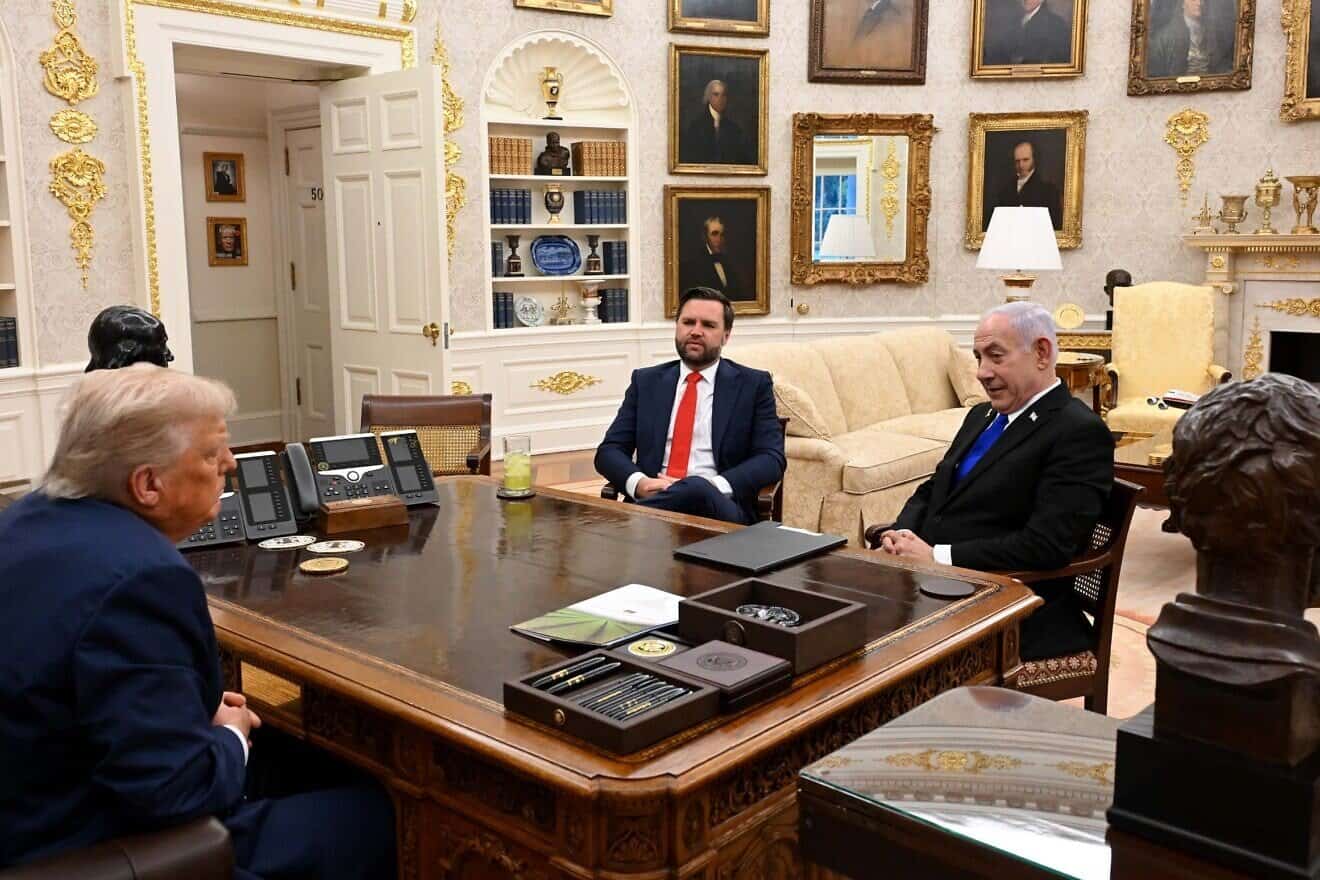
Israeli Prime Minister Benjamin Netanyahu at a second meeting with U.S. President Donald Trump, and also attended by Vice President JD Vance, held in the Oval Office in the White House on July 8, 2025. Credit: Avi Ohayon/GPO.

As U.S. and Israeli leaders continue to hold meetings in Washington on Tuesday, experts told JNS that the discussions between U.S. President Donald Trump and Israeli Prime Minister Benjamin Netanyahu may be “transformational” for the entire Middle East.

Jonathan Schanzer, executive director of the Foundation for Defense of Democracies, told JNS that what the two leaders have described of their plans could reset the region.

“An end to Iranian aggression, peace between Israel and Syria, plus an end to the Gaza war with resettlement opportunities for Gazans and regional leadership in the Strip? One of these would be a remarkable achievement,” Schanzer said. “All of them would amount to a new Middle East.”

“What the two leaders laid out last night was nothing short of transformational,” he added.

‘Things may be moving in the right direction’

At their White House dinner on Monday, Trump and Netanyahu said that they were working on a plan to relocate Gazans either within the coastal enclave in what Trump called a “freedom zone,” or to third countries.

“I think President Trump had a brilliant vision. It’s called free choice. If people want to stay, they can stay, but if they want to leave, they should be able to leave,” Netanyahu said.

He emphasized that Gaza “shouldn’t be a prison. It should be an open place.”

In February, Trump first suggested that the United States could “own” the Gaza Strip with implications for U.S. involvement that drew criticism from some Republican lawmakers and a number of Arab states.

Schanzer told JNS that the latest discussions of plans for the long-term redevelopment of Gaza no longer seem to phase regional leaders.

“I didn’t see a massive backlash to Trump’s comments last night,” Schanzer said. “That seems significant to me. I get the sense that things may be moving in the right direction.”

Assaf Orion, a fellow at the Washington Institute for Near East Politics and a retired brigadier general in the Israel Defense Forces, told JNS that any maximalist versions of those plans to relocate Gazans and reoccupy the Strip would carry “a prohibitive cost in blood and treasure.”

“We haven’t heard of a single country willing to take them in,” Orion said. “It looks like one of the magical thinking solutions that both parties to the conflict share—wishing that when we get up next morning, the other side won’t be here. I don’t see it as a realistic option.”

“If we are to occupy Gaza and manage it with military rule, this would be our national project for the next generation,” he added. “This is billions and billions of dollars, and 100,000s of soldiers and an endless amount of casualties.”

Schanzer and Orion agreed that Netanyahu is likely conducting this latest trip to Washington—his third since Trump resumed office—with an eye to potential elections that could improve his majority in the Knesset and reduce his reliance on right-wing parties led by Itamar Ben-Gvir, Israel’s national security minister, and Bezalel Smotrich, its finance minister, both of whom object to a ceasefire-for-hostages deal with Hamas.

“This visit undeniably boosts Netanyahu’s political profile at home,” Schanzer said. “But Bibi has some big choices ahead. Does he call for snap elections as a means to ride the wave of successes he’s experienced? There is risk. But there is also risk in riding out his term with Ben-Gvir and Smotrich, who will try to derail any efforts to reach an end to the conflict in Gaza.”

“Netanyahu may not love the idea, but Trump does,” he stated. “And that accounts for quite a lot.”

“It’s very clear in recent weeks that he’s already campaigning for elections,” Orion said. “I think that Netanyahu—the No. 1 politician in Israel, bar none—knows how to identify the political and electoral potential of the victory over Iran. He also knows how to play the political potential of his relations with President Trump. He’s now showing his hand as the statesman, as the victor of Iran, as the savior of the nation from nuclear annihilation.”

“He may be seeing an election as an option, maybe even a desirable option,” Orion said. “The calculus that guided Netanyahu so far in decisions about Gaza might have changed a little with elections before his eyes.”

‘It’s not a one-shot problem’

Trump said on Monday that the United States would begin “very high-level” direct talks with the Iranians on Saturday to try to find a solution for Washington’s remaining issues with Iran’s nuclear program after the U.S. strikes in mid-June on the Fordow, Natanz and Isfahan nuclear facilities.

“We’re dealing with them directly, and maybe a deal is going to be made, that’ll be great,” Trump said. “It’ll be really great for Iran, I can tell you that.”

One of the open questions about negotiations with Iran is whether the U.S. and Israeli air campaign against Iran’s nuclear sites, air defenses and military leadership has left them more open to a deal or will push them to further preserve and conceal their nuclear activities.

“The regime has very little leverage right now,” Schanzer told JNS. “I don’t know if a nuclear deal matters at this moment. Deterrence and freedom of action seem to be the key ingredients to prevent a renewed nuclear program. A deal with Iran that ends the nuclear program, the ballistic-missile program and the proxy network would be a massive lift. But if there was ever a time to try, it would be now.”

Orion said he had concerns that despite the “world-class” air campaign against Iran, the United States and the international community might falsely view the problem of Iran’s threat to Israel as settled.

“There is a high probability that they won’t agree on the diplomatic side, that they will slow roll the negotiation, and, on the side, they will try to recuperate, to salvage whatever’s possible and to hide it somewhere,” Orion said. “It’s not a one-shot problem. It’s an ongoing effort.”

That commitment will have to be similar to the campaign against Hamas, even if the war in Gaza comes to an end, Orion told JNS.

“I think with Iran, the game is still on,” he said. “It’s not ‘Mission Accomplished.’ We can’t go and have beers because this problem is solved. On Gaza, there’s a wide understanding that this war must end, even if we will need to continue campaigning against Hamas for years and decades to come. There’s no total victory in that sense.”


Zawartość publikowanych artykułów i materiałów nie reprezentuje poglądów ani opinii Reunion’68,
ani też webmastera Blogu Reunion’68, chyba ze jest to wyraźnie zaznaczone.
Twoje uwagi, linki, własne artykuły lub wiadomości prześlij na adres:
webmaster@reunion68.com



‘Get Out’: Adams Urges Cuomo Not to Play Spoiler in NYC Mayoral Race, Woos Jewish Voters

‘Get Out’: Adams Urges Cuomo Not to Play Spoiler in NYC Mayoral Race, Woos Jewish Voters

Corey Walker


New York City Mayor Eric Adams attends “October 7: One Year Later” commemoration in New York City to mark anniversary of the October 7, 2023 Hamas-led attack in Israel. Photo: Ron Adar/ SOPA Images via Reuters Connect

New York City Mayor Eric Adams has a blunt message for former New York Governor Andrew Cuomo: “Get out.” 

In an interview released Monday by The Free Press, Adams urged Cuomo to exit the New York City mayoral race and clear the way for him him to prevail in November by unifying the opposition to controversial Democratic nominee Zohran Mamdani.

“That’s the right thing to do for the city of New York,” said Adams during a conversation filmed at Gracie Mansion.

Although still a registered Democrat, Adams is running for reelection in November as an independent against the Democrats’ Mamdani, Republican nominee Curtis Sliwa, and potentially Cuomo, who for now remains formally in the race as an independent candidate despite losing to Mamdani last month in the Democratic primary.

Mamdani, a member of the Democratic Socialists of America and an outspoken critic of US support for Israel, has built his campaign around challenging what he calls the Democratic Party’s brand of establishment politics. His vocal criticism of Israel’s military actions in Gaza and support for the Boycott, Divestment and Sanctions (BDS) movement have earned him both national attention and fierce backlash.

Adams, one of the most pro-Israel mayors in the country, has cast the progressive firebrand as dangerously out of step with mainstream Democrats. Without naming him directly in the interview, Adams painted a stark picture of ideological contrast, describing Mamdani’s worldview as extreme and divisive.

“We want to get safer, but when you look at someone like the candidate for mayor [who] wants to empty out Rikers Island, wants to defund police departments, the desire of believing we should not go after those who are repeated offenders and shoplifting, that is going to take us back,” Adams said. 

Mamdani, a State Assembly member from Queens and the son of prominent leftist intellectual Mahmood Mamdani and filmmaker Mira Nair, has long aligned himself with anti-imperialist causes and Global South solidarity movements. While he has not directly responded to Adams’ latest remarks, he has previously accused the mayor of fear-mongering and failing to address the suffering of Palestinians.

New York City has a significant Jewish population, a key factor in Adams’s political calculus. Mamdani’s harsh critiques of Israel could prove polarizing among voters, particularly in more moderate or older blocs. As a result, Adams has made overtures to the Jewish community in an attempt to consolidate support of a critical voting bloc ahead of the general election.

“When you have the small population of Jewish residents [making up] 51 percent of the hate crimes [victims] in this city, that’s problematic,” Adams said. “So we started in office to end antisemitism. We signed the IHRA agreement, which standardized what antisemitism is.”

As mayor, Adams signed Executive Order 52 on June 8, 2025, formally adopting the International Holocaust Remembrance Alliance’s (IHRA) working definition of antisemitism.

The definition characterizes antisemitism as “a certain perception of Jews … expressed as hatred toward Jews” and lists 11 illustrative examples, such as Holocaust denial, collective Jewish responsibility, and denying Jews’ right to self-determination. Adams’s order directs all city agencies to apply this definition to identify and address antisemitic incidents, without infringing on First Amendment protections.

Adding another layer of uncertainty to the general election race is the potential impact of Cuomo, who has floated a return to the campaign trail in recent months. Cuomo, also a staunch supporter of Israel during his tenure as governor, could divide pro-Israel voters and complicate Adams’s path to victory.

In the interview, Adams didn’t mince words about Cuomo’s potential spoiler role in November. He emphasized that Cuomo had already lost against Mamdani and that the former governor should gracefully bow out of the competition and let a stronger opponent combat the ascendant socialist.

The race, still months away from formal filing deadlines, is already emerging as a proxy battle over Israel, the direction of US foreign policy, and the growing rift between the Democratic establishment and its insurgent left wing.

In recent weeks, Adams has held events with Jewish community leaders and appeared on local radio stations emphasizing his unwavering support for Israel. His campaign advisers believe the contrast with Mamdani will be a central line of attack.


Zawartość publikowanych artykułów i materiałów nie reprezentuje poglądów ani opinii Reunion’68,
ani też webmastera Blogu Reunion’68, chyba ze jest to wyraźnie zaznaczone.
Twoje uwagi, linki, własne artykuły lub wiadomości prześlij na adres:
webmaster@reunion68.com