Archive | 2025/07/11

Ustalenia IPN: zbrodni w Jedwabnem dokonali Polacy z niemieckiej inspiracji

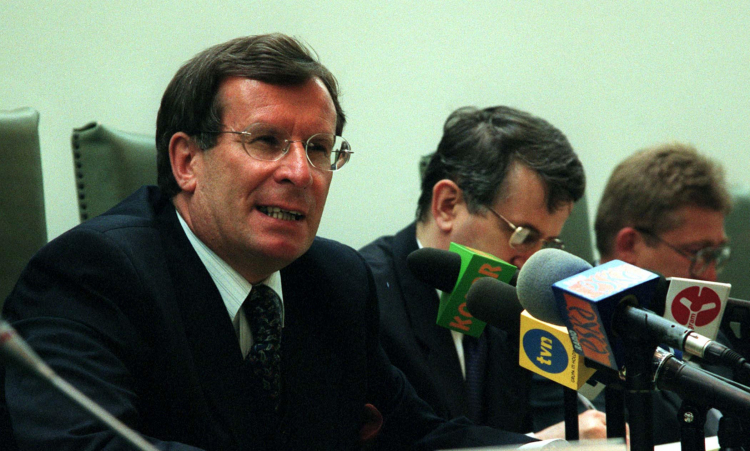
Witold Kulesza /L/, szef pionu śledczego IPN podczas konferencji dotyczącej śledztwa w sprawie zbrodni w Jedwabnem, Warszawa, 5 czerwca 2001r. Fot. PAP/Piotr Rybarczyk


Ustalenia IPN: zbrodni w Jedwabnem dokonali Polacy z niemieckiej inspiracji

jkrz/ wj/ jw/


10 lipca 1941 r. w Jedwabnem zamordowanych zostało mniej więcej 340 miejscowych Żydów, większość z nich spalono żywcem w stodole. Według ustaleń IPN sprzed ponad 20 lat zbrodni dokonali Polacy, ale z niemieckiej inspiracji.

Jedwabne, miasteczko w okolicach Łomży, między wrześniem 1939 r. a czerwcem 1941 r. znajdowało się pod okupacją sowiecką. 23 czerwca 1941 r., nazajutrz po wybuchu wojny niemiecko-sowieckiej, do Jedwabnego wkroczył witany kwiatami przez mieszkańców oddział Wehrmachtu. Żołnierze natychmiast ruszyli dalej na wschód, a nadzór nad miejscowością od tego momentu sprawowała niemiecka żandarmeria (według różnych źródeł posterunek liczył od ośmiu do 11 osób). Zaczęły też funkcjonować władze cywilne – z polskim burmistrzem i jego zastępcami.

To oni mieli być organizatorami zbrodni, do której doszło 10 lipca 1941 r.

Pierwsze śledztwo w tej sprawie, tuż po wojnie, zakończyło się procesem przed Sądem Okręgowym w Łomży i skazaniem na śmierć jednego oskarżonego, a na kary więzienia (od ośmiu do 15 lat) dziewięciu kolejnych.

Ostatecznie jednak wyrok śmierci w drodze łaski został zamieniony na karę więzienia, a wszyscy skazani wyszli na wolność przed upływem terminu zasądzonej kary.

Nowe śledztwo w 2000 r. wszczął Instytut Pamięci Narodowej i wobec niewykrycia sprawców umorzył postępowanie.

W punkcie wyjścia pion śledczy IPN przyjął trzy hipotezy, które weryfikowano na podstawie wszystkich dowodów gromadzonych w toku śledztwa. Według pierwszej z tych hipotez zbrodni w Jedwabnem dokonali sami Niemcy bez udziału Polaków lub też zmuszając do udziału w jej dokonaniu pewną grupę polskich cywili. Druga hipoteza zakładała, że zbrodni w Jedwabnem dokonali sami Polacy z własnej inicjatywy, bez współdziałania z Niemcami, zaś trzecia, że zbrodni „dokonała grupa Polaków działających z niemieckiej inspiracji, w poczuciu dozwolonej ze strony Niemców i pełnej bezkarności”.

„Wykonawcami zbrodni, jako sprawcy sensu stricto, byli polscy mieszkańcy Jedwabnego i okolic – mężczyźni, w liczbie co najmniej około 40. (…) Należy przyjąć, iż aktywnie uczestniczyli oni w dokonaniu zbrodni, uzbrojeni w kije, orczyki i inne narzędzia.”

Rok przed wydaniem postanowienia o umorzeniu śledztwa, 9 lipca 2002 r. (zakończono wówczas wszystkie czynności zaplanowane w śledztwie), prokurator Radosław Ignatiew (ówczesny naczelnik Oddziałowej Komisji Ścigania Zbrodni przeciwko Narodowi Polskiemu w Białymstoku) przedstawił prawdopodobny przebieg zbrodni.

Napisał, że 10 lipca 1941 r. nad ranem do Jedwabnego zaczęli przybywać mieszkańcy okolicznych wsi z zamiarem brania udziału w zaplanowanej wcześniej zbrodni zabójstwa żydowskich mieszkańców tej miejscowości. W wieczór poprzedzający zdarzenia niektórzy żydowscy mieszkańcy uprzedzeni zostali przez znajomych Polaków, że przygotowywane jest zbiorowe działanie przeciwko Żydom.

Od godzin rannych rozpoczęło się wypędzanie z domów ludności żydowskiej i gromadzenie jej na rynku miasteczka. Zgromadzonym kazano wyrywać trawę spomiędzy kamieni brukowych, którymi wyłożony był rynek. Dopuszczano się przy tym aktów gwałtu i przemocy wobec zgromadzonych. Dokonywali tego mieszkańcy Jedwabnego i okolic, narodowości polskiej.

Prokurator Ignatiew zaznaczył, że liczni przesłuchani w toku śledztwa świadkowie wspominali o obecności w Jedwabnem umundurowanych Niemców. „Niemcy ci prawdopodobnie w małej grupie asystowali w akcji wyprowadzania pokrzywdzonych na rynek i do tego ograniczyła się ich czynna rola. Nie jest w świetle zgromadzonych dowodów jasne, czy uczestniczyli w konwojowaniu ofiar na miejsce kaźni i czy byli obecni przy stodole. Zeznania świadków w tym zakresie różnią się zasadniczo” – napisał prokurator IPN.

W kolejnym fragmencie opisał zdarzenia na rynku i w jego okolicach. Zgromadzonych tam żydowskich mężczyzn zmuszono do rozbicia stojącego na skwerku pomnika Lenina (ustawionego w trakcie okupacji sowieckiej – PAP), a potem do przyniesienia jego fragmentów na rynek, zaś stamtąd do stodoły.

„Grupa ta (żydowskich mężczyzn – PAP) mogła liczyć około 40-50 osób. Był w niej również miejscowy rabin. Ofiary z tej grupy zgładzono w nieustalony sposób, a ciała wrzucono do grobu wykopanego wewnątrz stodoły. Na zwłoki w grobie wrzucono części rozbitego popiersia Lenina” – napisał prokurator Ignatiew.

Druga, większa grupa ludności żydowskiej, została wyprowadzona z rynku po upływie pewnego czasu, być może 1-1,5 godziny, jak określił to jeden ze świadków. Inni świadkowie wskazywali, że było to późne południe. „W grupie tej było kilkaset osób, prawdopodobnie około 300, na co wskazuje liczba ofiar w obu grobach, według szacunkowej oceny ekipy archeologiczno-antropologicznej biorącej udział w czynnościach ekshumacyjnych” – zaznaczył prokurator.

W drugiej grupie znajdowały się ofiary obu płci w różnym wieku, wśród nich także dzieci i niemowlęta. Ludzie ci zostali wprowadzeni do drewnianej, krytej strzechą stodoły. Po zamknięciu budynek został oblany naftą i podpalony. Znajdujący się w środku Żydzi spłonęli żywcem.

Prokurator Ignatiew odniósł się również do podanej w publikacji Jana Tomasza Grossa „Sąsiedzi” informacji o liczbie ofiar zbrodni z 10 lipca 1941 r. – ok. 1600.

„Niepełny rozmiar prac ekshumacyjnych, a także niemożność zweryfikowania hipotezy o istnieniu grobu lub grobów zbiorowych na terenie żydowskiego cmentarza nie pozwala na określenie w sposób pewny liczby wszystkich ofiar zamordowanych w dniu zbrodni w Jedwabnem. Liczba 1600 ofiar bądź zbliżona, wydaje się wysoce nieprawdopodobna i nie znalazła potwierdzenia w toku prowadzonego śledztwa. W dniu zbrodni w Jedwabnem przebywały na pewno osoby narodowości żydowskiej, które schroniły się tam m.in. z Wizny i Kolna. Jednakże pewna grupa żydowskiej ludności ocalała. Przyjąć można, że było to co najmniej kilkadziesiąt osób, które mieszkały po dacie zbrodni w miasteczku i jego okolicach, do początków listopada 1942 r.” – napisał prokurator Ignatiew.

„Co do udziału polskich cywili w dokonanej zbrodni, należy przyjąć, iż była to rola decydująca w zrealizowaniu zbrodniczego planu. Przyjąć można, że zbrodnia w Jedwabnem została dokonana z niemieckiej inspiracji. Obecność choćby biernie zachowujących się niemieckich żandarmów z posterunku w Jedwabnem, a także innych umundurowanych Niemców (jeśli założyć, że byli oni obecni na miejscu zdarzeń) była równoznaczna z przyzwoleniem i tolerowaniem dokonania zbrodni na żydowskich mieszkańcach tej miejscowości. W tym stanie rzeczy stwierdzić należy, że zasadne jest przypisanie Niemcom, w ocenie prawnokarnej, sprawstwa sensu largo tej zbrodni. Wykonawcami zbrodni, jako sprawcy sensu stricto, byli polscy mieszkańcy Jedwabnego i okolic – mężczyźni, w liczbie co najmniej około 40. (…) Należy przyjąć, iż aktywnie uczestniczyli oni w dokonaniu zbrodni, uzbrojeni w kije, orczyki i inne narzędzia” – zaznaczył.

Z zeznań świadków wynikało, że po dokonaniu zbrodni doszło do rabowania mienia pozostałego po ofiarach.

W uzasadnieniu do umorzenia śledztwa zaznaczono, że nie jest możliwe określenie przyczyn biernego zachowania się większości ludności miasteczka w obliczu zbrodni. „W szczególności nie można przesądzić, czy bierność ta była wynikiem akceptacji zbrodni, czy też wynikała z zastraszenia brutalnością działania sprawców. Taka postawa mieszkańców Jedwabnego wobec zbrodni dokonanej w dniu 10 lipca 1941 r. nie poddaje się kwalifikacji prawnokarnej, nie może być zatem przedmiotem ocen w kategorii przypisania odpowiedzialności karnej” – napisał prokurator Ignatiew.

Na koniec dodał, że spośród osób, których nazwiska, jako sprawców wymienione zostały w aktach spraw, część została prawomocnie osądzona, a inne już w chwili prowadzonego przez niego śledztwa nie żyły.

„Spośród osób, których nazwiska, jako sprawców wymienione zostały w aktach spraw, część została prawomocnie osądzona. Inne już nie żyją. […] Nie zgromadzono wystarczających dowodów, które pozwoliłyby na zidentyfikowanie i postawienie zarzutów ewentualnym innym żyjącym sprawcom, którzy zaangażowani byli we wzięcie udziału w dokonaniu zabójstwa obywateli polskich narodowości żydowskiej w dniu 10 lipca 1941 r. w Jedwabnem” – napisał prokurator Ignatiew w konkluzji uzasadnienia o umorzeniu śledztwa. (PAP)


Zawartość publikowanych artykułów i materiałów nie reprezentuje poglądów ani opinii Reunion’68,
ani też webmastera Blogu Reunion’68, chyba ze jest to wyraźnie zaznaczone.
Twoje uwagi, linki, własne artykuły lub wiadomości prześlij na adres:
webmaster@reunion68.com



The Trump-Bibi Bond

The Trump-Bibi Bond

Lee Smith


Like Reagan and Thatcher, and Roosevelt and Churchill, an American president found a fighting partner—this time in the Middle East

.

President Donald Trump shakes hands with Israeli Prime Minister Benjamin Netanyahu at the White House in Washington, D.C., April 7, 2025
Brendan Smialowski/AFP via Getty Images

Israeli Prime Minister Benjamin Netanyahu will meet Donald Trump today at the White House for their fourth meeting in a year. Last July, Netanyahu traveled to Palm Beach, Florida, to meet with candidate Trump at his Mar-a-Lago mansion. During their last official meeting at the White House on April 7, the president seemed to throw a curveball at Bibi when he announced that the administration would engage in direct talks with Iran over its nuclear program. Both the left-wing media and the Tucker Carlson-led faction of the right erupted with glee at the thought of the Israeli prime minister getting publicly spanked. As it turned out, the meeting was camouflage for Trump and Netanyahu’s joint plans to eliminate Iran’s nuclear program through military action—part of the most successful high-level deception operation since the Allied landing at Normandy.

This time, there’s little doubt about the strength of the relationship between the two world leaders, who will discuss plans for a cease-fire in Gaza and no doubt celebrate the historic victory they won together by destroying the bulk of Iran’s nuclear weapons program. “Bibi and I just went through HELL together,” Trump posted on Truth Social on June 25. “Bibi could not have been better, sharper, or stronger in his LOVE for the incredible Holy Land.” The American president added, “Perhaps there is no one that I know who could have worked in better harmony with the President of the United States, ME, than Bibi Netanyahu.”

Certainly, the relationship between the two men, each of whom prides himself on being at war with his country’s elites, has gone through some rocky patches. Still, it is nonetheless the most consequential relationship between world leaders since Ronald Reagan and Margaret Thatcher teamed up to end the Cold War—and perhaps even since Winston Churchill enlisted Franklin Delano Roosevelt’s aid in defeating Nazi Germany. It’s easy to say that the Churchill-Roosevelt relationship was far more significant to the world at large than Trump’s partnership with Bibi to bomb Fordow. But we’ll never know the extent to which the Islamic Republic threatened to destabilize the world order, since the United States and Israel destroyed the terror regime’s nuclear weapons program before it tested our peace—a peace that has been kept by two resolute leaders.

Over the course of the war, Churchill and FDR exchanged more than 2,000 letters and telegrams. Five days after Churchill was named prime minister in May 1940, he wrote Roosevelt: “If necessary we shall continue the war alone and we are not afraid of that. But I trust you realize, Mr. President, that the voice and force of the United States may count for nothing if they are withheld too long. You may have a completely subjugated, Nazified Europe established with astonishing swiftness, and the weight may be more than we can bear. All I ask you now is that you should proclaim non-belligerency, which would mean that you would help us with everything short of actually engaging armed forces.”

The relationship between the two men is the most consequential relationship between world leaders since Ronald Reagan and Margaret Thatcher teamed up to end the Cold War—perhaps even since Churchill and FDR defeated Nazi Germany.

Polls showed that while Americans backed aiding Great Britain, most wanted to stay out of the war. FDR nonetheless prepared them for the role that he believed the United States was destined to play. “Never before has our American civilization been in such danger as now,” he said in a late December 1940 speech. “If Great Britain goes down, all of us in the Americas would be living at the point of a gun.”

Nearly 19 months after Churchill took charge, the Japanese bombed Pearl Harbor, Hitler declared war on the United States, and FDR brought his fellow Americans into a war to save civilization.

Netanyahu spent nearly three decades waiting for an American leader who understood the stakes of Iran’s nuclear weapons program the way he did. He began warning about the dangers of an Iranian bomb in his 1995 book, Fighting Terrorism. The Islamic Republic, he wrote, was between three to five years away “from possessing the prerequisites required for the independent production of nuclear weapons.” However, the Clinton administration wasn’t paying attention even after Iranian-backed group Hezbollah al-Hijaz killed 19 U.S. airmen and wounded nearly 500 more when it bombed the Khobar Towers in Saudi Arabia in 1996.

The murder of Americans on Saudi soil underscored a point that U.S. policymakers would continue to obscure, or miss entirely: Iran saw neither Israel nor Saudi Arabia as its chief foe; rather, that was America. The Iranians targeted Saudi interests and made war on Israel, primarily through its Lebanese proxy Hezbollah, because Saudi Arabia and Israel are U.S. allies, pillars of the Washington-led security alliance in the Middle East that Tehran intended to destroy and replace with its own regional order. Since the end of WWII, we have been the major power in the region. Thus, as the 1979 takeover of the U.S. embassy in Tehran and the kidnapping of 52 hostages for 444 days made clear, the Islamic Republic had America in its crosshairs from the start.

U.S. hegemony in the Persian Gulf was one of the prizes that FDR won by bringing America into the war. In a February 1945 meeting on Egypt’s Great Bitter Lake with the founder of modern Saudi Arabia, King Abdul Aziz Ibn Saud, the U.S. president agreed to protect the kingdom in exchange for cheap Saudi oil. This arrangement would keep global markets humming throughout the Cold War and ensure that, should Washington ever need to mobilize troops against the Red Army, they’d never be short of fuel. Yes, the Eastern Mediterranean was an important Cold War testing ground where Israel’s serial victories over Soviet proxies demonstrated American military and technological supremacy. But for the United States, the most crucial part of the Middle East was always the Gulf, the cornerstone of our postwar peace and prosperity.

For Netanyahu, managing relations with Israel’s superpower patron often involved reminding forgetful U.S. policymakers how our regional security architecture worked and why Iranian ambitions threatened America’s greatness. According to a 2009 diplomatic cable, Bibi told a U.S. congressional delegation that “a nuclear Iran [is] the greatest threat facing Israel, and urged strong economic sanctions backed by a viable military option to confront a problem that he said threatened the region and could prove a ‘tipping point’ in world history.”

In a 2012 speech before the U.N. General Assembly, Netanyahu warned, again in Churchillian tones, “At stake is not merely the future of my own country. At stake is the future of the world. Nothing could imperil our common future more than the arming of Iran with nuclear weapons.”

He told the U.N. audience that he’d been “speaking about the need to prevent Iran from developing nuclear weapons for over 15 years.” He said, “I speak about it now because the hour is getting late, very late.”

Paradoxically, it was Netanyahu’s long record of warning against the imminent threat of the Iranian nuclear program that began raising questions as early as 2012, and again in recent months, before he and Trump partnered to obliterate Fordow, Isfahan, and other nuclear sites. Namely, if the midnight hour is always so near, why don’t the Iranians have the bomb yet? Isn’t this a case of the Bibi who cried wolf?

That’s a good question. Why didn’t Iran already have the bomb? After all, nuclear technology dates back to the 1930s, so it’s not esoteric knowledge. Lots of other countries got the bomb, even countries as backwards and corrupt as Iran—such as Communist China, North Korea, and Pakistan. College students know how to build the bomb; truck drivers too. You can buy blueprints for a bomb online.

The Iranians spent billions building the infrastructure for a bomb and stole what they couldn’t buy, yet they still couldn’t get it done because the Israelis kept pushing them back. While Netanyahu and other Israeli officials kept warning of the Iranian bomb, Jerusalem also fought a decades-long shadow war against the terror regime—often with American help. For instance, the Israelis and the George W. Bush administration reportedly worked together on Stuxnet, a computer worm that destroyed Iranian centrifuges. The Israelis also interdicted equipment and killed nuclear scientists, which showed that even if you can’t destroy the knowledge it takes to build a bomb, you can certainly discourage scientists, whether homegrown or foreign mercenaries, from using their talents to further that mission.

Maybe the Israelis would have been able to keep delaying Iran’s program forever, if not for Barack Obama: He wanted Iran to have the bomb. Obama believed that Israel was the destabilizing force in the Middle East and thus the best way to stabilize it was by balancing Israel against Iran—that is, by withdrawing U.S. support from its ally and strengthening an anti-American regime responsible for the deaths of thousands of Americans in Lebanon, Iraq, Israel, and elsewhere. Obama’s rebalancing act, what he called a new geopolitical “equilibrium,” required getting Iran the bomb to keep the Israelis in check.

Obama’s problem, and Iran’s, was that Israel kept setting back the mullah’s nuclear program. Thus, the purpose of Obama’s Iran deal, formally known as the Joint Comprehensive Plan of Action (JCPOA), was to get the international community to help Iran build the bomb and commit America to protecting the Iranian bomb from Israel.

The idea was so dangerously crazy that in a hearing on Capitol Hill, then Sen. Marco Rubio asked Obama’s Secretary of State John Kerry to clarify Annex III of the JCPOA, which obligated the United States, world powers, and the European Union “to strengthen Iran’s ability to protect against, and respond to nuclear security threats, including sabotage.” Rubio wanted to know if the JCPOA required the United States to defend Iran from an Israeli cyberattack. Kerry replied, “I think we just have to wait until we get to that point.”

In March 2015, Netanyahu spoke out against Obama’s apocalyptic policy before a joint session of Congress; he’s made four such appearances before U.S. lawmakers, one more than Churchill, and more than any other world leader. “Iran’s regime is not merely a Jewish problem, any more than the Nazi regime was merely a Jewish problem,” said Netanyahu. “The 6 million Jews murdered by the Nazis were but a fraction of the 60 million people killed in World War II. So, too, Iran’s regime poses a grave threat, not only to Israel, but also the peace of the entire world.”

Of course, Obama wasn’t listening: His policy’s goal of hobbling an ally that projects power on behalf of America is evidence that it was really America he wanted to weaken, a goal he shared with the Iranians. Donald Trump saw the problem clearly. After declaring his candidacy in June 2015, Trump spoke about the Iran deal frequently on the campaign trail, calling it “the worst deal ever negotiated” and saying it could lead to a “nuclear holocaust.” It must have seemed a terrible irony to the Israeli prime minister that the American leader he had been waiting for was an underdog outsider seemingly destined to lose to Hillary Clinton, who made a point of declaring neither her full support nor her open opposition to the deal. But then fate intervened: Trump won.

At the end of April 2018, Netanyahu briefed Trump about the nuclear archives Israel had lifted from a Tehran warehouse, showing that the Iranians had lied for decades about their nuclear activities. In early May, the president withdrew from the JCPOA and embarked on a maximum pressure campaign, imposing further sanctions on the regime that emptied its war chests and checked significant advancements in the nuclear program. In January 2020, Trump liquidated the commander of Iran’s expeditionary terror unit, Qassem Soleimani. Killing the man responsible for the deaths of hundreds of U.S. servicemen in Iraq gave evidence that the American president was determined to end the Iranian threat.

Trump critics, especially isolationists in his own party, wondered why the Iranian nuclear issue had become so urgent again after Trump’s reelection. Why was Netanyahu, the first foreign leader to visit him in February, invited to visit the White House again in April? What was wrong with simply maintaining the status quo, instead of rushing to war?

The reason is simple: The Joe Biden administration had let Iran out of the box. During Biden’s four years, he’d given the regime access to billions of dollars while its proxies made war on Israel. In fact, the Biden team saw the aftermath of the Oct. 7 attack as an opportunity to topple Netanyahu from power and replace him with a more pliable leader. The Biden team wanted a PM who’d allow Israel to be balanced against Iranian proxies in Lebanon and Syria, agree to a Palestinian state, and accommodate a new regional order led by a nuclear-armed Iran backed by Washington—Obama’s order.

Trump saw that was madness. As Israel prepared to retaliate against an Iranian strike in October 2024, Biden warned Netanyahu not to hit Iran’s nuclear facilities. Trump thought that was nuts. “That’s the thing you want to hit, right?” said the then candidate. “It’s the biggest risk we have, nuclear weapons.”

Trump’s opinion about the prospect of a nuclear-armed Iran has been consistent throughout his political career, from his 2016 campaign through his third campaign in 2024. At virtually every campaign stop, Trump explained that Iran couldn’t be allowed to have the bomb. Once elected to a second term in the White House, he regularly warned of the dangers of a nuclear-armed Iran. He said he’d prefer to handle the threat diplomatically, but he’d do it the other way if given no choice. In either case, he’d never let Iran get the bomb.

From Trump’s perspective, the problem wasn’t just the prospect of a terror regime launching nuclear weapons at Israel, Saudi Arabia, and other U.S. allies—and in time at Europe and even the U.S. homeland. A nuclear-armed Iran threatened America’s historic position in the Gulf. After all, the chief purpose of the postwar U.S. Navy was to keep shipping lanes open and ensure the free flow of cheap Gulf oil that has given the U.S. ultimate control over global oil markets, including the energy supplies of its leading trade partners in Europe and Asia. No postwar arrangement has been more important in keeping the United States secure and prosperous than our role in the Gulf.

An Iranian bomb did not pose the same level of direct threat to the U.S. homeland as the Soviet Union’s enormous nuclear arsenal did. But it could hardly be wished away. A nuclear Iran could, among other things, close the Strait of Hormuz, send oil prices soaring, and destabilize global markets. In this framework, it would also thwart Trump’s most important foreign-policy initiative: rolling back China. What was the point of a trade war with Beijing to reshore manufacturing and fix the trade imbalance that had impoverished the American middle class if China’s main Middle East ally could close a major trade route through which one-fifth of the world’s energy passes? Iran could never have the bomb.

Then there was the not negligible fact that the Iranians kept sending hit squads to hunt Trump in retaliation for killing Soleimani. A nuclear Iran could deploy terror squads around the world with near impunity. Iran must never have the bomb.

In time, perhaps we’ll have the full story of how, when, and where Trump and Netanyahu plotted their strategy, and how they used misdirection and ambiguity to throw off Iran as well as their domestic adversaries. Like FDR, Trump also had to fight off an isolationist faction in his party, while Netanyahu has been under continuous siege by Israel’s version of the Deep State. In his June 25 post on Truth Social, Trump told his partner’s domestic opponents to lay off, because Bibi is a hero.

“Bibi Netanyahu was a WARRIOR,” Trump wrote, “like perhaps no other Warrior in the History of Israel, and the result was something that nobody thought was possible, a complete elimination of potentially one of the biggest and most powerful Nuclear Weapons anywhere in the World, and it was going to happen, SOON! We were fighting, literally, for the Survival of Israel, and there is nobody in Israel’s History that fought harder or more competently than Bibi Netanyahu.”

Soon after, Netanyahu thanked Trump on X. “I was deeply moved by your heartfelt support for me and your incredible support for Israel and the Jewish people. I look forward to continue working with you to defeat our common enemies.”

Churchill and Roosevelt’s voluminous correspondence gives us details of the relationship they forged to save the world, and the same is so with the record of Reagan and Thatcher’s secure phone calls. But these were all private exchanges made public only later. What we’re watching with Trump and Netanyahu on social media is unique: the public declaration of a friendship, its goals and commitments, between two world leaders—a bond that makes the world safer.


Zawartość publikowanych artykułów i materiałów nie reprezentuje poglądów ani opinii Reunion’68,
ani też webmastera Blogu Reunion’68, chyba ze jest to wyraźnie zaznaczone.
Twoje uwagi, linki, własne artykuły lub wiadomości prześlij na adres:
webmaster@reunion68.com


Israeli Official Says Some of Iran’s Highly Enriched Uranium Likely Survived US Strikes: Report

Israeli Official Says Some of Iran’s Highly Enriched Uranium Likely Survived US Strikes: Report

Ailin Vilches Arguello


A satellite image shows airstrike craters over the underground centrifuge halls of Iran’s Natanz Enrichment Facility following US airstrikes amid the Iran-Israel conflict, June 22, 2025. Photo: Maxar Technologies/Handout via REUTERS

Israeli intelligence officials have reportedly concluded that parts of Iran’s underground stockpile of highly enriched uranium likely survived last month’s US-Israeli strikes, reviving questions about how severely the attacks degraded Tehran’s nuclear capabilities.

According to the New York Times, a senior Israeli official said the country believes some of Iran’s 60% enriched uranium remains accessible at nuclear sites that were buried too deep to be destroyed in last month’s strikes.

Although Israel has long monitored Tehran’s nuclear program, the Israeli official said Iran intensified its push toward developing a nuclear weapon after Hezbollah leader Hasan Nasrallah was killed last September.

Last month, Israel launched Operation Rising Lion, a sweeping military campaign aimed at dismantling Iran’s nuclear capabilities and neutralizing what officials described as an imminent nuclear threat.

Israel’s campaign of airstrikes and covert sabotage from within Iran came on the 61st day of a 60-day deadline set by US President Donald Trump for Tehran to secure a deal through diplomacy to curb the country’s nuclear activities.

The US joined Israel’s airstrike campaign against Tehran by launching a large-scale military operation that destroyed three key nuclear enrichment facilities — Isfahan, Natanz and Fordow — ultimately leading to a US-brokered ceasefire.

In the aftermath of the strikes, intelligence and media reports on the extent of damage to Iran’s nuclear capabilities have been inconsistent and often contradictory.

According to Rafael Grossi, the head of UN nuclear watchdog the International Atomic Energy Agency (IAEA), Iran could resume producing enriched uranium within months.

Several experts have also warned that Iran likely relocated its stockpile of near-weapons-grade highly enriched uranium from the targeted sites ahead of the strikes and may now be concealing it elsewhere.

These assessments raised doubts about the effectiveness of US strikes aimed at crippling Tehran’s nuclear program.

However, US Defense Secretary Pete Hegseth said last month he was unaware of any intelligence indicating that Iran had moved its highly enriched uranium to protect it from US strikes, with preliminary assessments suggesting the attacks may have delayed Iran’s nuclear program by several months.

Other US intelligence officials have reported that Tehran’s nuclear sites were “severely damaged” during the American airstrikes.

Last week, the Pentagon announced that US strikes set back Iran’s nuclear program by as much as two years, indicating that the military operation likely met its objectives despite other assessments.

Iranian Foreign Minister Abbas Araghchi, meanwhile, acknowledged that the damage to Iran’s nuclear facilities during last month’s attacks was significant, but also said the regime was still assessing its full extent.

President Trump has said he would consider carrying out further strikes on Iran if US intelligence reveals new concerns about the country’s uranium enrichment program.


Zawartość publikowanych artykułów i materiałów nie reprezentuje poglądów ani opinii Reunion’68,
ani też webmastera Blogu Reunion’68, chyba ze jest to wyraźnie zaznaczone.
Twoje uwagi, linki, własne artykuły lub wiadomości prześlij na adres:
webmaster@reunion68.com