Archive | 2025/07/14

Otwarta odpowiedź do Petera Oborne’a i Irfana Chowdhury’ego

David Collier – niezależny dziennikarz śledczy


Otwarta odpowiedź do Petera Oborne’a i Irfana Chowdhury’ego

Andrzej KOraszewski


Mój list do Davida (Autora poniższego tekstu), który wyślę dopiero po publikacji:

Drogi Davidzie,

Zapewne kojarzysz nazwisko Malgorzata Koraszewska, prosiła cię o pozwolenie na tłumaczenie twoich tekstów na język polski i publikację na naszym blogu. Prawdopodobnie, (podobnie jak to stało się z kilkoma innymi zaprzyjaźnionymi autorami), wysyłała już tylko linki do polskiej wersji, informując, że tekst został opublikowany. Małgorzata zmarła 17 czerwca, a ja udaję, że to nie jest prawdą i ciągnę ten wózek dalej. Można powiedzieć, że to zabawne, albo makabryczne. Pracuję na dwóch komputerach, bo wszystkie nasze źródła przychodzą na jej komputer, więc rano siadam w fotelu, na którym umarła, przeglądam jej pocztę i wysyłam do siebie to, nad czym będę pracował. Nadal codziennie dostaję od Malgorzaty kilka, czasem kilkanaście listów. Dziś przysłała ten tekst i natychmiast go opublikowałem. Jeśli ci się to nie podoba możesz mnie pozwać. (Świetny tekst, idealnie pasuje do mojego agresywnego nastroju. )

Pieprzyć tych sukinsynów

Andrzej  

***

To jest otwarta odpowiedź na e-mail, który otrzymałem od Petera Oborne’a i Irfana Chowdhury’ego, kwestionujący moje uwagi na temat głodu w Gazie. Opublikowałem ich wiadomość tutaj.


Szanowni Irfan Chowdhury i Peter Oborne,

Dziękuję za wiadomość. Jak mam w zwyczaju, odpowiadam w formie publicznej. W ten sposób zarówno wasze pytania, jak i moje odpowiedzi są dostępne w pełnej wersji i mam pewność, że moje słowa nie zostaną zmanipulowane ani wyrwane z kontekstu, by przekazać sens, którego nigdy nie zamierzałem.

Zaledwie kilka tygodni temu zauważyłem, że Peter określił niedawny raport CfMM dotyczący BBC jako „znakomity” i „wnikliwy”. W tym raporcie wspomniano mnie tylko raz, a mimo to zdołano przypisać mi cytat, którego nigdy nie wypowiedziałem – więc z pewnością nie można mówić o „wnikliwości”! Dodając do tego fakt, że kluczowe wskaźniki użyte w raporcie CfMM to amatorski bełkot (wkrótce opublikuję coś więcej na ten temat), mam nadzieję, że wybaczycie mi sceptycyzm wobec waszej zdolności do rzetelnego podejścia w sprawach dotyczących Izraela i/lub faktów.

Daliście mi czas na odpowiedź do czwartku 10 lipca, do godziny 12:00 – dlatego upewniłem się, że ten tekst zostanie opublikowany przed tym terminem.

Przechodząc do istoty waszego maila – piszecie, że pracujecie obecnie nad tekstem zatytułowanym „Complicit: Britain’s Role in the Destruction of Gaza” (Współwinni: Rola Wielkiej Brytanii w zniszczeniu Gazy). Poprosiliście mnie o wyjaśnienie treści mojego posta z 19.12.2024, w którym podważam narrację o masowym głodzie, pragnieniu, umieraniu z niedożywienia i ludobójstwie. Poniżej zamieszczam obraz tego posta:
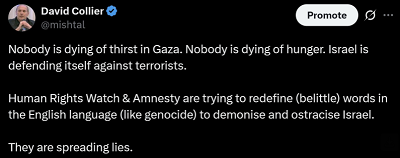
W waszym mailu kwestionujecie moje stanowisko wobec zarzutów o masowe umieranie z głodu, opierając się na trzech źródłach (Action Aid, Oxfam i UNICEF), by dowieść, że się mylę i że ok. 1,8 miliona mieszkańców Gazy wkrótce umrze, ponieważ nie mają co jeść ani pić. Mam nadzieję – choć nie jestem tego pewien – że fakt, iż nie kwestionujecie mojego stwierdzenia, iż Izrael broni się przed terrorystami, oznacza, że przynajmniej z tym się zgadzacie.

Dla jasności, oto źródła, na których się opieracie:

  • Ostrzeżenie Action Aid opiera się na wypowiedzi Amjada Al-Shawy, dyrektora Palestyńskiej Sieci Organizacji Pozarządowych (PNGO).
  • Oświadczenie Oxfam nie ujawnia źródła informacji logistycznych (czyli zapewne Hamas), a ostrzeżenie wygłasza Sally Abi-Khalil, dyrektorka Oxfam na Bliski Wschód i Afrykę Północną.
  • Komunikat prasowy UNICEF (który opublikowano po moim poście) pochodzi od przedstawicielki prasowej UNICEF Rosalii Bollen i opiera się na niezweryfikowanych relacjach, by opowiedzieć historię jednej tragicznej śmierci.

Zacznę od Action Aid. Nawet nie będę się rozwodził nad faktem, że pracownicy tej organizacji byli przyłapywani na gloryfikowaniu terroryzmu i terrorystów – skupię się jedynie na zarzutach o głód. Dziewięć miesięcy przed swoim grudniowym ostrzeżeniem, Action Aid twierdziło, że „system pomocy znajduje się na skraju całkowitego załamania”. W oświadczeniu napisano: „Jeśli mieszkańcy Gazy nie umrą od bomb, prawdopodobnie umrą z głodu.”

Cóż, myślę, że wszyscy się zgodzimy, że tak się nie stało. Czytając ten absurdalny komunikat alarmowy Action Aid z 6 marca 2024 r. (czyli Hamasowską propagandę), nie mam pojęcia, dlaczego mielibyście traktować ich jako źródło wiarygodnych informacji dziewięć miesięcy później. Ja z pewnością bym nie traktował.

Następnie – niepoparte źródłami ostrzeżenia Oxfam. Już w grudniu 2023 r. Oxfam twierdził, że:

Może to tylko moje odczucie, ale skoro ponad 90% ludności Gazy nie umarło z głodu 18 miesięcy temu, a przewidywany głód się nie ziścił – mimo że nie było przedłużonego zawieszenia broni – nie widzę powodu, by traktować poważnie tę organizację, która nieustannie głosi podobne katastroficzne prognozy. To z pewnością nie jest organizacja oparta na faktach i jestem zdumiony, że uznajecie ją za wiarygodną. Czy w ogóle sprawdzacie źródła?

Pozostaje jeszcze relacja z drugiej ręki opublikowana przez UNICEF po moim poście. Dla urozmaicenia, załóżmy, że UNICEF opublikował to wcześniej – i że znałem treść tej wypowiedzi. Oto jak UNICEF w marcu 2024 r. zapowiadał, że głód jest „nieuchronny”:

Cóż, ta prognoza również się nie sprawdziła!

Mimo że nie było zawieszeń broni, Izrael kontynuował eliminację Hamasu, a żadne z żądań tych organizacji nie zostało spełnione – scenariusze głodu głoszone przez te grupy po prostu się nie zrealizowały.

Tak samo jak oskarżenie o ludobójstwo, narracja o masowym głodzie to kolejne bezpodstawne brednie, mające na celu demonizowanie jedynego państwa z większością żydowską na świecie i jedynej funkcjonującej demokracji w regionie MENA.

Prawdziwa tragedia polega nie tylko na tym, że UNICEF i inne organizacje powielają narracje zbieżne z Hamasem. Problemem jest to, że takie wypaczenia podważają ich wiarygodność – a wraz z nią zdolność do zwracania uwagi na PRAWDZIWE katastrofy humanitarne. Podczas gdy międzynarodowi aktywiści krzyczą „Wszyscy patrzą na Rafah”, świat odwraca wzrok od Sudanu, gdzie setki tysięcy ludzi umiera z głodu, bez dostępu do pomocy i bez politycznego głosu, który mógłby ich reprezentować.

Tak właśnie wygląda sytuacja, gdy oburzenie zostaje przejęte przez propagandę. Energia moralna zostaje źle ukierunkowana, a ci, którzy nie mają swojego lobby, zostają porzuceni na pastwę losu.

Wątpię, by nasze ulice zapełniły się protestami wzywającymi rząd do ratowania mieszkańców Sudanu. Kiedy oburzenie nie jest napędzane obsesją antyizraelską, ulice pozostają puste.

Gdyby Gazyjczycy po prostu oddali zakładników, a Hamas zrzekł się władzy – konflikt by się skończył. Mieszkańcy Sudanu nie mają takiej możliwości. Takie kłamstwa o Gazie kosztują życie. Odciągają uwagę od miejsc, gdzie ludzie naprawdę umierają z głodu. „Wszyscy patrzą na Rafah” – więc nikt nie patrzy tam, gdzie naprawdę trwa klęska głodu na ogromną skalę.

Te organizacje i wiele podobnych zostały zrujnowane przez aktywistów, którzy je upolitycznili. Wiem, jak źle to wygląda, bo napisałem szczegółowy raport o upadku Amnesty – i odkryłem, że przedstawicielka Amnesty w Gazie nie tylko gloryfikowała terrorystów z Islamskiego Dżihadu, ale też nawoływała do autocenzury w imię ochrony „ruchu oporu”. Jestem pewien, że gdyby nadal tam była, chętnie powoływalibyście się na jej prorządowe (czyt. proterrorystyczne) wypowiedzi jako kolejne „dowody”, na które uważacie, że powinienem odpowiedzieć.

Te upolitycznione organizacje opierają się na informacjach przekazywanych przez ludzi osadzonych w strukturach klanowych Gazy, powiązanych z licznymi ugrupowaniami terrorystycznymi działającymi w regionie. Nie ma tam żadnej „niezależności”. Organizacje te działają na rzecz zakończenia konfliktu w sposób, który umożliwiłby Hamasowi utrzymanie władzy. Tym samym wykonują robotę Hamasu i całe ich przekazy należy traktować jako propagandę wspierającą tę zdelegalizowaną organizację terrorystyczną.

Rozumiem, że taka jest prawda – ale nie dziwię się, że ludzie, którzy traktują CfMM jako wiarygodne źródło, nie są w stanie jej dostrzec. Mam nadzieję, że choć trochę otworzyłem wam oczy.

I tak, potwierdzam otrzymanie waszej wiadomości.


Zawartość publikowanych artykułów i materiałów nie reprezentuje poglądów ani opinii Reunion’68,
ani też webmastera Blogu Reunion’68, chyba ze jest to wyraźnie zaznaczone.
Twoje uwagi, linki, własne artykuły lub wiadomości prześlij na adres:
webmaster@reunion68.com

Lebanese president nixes normalization with Israel

Lebanese president nixes normalization with Israel

Charles Bybelezer


“It is not currently part of Lebanese foreign policy,” Joseph Aoun said.

.

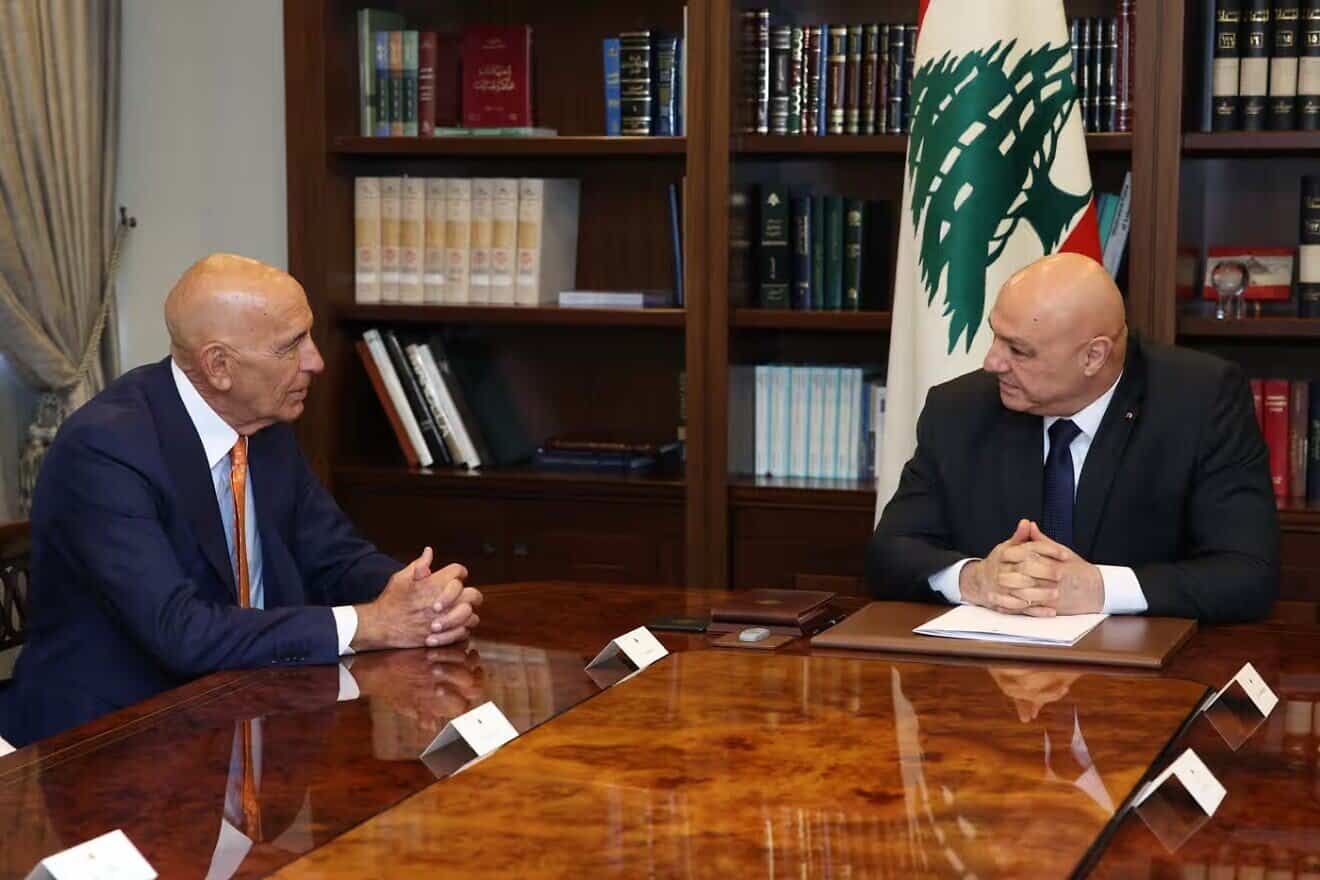
U.S. Special Envoy for Syria Thomas Barrack (left) and Lebanese President Joseph Aoun at the presidential palace in Baabda, east of Beirut, on July 7, 2025. Credit: Lebanese Presidency Press Office.

Lebanese President Joseph Aoun on Friday ruled out the prospect of normalizing relations with Israel, though he expressed a desire to end the longstanding conflict with the Jewish state.

“Peace is the lack of a state of war, and this is what matters to us in Lebanon at the moment. As for the issue of normalization, it is not currently part of Lebanese foreign policy,” Aoun said, according to Agence France-Presse.

The comments come after Israeli Foreign Minister Gideon Sa’ar said last week that Jerusalem is committed to expanding the Abraham Accords and is “interested in adding countries such as Syria and Lebanon, our neighbors, to the circle of peace and normalization.”

Syria’s new governing authority has claimed a willingness to work with the United States to reimplement the 1974 disengagement agreement with Israel, which created a U.N.-monitored buffer zone separating the two countries.

Thomas J. Barrack Jr., U.S. ambassador to Turkey and special envoy for Syria, told The New York Times last week that Jerusalem and Damascus were engaged in “meaningful” talks aimed at restoring calm to their shared border.

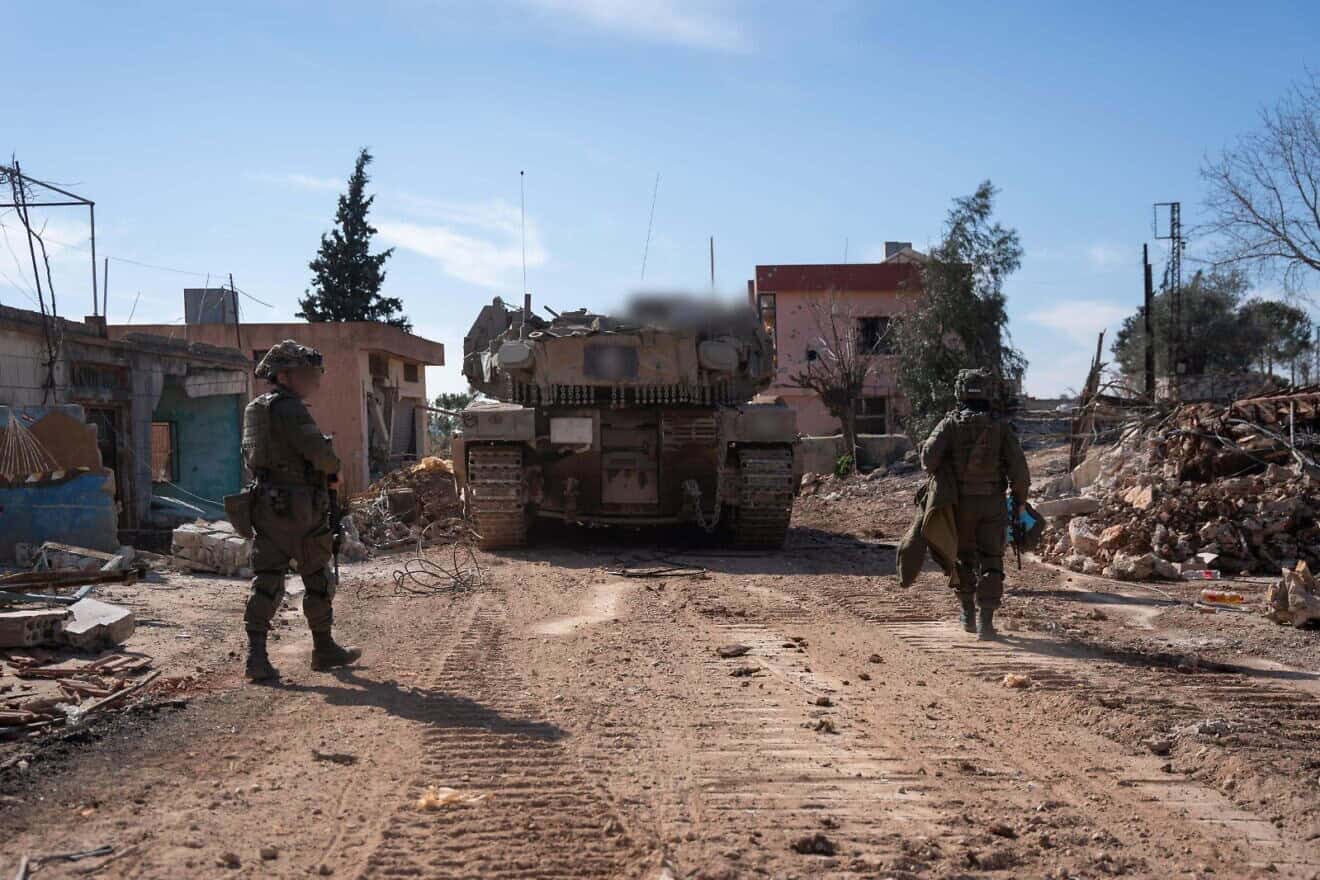
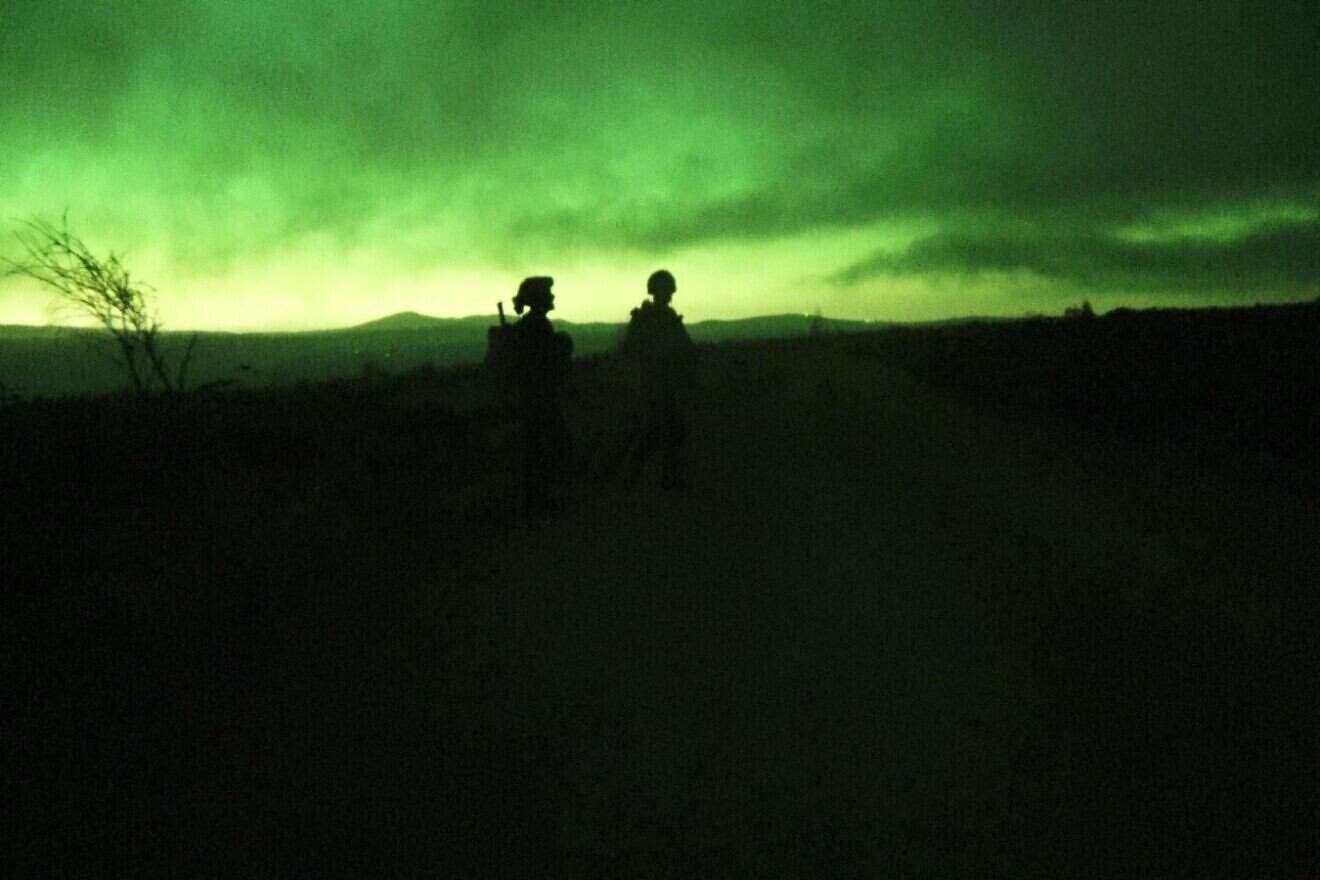
Israel Defense Forces operate against the Iranian-backed Hezbollah terrorist group in Southern Lebanon, July 2025. Credit: IDF.

On Friday, Aoun called on the Israeli military to withdraw from five positions along the Israel-Lebanon frontier. The outposts are located at strategic points, including a hill near Labbouneh, opposite the Israeli town of Shlomi; the Jabal Blat peak, across from Moshav Zar’it; a hill opposite Moshav Avivim and Kibbutz Malkia; another facing Moshav Margaliot; and one near the town of Metula.

Defense Minister Israel Katz said in March that IDF troops would remain at the sites in Southern Lebanon “indefinitely,” despite the launch of talks with Beirut over 13 disputed points along the border.

Aoun claimed on Friday that the Israel Defense Forces presence in Lebanon “obstruct[s] the complete deployment of the [Lebanese] army up to the internationally recognized borders.”

Ceasefire agreement and U.N. Resolution 1701

On Nov. 26, 2024, Jerusalem and Beirut signed a ceasefire deal aimed at ending more than a year of cross-border clashes between the IDF and Hezbollah. The Iranian-backed terrorist group began attacking the Jewish state in support of Hamas a day after the Oct. 7, 2023, massacre.

As part of the agreement, both sides acknowledged the significance of U.N. Security Council Resolution 1701, which ended the 2006 Second Lebanon War but has never been fully enforced. The resolution calls for the complete demilitarization of Hezbollah south of the Litani River and prohibits the presence of any armed groups in Lebanon other than the Lebanese Army and the United Nations Interim Force in Lebanon (UNIFIL).

Since the truce, Israel has conducted frequent operations to prevent Hezbollah from rebuilding its terrorist infrastructure and so violating the terms of the truce.

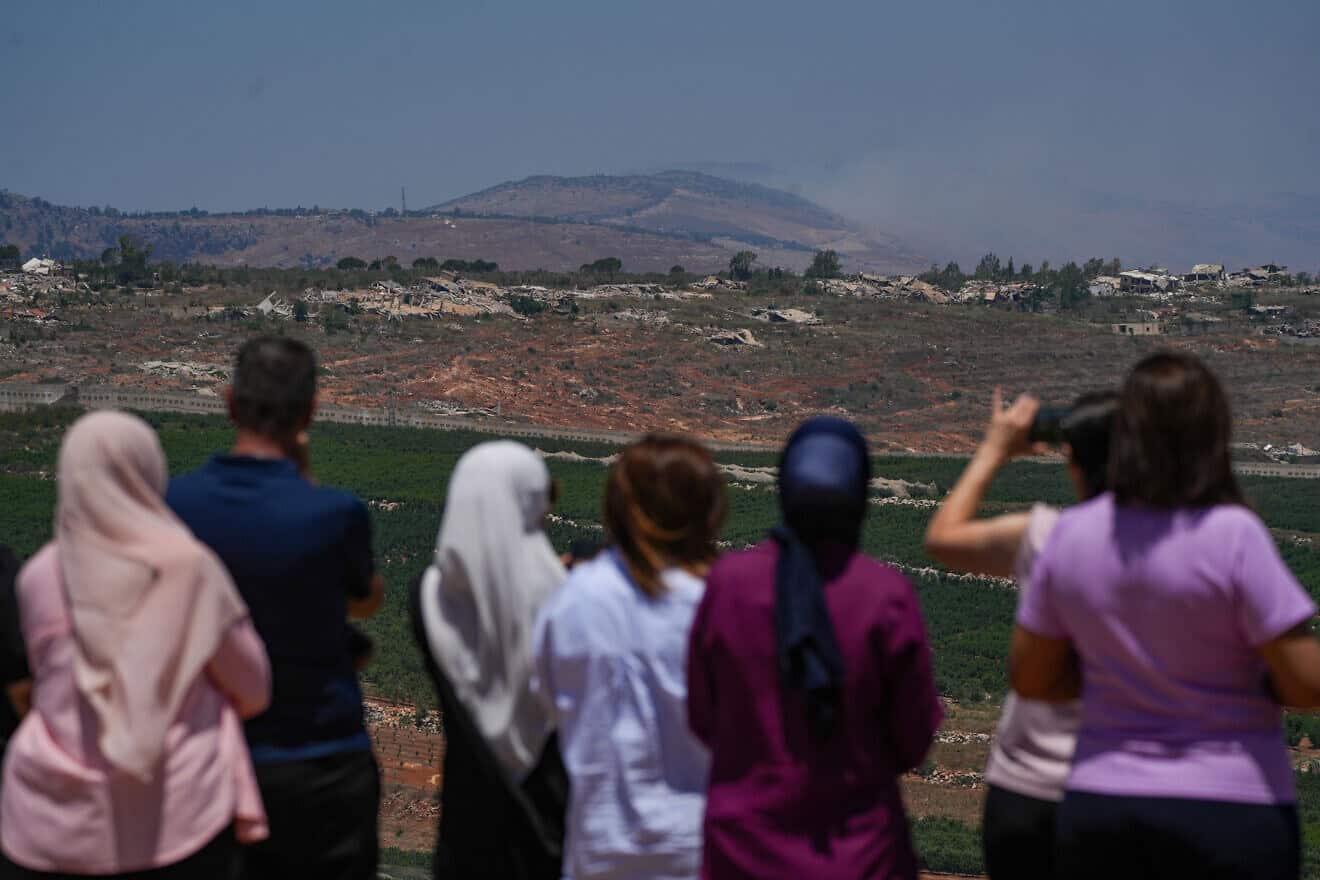
Smoke rises from Israeli airstrikes in Southern Lebanon, as it seen from the Israeli side of the border, June 27, 2025. Photo by Ayal Margolin/Flash90.

U.S. roadmap for disarmament

Barrack said on Monday that Hezbollah must see “a future for them” as part of a broader disarmament roadmap delivered to the Lebanese government on behalf of Secretary of State Marco Rubio.

“Hezbollah is a political party. It also has a militant aspect to it,” Barrack told reporters after meeting with Aoun in Beirut, according to AFP. “Hezbollah needs to see that there’s a future for them, that the road is not harnessed solely against them, and that there’s an intersection of peace and prosperity for them also.”

Hezbollah is designated as a Foreign Terrorist Organization by the U.S. State Department.

Barrack described the Lebanese government’s response to the plan as “thoughtful” and “spectacular,” adding, “We’re creating a go-forward plan. To create that, we need dialogue.”

While the official response was not made public, Aoun reiterated on Friday that his government is determined to “hold the monopoly over weapons in the country.” The move, he said, would be carried out in accordance with “the interest of the state and its security stability to preserve civil peace on one hand, and national unity on the other.”

Israeli soldiers operating against Hezbollah in Southern Lebanon, February 2025. Credit: IDF.

Israeli Finance Minister Bezalel Smotrich told JNS on Monday that while he hadn’t heard Barrack’s specific comments, “Hezbollah has to disarm. That is the position of President Trump’s administration and, in my estimation, his people.

“If Hezbollah wants to be a civil body without arms or anything and to be a part of the State of Lebanon, I don’t interfere with Lebanon and how it wants to run itself. There’s a democracy there. [But] Hezbollah won’t have weapons. Period. No chance,” Smotrich said.

Hezbollah leader Naim Qassem on Sunday rejected the possibility of disarmament, citing “Israeli threats” and warning of a “confrontation” in response.


Zawartość publikowanych artykułów i materiałów nie reprezentuje poglądów ani opinii Reunion’68,
ani też webmastera Blogu Reunion’68, chyba ze jest to wyraźnie zaznaczone.
Twoje uwagi, linki, własne artykuły lub wiadomości prześlij na adres:
webmaster@reunion68.com

We Don’t Always Need to Be in the Room to Make a Difference

We Don’t Always Need to Be in the Room to Make a Difference

Pini Dunner


A Torah scroll. Photo: RabbiSacks.org.

This week, I listened to a riveting episode of The Rest is History, the ever-excellent podcast hosted by Dominic Sandbrook and Tom Holland. This one was about the infamous Munich Conference of September 1938, which allowed Nazi Germany to annex the Sudetenland so that they wouldn’t go to war with Czechoslovakia, which would inevitably have drawn in France, and then Great Britain.

If you’ve spent any time dabbling in 20th-century history, you’ll know that the Munich Conference has become the gold standard for the failure of the diplomatic policy known as “appeasement.” British Prime Minister Neville Chamberlain — umbrella in hand, and full of patrician optimism — famously emerged from negotiations with Adolf Hitler waving a piece of paper signed by the Nazi dictator and promising “peace for our time.” 

Less than a year later, Hitler invaded Poland, and the world was plunged into one of the most devastating wars in all of history. Chamberlain’s name has been synonymous with diplomatic naïveté ever since.

But here’s the kicker: what most people forget — or probably never knew to begin with — is that the country being discussed at Munich — Czechoslovakia — wasn’t even at the table. 

Britain, France, Germany, and Italy hashed out the fate of a sovereign nation without even bothering to invite any representatives from Czechoslovakia to participate. As Sandbrook and Holland dryly observed, it was a negotiation about Czechoslovakia, conducted without Czechoslovakia.

Czechoslovak President Edvard Beneš was famously informed of what had happened at Munich while he was taking a bath. According to multiple historical accounts, he received the news from his aides or possibly a British envoy. 

His initial response, as reported in various memoirs and diplomatic recollections, was short and bitter: “We have been betrayed.” He later added, “We have been deceived by our friends and left at the mercy of our enemies.”

And if you think that sort of thing doesn’t happen anymore, well, think again. Jump forward to 2015. The JCPOA, otherwise known as Obama’s Iran Nuclear Deal, was signed by Iran and the so-called P5+1 powers — China, France, Russia, the UK, the US, and Germany. 

Notably absent from the table was Israel. You know — the country Iran regularly threatens to wipe off the map. The country most likely to be targeted by an Iranian nuclear weapon if, heaven forbid, one were ever developed.

Michael Oren, Israel’s former ambassador to the United States, recounts in his book Ally that President Obama consistently gave the impression — through word and deed — that he believed he knew what was best for Israel better than its own democratically elected leaders did. As Oren writes, it was a startling form of paternalism. And it’s hard not to hear echoes of Munich.

Which is why recent developments in the Middle East feel nothing short of miraculous. Conversations about the future of the region are taking place — often behind closed doors, sometimes without direct Israeli input, but increasingly with it. 

Just this week, there was direct contact between Israel and Lebanon. Lebanon, Syria, and Saudi Arabia are reportedly engaged in serious discussions with the US — and with Israel — about expanding the Abraham Accords. 

On the surface, it might appear that Israel is still being sidelined. But in reality, the playing field has shifted dramatically. This time, instead of the United States arrogantly assuming it knows what’s best for Israel, something remarkable has happened: God intervened.

Somehow, against all odds, Israel’s enemies have been stymied. Iranian nuclear sites — long the subject of breathless speculation and veiled threats — were bombed into oblivion. Strategic alliances are forming that would have been unthinkable just a few years ago. And much of it has happened without direct Israeli involvement. Which brings us to Parshat Balak

If you blink, you might miss it — but Parshat Balak is one of the most astonishing episodes in the entire Torah. Not because of what the Jewish people do, but because of what they don’t do. In fact, they do nothing at all. They are completely marginal to the main narrative.

While the Israelites are camped peacefully in the wilderness, a drama of international intrigue is unfolding just beyond their line of sight. Balak, king of Moav, is in a panic. The Israelites have emerged from Egypt, miraculously survived forty years in the desert, and now threaten his kingdom by sheer proximity. 

But Balak knows he can’t beat them militarily. After all, they had already obliterated the warrior nation of Amalek on the battlefield. Balak didn’t want Moav to suffer the same fate. So instead, he turns to spiritual warfare. Balak engages the enigmatic prophet-for-hire, Bilaam, to curse the Jewish people. He wants them destroyed — not through force of arms, but through words.

Like so many Torah narratives, this isn’t merely the tale of some ancient tribal conflict. It’s a blueprint for what antisemitism has often looked like throughout history: plots hatched in smoke-filled rooms by people with power, aiming to sabotage the Jewish future from afar. 

And just like at Munich, or in the JCPOA negotiations, or at any number of international diplomatic settings — there isn’t a single Jew in the room. And yet, everything turns out okay. Scratch that. It turns out better than okay.

Bilaam opens his mouth to curse the Israelites — and instead, out come blessings. God turns his words inside out. Every attempt at sabotage is divinely inverted. Which is why the verse (Num. 24:5) — “How goodly are your tents, Jacob” — has become a permanent fixture in Jewish liturgy. Balak’s scheme collapses in divine irony. The entire threat — real, sophisticated, and well-financed — evaporates without the Israelites ever knowing what was happening as it unfolded.

And that’s the lesson. Sometimes the most incredible miracles are the ones we don’t even know have happened until after they’ve happened. Sometimes the most profound divine interventions take place in a room where no one representing the Jewish people has a seat — because God Himself takes the seat on our behalf.

When we look at recent events through that lens, we stop being passive observers of history and begin to sense the Divine choreography at work. 

Iran, once untouchable, suddenly suffers catastrophic setbacks. Arab leaders, who once wouldn’t even acknowledge Israel’s existence, are now quietly exploring peace and cooperation. And America is doing what’s in Israel’s best interests — despite the noise from woke troublemakers and social media agitators.

It’s not because Israel was in the room. It’s because God was, just like in Parshat Balak. 

So, the next time someone points out how Israel is being left out of this or that negotiation, or how Jewish interests are being ignored in high-level diplomatic conversations, take a breath. 

Remember Balak. Remember Bilaam. Remember the destruction of Iran’s nuclear facilities by the United States. And remember this: we don’t always have to be in the room — so long as God is.


The author is a rabbi in Beverly Hills, California


Zawartość publikowanych artykułów i materiałów nie reprezentuje poglądów ani opinii Reunion’68,
ani też webmastera Blogu Reunion’68, chyba ze jest to wyraźnie zaznaczone.
Twoje uwagi, linki, własne artykuły lub wiadomości prześlij na adres:
webmaster@reunion68.com