Archive | January 2026

The Missing Stories of Sexual Abuse During the Holocaust


The Missing Stories of Sexual Abuse During the Holocaust

Esther Dror and Ruth Linn


Two Israeli researchers uncover Nazi crimes that targeted their victims because of their gender, and the postwar narrative of suspicion that ensured their continuing silence
Tablet Magazine

We were liberated from the camp by the Red Army—it was horrible. The soldiers were like wild horny animals—no girl and no woman were safe. My friends and I found a place to hide in barracks full of former prisoners, all men. The men who stayed in that barracks were tired and therefore incapable to rape us, and the Soviet soldiers didn’t look for us in that barracks.

This confession reached us in 2016. On the other side of the phone was Anna, an Israeli citizen, a woman who introduced herself as a Holocaust survivor who had just read our book in Hebrew, titled How Did You Survive.

We were not surprised. Anna wanted to assure us that although war was a dangerous time for girls, she nevertheless “succeeded in escaping its gender’s fate.”

Why was it so important for Anna to share with us a narrative of a spotless past?

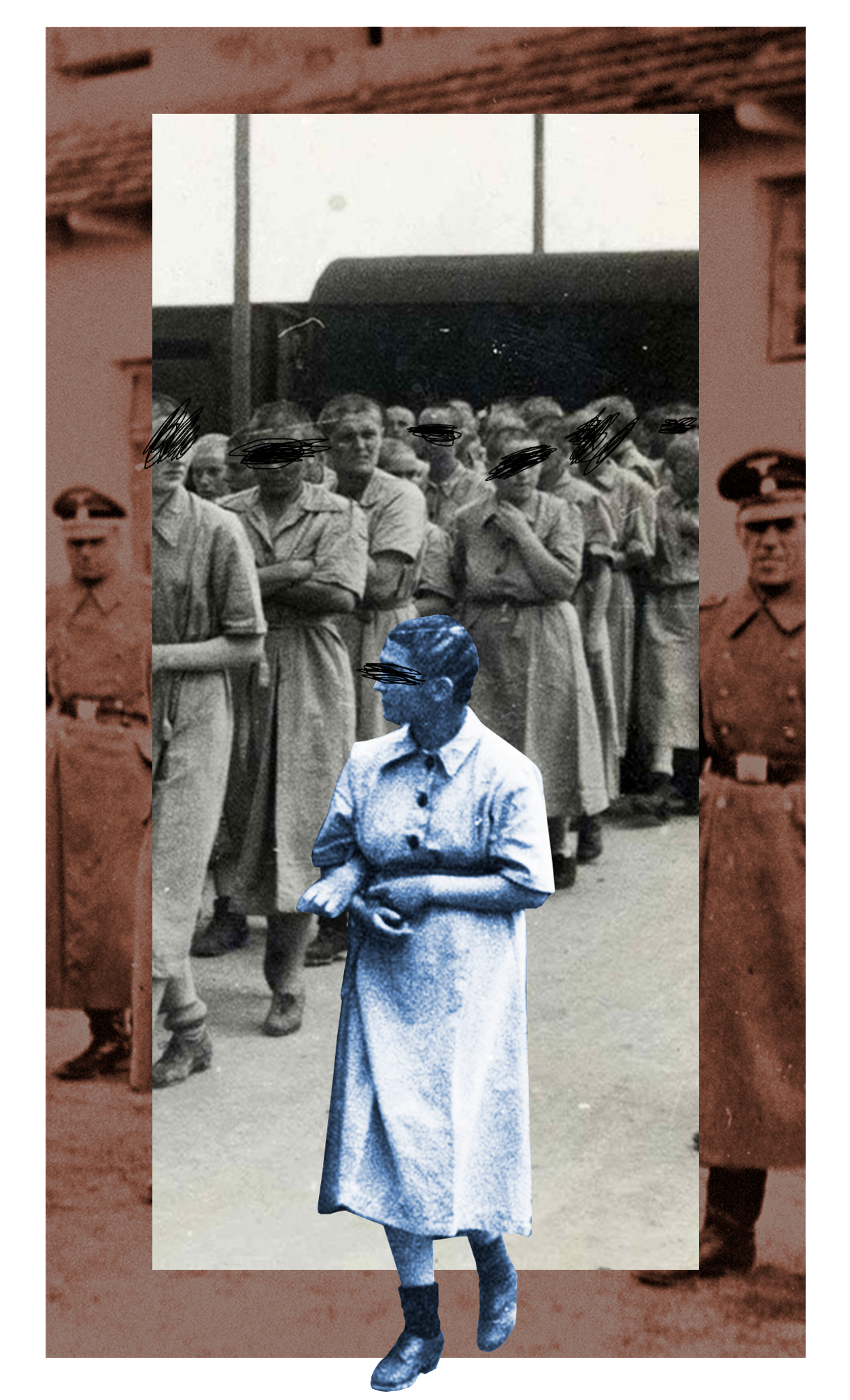
We chose to answer this enigmatic question by listening to the stories of 23 women and three men, all Holocaust survivors and Israeli residents aged 75 to 93. As Israeli academics and researchers of people in stressful situations, we were quite familiar with the horrors of war and with the specifics of World War II. Yet, we were not aware of the war against the suspicion that these women had been fighting ever since they set foot in their homeland—Israel.

At the time, even though little was known about the Holocaust, suspicions prevailed: “If you survived that terrible war, you must have been violated. You must have used your body, or you have merely been raped.” The most beautiful female survivors could not escape this hidden blame.

Similar suspicions emerged in postwar Israeli literature, poems, and artworks. Notable in this regard is the poem by Yitzhak Sadeh, the mythological commander of the Palmach (the major Jewish resistance organizations of the Yishuv, the pre-1948 Jewish population of Israel), which he titled “My Sister on the Beach.” In it, Sadeh depicts an encounter with a young female Holocaust survivor, real or imaginary, who had found her way to Israel from Europe via an illegal refugee boat:

Darkness. On wet sand my sister stands: Dirty, barefoot, her clothes are ripped and her head is down as she stands and weeps.

I know that a tattoo is imprinted on her flesh; For officers only.

While Sadeh probably intended to raise empathy and compassion toward this poor immigrant, one wonders if he would be so suspicious regarding a survivor’s past if the subject of his poem was not a female survivor, but a male. In his poem, Sadeh provides the woman an opportunity to defend herself: “Am I worthy that young healthy boys risk their lives for me? No, there is no place for me in the world. I should not live.”

We listened carefully to the response that Sadeh placed in the girl’s mouth. One of us, Ester Dror, is a daughter of an Auschwitz woman survivor. The second, Ruth Linn, is a daughter of Israeli pioneers, who served under Sadeh. We both recalled how cautiously our teachers in school discussed the rules of war—and how little was said, if at all, about women’s fate during the ancient wars depicted in the Bible, and about the fact that the winning soldiers were permitted to marry the conquered and abused women.

Ruth Bondy, a writer and a survivor of the Terezin Ghetto, thus describes her experience as a new immigrant in Israel immediately after the war: “Here in Israel the Jews also wished to know: How did you stay alive? What did you have to do to survive? And in their eyes a spark of suspicion shone: a capo? a prostitute?”

Similar feelings are shown by the American author Ruth Kluger, who survived the Holocaust as a child of 12. Kluger emphasizes the endless struggle of women against what was sometimes required of them in order to survive, both during the war and in light of the postwar “collective narrative” of suspicion:

And there were, in fact, both men and women with whorehouse fantasies who wanted to know whether I had been raped. Like the college doctor who saw the Auschwitz number on my left arm and called sundry nurses and colleagues, as if, now that I had washed up on these shores, the natives could invade my privacy at will. I was shaken but I’d answer, no, not raped: they merely wanted to kill me. I’d explain the concept of Rassenschande, the rule against miscegenation Aryan style, because I found it interesting that a malicious idea could serve as protection (albeit not a foolproof one) against sexual abuse.

In his movie Stalags (a Hebrew nickname for concentration camps), the journalist and filmmaker Ari Libsker claims that the suspicious attitude toward female Holocaust survivors is largely a result of the notorious Israeli popular booklets of the ’60s which carry the same name. The Stalags booklets described the erotic sadistic-masochistic abuse inflicted by a German woman commander on American male inmates. Libsker explains that these ideas of sexual abuse popped into his mind already as a child, during his visit with his grandmother in Haifa. There, he happened to hear about a neighbor, a childless woman Holocaust survivor who used to scream during her sleep. The gossip was that she had probably lost her mind because she was forced by the Germans into prostitution. “How easy it was back then to attach this stereotype to women survivors who were beautiful and childless,” he concludes.

Yet even if we agree that these are exclusively fabricated tales, they are probably not fully detached from the suffering of actual women during the Holocaust. However, for many years, most researchers preferred not to contaminate their research with topics related to sexuality that might be judged by the public as improper. The few who dared to do so faced hostile academic responses.

When Joan Ringelheim first presented her data on the sexual vulnerability and agency of Jewish women during the Holocaust, for example, she was accused of disrespecting the victims’ memories, serving the purposes of Holocaust deniers. Similarly, when Sonja Hedgepeth and Rochelle Saidel, two noted American scholars, presented similar data, they were scolded by a famous Holocaust researcher present at their conference (whom they refused to name): “You are not allowed to talk about it [sexual abuse of Jewish women] if you have no proof.” Other scholars reported that they were often ridiculed for not knowing that “Jewish women always knew how to protect their bodies.”

A common obstacle to studying this topic was the Nuremberg Laws, which officially forbid intercourse between Aryans and Jews. As expressed by the scholar Gideon Grief:

It is inconceivable that brothels, which did exist in the different camps, employed Jewish prostitutes. Utterly inconceivable, because it contradicts the most basic thing upon which The Third Reich was established: that the Jewish race is inferior. It does not belong to the family of man and it is inconceivable that there would be a physical sexual relationship between the Aryan and the “Unter Menchen,” the Jewish sub-human.

The reluctance of formal historians to study women’s sexual abuse during the Holocaust was supported by the fears of survivors themselves. Both groups feared that certain testimonies would eroticize the extermination. As Ruth Bondy observes:

Everything in me is outraged at the mention of this concept … The theme of sexuality during the Holocaust has been blown out of all proportion, dating from the time of Ka Tzetnik. This subject attracts far more attention than that of the slaughter but is inconsequential compared with all that happened. If 2 million Jewish women were murdered during the Holocaust, sexual molestation was the lot of a few, but violence was the lot of the many. They faced cruel choices connected to annihilation, which is soul-searing, whereas the coupling of sex and destruction makes for more striking headlines

Shoshana, an Auschwitz Birkenau survivor whom we met, related:

We were naked over there, at Mengele’s [during the selection] and all around us were SS soldiers, guarding us … and this young beautiful woman offered to sell herself. She actually shook her breasts in front of the soldiers who guarded us. She may have thought she would save herself and indeed, she was taken, perhaps for this purpose. She never came back, and I told no one, even not to her husband whom I met after the war. I didn’t want to tarnish her memory.

“But I didn’t do that,” emphasized Shoshana, quietly, like the other survivors that we met, when our discussion reached its end. “She [the woman who offered herself to the guards] was already married. She may even have had a propensity … I also could offer myself, but it never occurred to me to do so: I was unmarried and a virgin. I was brought up in a religious family—I’d rather die.”

Like many other survivors whom we met and whose diaries we had read, Shoshana not only asserted that it didn’t happen to her, but also that it couldn’t have happened to her under any circumstances, since she was both young and a virgin, and lacked the necessary knowledge about sex due to her strict upbringing in an Orthodox Jewish family. Shoshana’s well-armored words lead us to wonder further how the patriarchy narrows down the options available for women in order to present a proper narrative that will be easily accepted by the wider public. In the words of Ruth Kluger: “Women have no past or aren’t supposed to have one. A man can have an interesting past, a woman only an indecent one.”

Tragically, when it comes to sex, it seems as there are no extenuating circumstances for women. Patriarchy expects us, women, to guard our innocence and the entirety of our bodies, even at the price of our lives during the Holocaust. In this spirit, the rabbinical establishment in Israel succeeded in convincing several municipalities to name streets and public gardens in memory of 93 girls from Bais Yaakov (an Orthodox seminar in Krakow), who, according to a story published after the war, committed group suicide in order to avoid being raped by German officers. Although no hard evidence exists of this event, the religious establishment highlights the 93 girls as a symbol of modesty.

The women we interviewed were eager to leave us with the proper stories that they were forced to construct since they first set foot in Israel. Like the young survivor in Sadeh’s poem “My Sister on the Beach,” they wanted to be remembered as women who were worthy of being saved, worthy of getting married, and worthy of the right to continued presence in this world. When we talked to them, 60 years after the Holocaust, they were already long-term Israeli citizens, mothers, grandmothers, and even great-grandmothers. They, and the historians alike, knew that “it did happen.” Yet they also whispered to us upon departure: “But I did not do it.”


Dr. Esther Dror is a lecturer on family education and gender at Kinneret College. She wrote her Ph.D. dissertation under the supervision of Prof. Linn.

Ruth Linn is the former Dean of the faculty of Education at the University of Haifa and the author of five books.


Zawartość publikowanych artykułów i materiałów nie reprezentuje poglądów ani opinii Reunion’68,
ani też webmastera Blogu Reunion’68, chyba ze jest to wyraźnie zaznaczone.
Twoje uwagi, linki, własne artykuły lub wiadomości prześlij na adres:
webmaster@reunion68.com


Holocaust Denial Is Best Predicted by Belief in Other Conspiracy Theories, New Research Shows


Holocaust Denial Is Best Predicted by Belief in Other Conspiracy Theories, New Research Shows

Jack Elbaum


White supremacist Nick Fuentes with a crowd of supporters after speaking at the America First Political Action Conference 4 outside of Huntington Place in in Detroit, Michigan, on June 15, 2024, after he and his supporters were ejected from the Turning Point USA ”People’s Convention.” Photo: Dominic Gwinn/ZUMA Press Wire via Reuters Connect


The best predictor of Holocaust denial is belief in other conspiracy theories, which is driven by low trust in institutions, according to newly published research.

The report, released by The Center for Heterodox Social Science and written by Canadian professor Eric Kaufman, is titled, “Recreational Racists and Performative Antisemites? A Profile of Right-Wing Audiences from Fuentes to Carlson.”

In the report, Kaufman explores the audiences of far-right podcasters, including Tucker Carlson, Nick Fuentes, and Candace Owens. He also extensively goes through a recent Manhattan Institute report that included findings on antisemitism and other forms of hate.

“Fuentes and others are infotainers, with very little impact on public opinion,” the professor states. “First, Fuentes’ audience is no larger than Alex Jones. My new survey shows that just 2-3 percent of US adults and 7 percent of [US President Donald] Trump voters under 35 tune in regularly.”

And while Kaufman found in the data that the audiences of Carlson and Owens are larger, “There are few white nationalists among Fuentes or Tucker Carlson’s followers. Only 10-20 percent of Fuentes & Carlson’s regular viewers back zero immigration or say you have to be white to be a ‘true American.’”

In his article on the report for Compact Magazine, the researcher argued, “It’s time to press pause on the panic about antisemitic and racist influencers taking over young conservatism. We should worry more about how a collapse in trust is fueling nihilistic conspiracy theories.”

He goes on to explain that the audiences of many of these podcasters are not particularly ideologically or consistently hateful. For example, “Holocaust denial is linked to other conspiracy theories but not as clearly to attitudes toward Jews, with only 22 percent of Holocaust deniers saying that Jews are given too much support and favorable treatment in American society.”

Instead, “Their racism is superficial, transgressive, and performative,” and it is driven by a form of nihilism that expresses itself in conspiracy theories.”

“Researchers find that an important predictor of belief in conspiracy theories is low trust,” Kaufman writes. “After all, conspiratorial thinking is predicated on a lack of trust in powerful elites and institutions, notably mainstream media, and a suspicion that one’s fellow citizens have had the wool pulled down over their eyes.”

On that note, he notes in a summary of his findings on social media that “the strongest predictor of Holocaust denial is believing in other conspiracy theories (i.e. moon landings, 9/11 an inside job). This is even more predictive than identifying as an antisemite!”

He continues, “Similar pattern for beliefs about ‘Israel’s supporters’ controlling the media. The more conspiratorial accounts (Jones, Fuentes, Tucker, Owens, Bannon) are twice as likely to believe this.”

“The strongest predictor of Jewish conspiracism is general conspiracism,” he writes.

The consequences of his findings, Kaufman explains, is that “the right-wing cultural ecosystem faces a dilemma. A degree of populist disruption, mistrust, and skepticism is necessary to reform established institutions and challenge the power of special interests, entryism, and ideological capture.”

However, “the challenge,” Kaufman argues, “is to permit all theories to be advanced in the public square, but have commentators dismantle those which are ungrounded in systematic evidence.”

He sees this as a dilemma that needs to be solved to prevent his concern over “the emergence of a floating ‘conspiracy vote,’ leaning young and nonwhite, which could shape the political and cultural direction of today’s unprecedentedly low-trust America.”


Zawartość publikowanych artykułów i materiałów nie reprezentuje poglądów ani opinii Reunion’68,
ani też webmastera Blogu Reunion’68, chyba ze jest to wyraźnie zaznaczone.
Twoje uwagi, linki, własne artykuły lub wiadomości prześlij na adres:
webmaster@reunion68.com


Cezar w Białym Domu


Cezar w Białym Domu

Melanie Phillips


To był tydzień, w którym znaczna część Zachodu uświadomiła sobie, że stary ład światowy przestał istnieć. Rodzi się nowy porządek — i wcale im się to nie podoba. I nie jest wcale oczywiste, że Izrael może spać spokojnie.

Administracja Trumpa przybyła na Światowe Forum Ekonomiczne w Davos — w samo serce liberalno-uniwersalistycznego bastionu — by oznajmić reszcie Zachodu, że globalizacja dobiegła końca. Zawiodła Europę i Stany Zjednoczone, zaszkodziła ich dobrobytowi i wzrostowi, a także uzależniła je — i uczyniła podległymi — innym, w tym również ich wrogom.

Światowi przywódcy, zmuszeni wysłuchać tej tyrady, wciąż byli oszołomieni po tym, jak prezydent USA Donald Trump zagroził przejęciem Grenlandii i ukaraniem państw, które wyrażą sprzeciw. W Davos wycofał się z tego i zawarł ramowe porozumienie z szefem NATO Markiem Rutte w sprawie bezpieczeństwa Arktyki — co brzmi jak działanie mocno spóźnione, ale potrzebne w obronie wolnego świata.

Co zdumiewające, nawet tak zagorzały zwolennik uniwersalizmu jak premier Kanady Mark Carney przyznał uczestnikom forum, że gra o globalny porządek dobiegła końca. Wiele państw dochodzi dziś do wniosku, że muszą zyskać większą autonomię strategiczną. „Kiedy zasady przestają cię chronić” — powiedział — „musisz chronić się sam”.

Doprawdy? Lepiej późno niż wcale? Niekoniecznie.

Carney i inni liberalni liderzy, którzy ubolewają nad końcem globalistycznego porządku, w rzeczywistości jedynie przyznają, że Waszyngton nie będzie go już dłużej tolerował. Nie są jednak skłonni przyznać, że przez lata wspierali międzynarodowy ład, który obiecywał liberalne ideały, a w rzeczywistości przynosił coś wręcz przeciwnego.

To ci sami przywódcy, którzy nadal rozwijają relacje gospodarcze z Chinami — jednym z głównych zagrożeń dla wolności i bezpieczeństwa na świecie.

To ci sami przywódcy, którzy przez ponad cztery dekady prowadzili politykę ustępstw wobec fanatycznego reżimu islamskiego w Iranie — reżimu, który eksportował terroryzm i masowe mordy, dążył do zdobycia broni jądrowej, prowadził wojny zastępcze przeciwko Izraelowi i uciskał własny naród. Przez ostatnie tygodnie, gdy co najmniej 16 500 Irańczyków zostało zamordowanych w próbie obalenia reżimu, ci światowi liderzy milczeli — i nie zrobili niemal nic.

Nawet teraz Francja, Hiszpania i Włochy blokują uznanie Korpusu Strażników Rewolucji Islamskiej — głównego narzędzia globalnej agresji reżimu — za organizację terrorystyczną.

Przywódcy z Davos wciąż pozwalają Rosji prać brudne pieniądze w swoich stolicach i ograniczają się do bezsilnego załamywania rąk w sprawie Ukrainy.

Nie podoba im się przywództwo oparte na sile, jakie reprezentuje Trump. A jednak to właśnie te kraje bezlitośnie szykanują Izrael w jego najtrudniejszych chwilach.

Karzą go za to, że się broni przed ludobójstwem, powielają kłamstwa Hamasu jako prawdy i wspierają Palestyńczyków w ich dążeniu do unicestwienia Izraela — finansując Autonomię Palestyńską, która nagradza zamachowców i wychowuje dzieci w duchu morderczej nienawiści do Żydów.

Ich hipokryzja w udawanym oburzeniu na to, czym stały się dziś Stany Zjednoczone, jest więc iście epicka. A jednak „nowy ład” Trumpa również powinien budzić poważny niepokój.

Trump zaprosił do swojego „Rady Pokoju” — organu, który ma ponoć wprowadzić erę pokoju i dobrobytu w Strefie Gazy — Katar i Turcję. A przecież oba te kraje są śmiertelnymi wrogami Izraela, Żydów i Zachodu.

Jak pisze Khaled Abu Toameh na łamach Gatestone, żadne z tych państw nie wierzy w jakikolwiek proces pokojowy między Izraelem a światem muzułmańskim. Przeciwnie — wciąż wspierają islamistów popierających terrorystów.

Międzynarodowa Unia Uczonych Muzułmańskich, której głównymi sponsorami są Katar i Turcja, wydała w zeszłym roku fatwę wzywającą świat islamu do prowadzenia wojny świętej (dżihadu) „przeciwko syjonistycznemu bytowi i wszystkim, którzy z nim współpracują”, nawołując do utworzenia zjednoczonego islamskiego sojuszu militarnego.

Na początku tego miesiąca wydała kolejną fatwę, w której ogłoszono „zakaz normalizacji stosunków z syjonistycznym wrogiem [Izraelem] w jakiejkolwiek formie”.

Nie mniej niepokojąca jest sytuacja w Syrii. Trump zachwyca się nowym prezydentem tego kraju, byłym dowódcą Al-Kaidy i ISIS, Ahmedem al-Sharaa, określając go jako „twardego” i „przystojnego”, traktując go jak zreformowanego lidera, który może odegrać istotną rolę w nowym, pokojowym Bliskim Wschodzie.

Tymczasem w ostatnich tygodniach siły al-Sharaa, wspierane przez Turcję, masakrują Kurdów — niegdyś nieocenionych sojuszników USA, którzy teraz zostali przez nie porzuceni.

Na początku tygodnia Tom Barrack, ambasador USA w Turcji, powiedział o kurdyjskich milicjach — Syryjskich Siłach Demokratycznych (SDF) — że ich pierwotne zadanie, czyli walka z ISIS, „w dużej mierze się zakończyło”. Według niego to Damaszek jest dziś gotów przejąć odpowiedzialność za bezpieczeństwo, w tym za więzienia, w których przetrzymywano bojowników ISIS.

W rezultacie — co jest absolutnie szokujące — więźniowie ISIS pilnowani dotąd przez Kurdów zostali pozostawieni samym sobie. Część z nich po prostu uciekła, zmuszając dowództwo USA do natychmiastowej interwencji i przeniesienia ich do Iraku, aby nie wpadli w ręce syryjskiego reżimu.

Al-Sharaa ma na koncie masakry Druzów, chrześcijan i Alawitów. Gdy tylko będzie miał okazję, skieruje swoje działa przeciwko Izraelowi.

Jeśli ktoś jeszcze zastanawia się, jak to możliwe, że administracja amerykańska tak dramatycznie nie rozumie fanatyzmu islamistów, powinien posłuchać szokujących wypowiedzi specjalnego wysłannika Trumpa, Steve’a Witkoffa. Ten stwierdził w Davos: „Iran musi zmienić swoje postępowanie… jeśli da do zrozumienia, że jest gotów to zrobić, myślę, że uda się dojść do rozwiązania dyplomatycznego”.

A więc nawet teraz administracja Trumpa zdaje się wierzyć, że fanatyczni ajatollahowie z Teheranu to rozsądni ludzie, którzy w imię pragmatyzmu porzucą to, co uważają za swój boski obowiązek: zniszczenie Izraela i Zachodu.

Tymczasem to właśnie Witkoff zapewniał wcześniej świat, że 800 irańskich demonstrantów schwytanych przez reżim i zagrożonych egzekucją zostanie ocalonych. Jeśli reżim nie zdążył ich zabić, zanim się wypowiedział, to nadal systematycznie to robi.

Witkoff twierdził też, że Hamas nie jest „ideologicznie nieprzejednany”, a władcy Kataru porzucili radykalizm i dziś są „naszymi sojusznikami”.

To po prostu niepojęte, że taki człowiek może być „specjalnym wysłannikiem” prezydenta Stanów Zjednoczonych — i to w tak dramatycznym momencie dla świata.

Ponad dwa tygodnie temu Trump zapewnił bohaterskich demonstrantów w Iranie, że „pomoc już nadchodzi”. Do tej pory nie nadeszła, a tysiące zostało zamordowanych i torturowanych. Amerykańska koncentracja sił wojskowych w regionie sugeruje, że USA albo szykują się do uderzenia na Iran, albo spodziewają się irańskiego ataku. Ale kto to wie?

Obecnie opinia publiczna dzieli się między tych, którzy twierdzą, że Trump ratuje świat, a tych, którzy uważają, że go niszczy.

Rzeczywistość jest taka, że nie jest ani faszystą, ani rasistą, ani szaleńcem — to raczej samozwańczy cesarz. Domaga się lojalności, kieruje się transakcyjnością, narcyzmem i żądzą odwetu, a swoje cele osiąga siłą.

Nie jest to ideał. Ale Trump działa z miłości do Ameryki, cywilizacji zachodniej i narodu żydowskiego. Jego polityczni przeciwnicy natomiast kierują się nienawiścią do Ameryki, cywilizacji zachodniej i narodu żydowskiego — lub obojętnością wobec tych, którzy tej nienawiści ulegają.

Trudno więc mówić o jakimś wyborze.

Nowy ład Trumpa wyłonia się z katastrofalnego upadku starego. Międzynarodowe prawo i instytucje ponadnarodowe powstały po to, by ograniczyć imperialną samowolę w imię pokoju, wolności i sprawiedliwości. Dziś ten porządek zdradził i porzucił pokój, wolność i sprawiedliwość. Efektem jest Cezar w Białym Domu.

Trump to najlepszy przyjaciel, jakiego Izrael kiedykolwiek miał w Białym Domu. Ale to nie czyni go idealnym. Może być największą nadzieją dla Żydów, może dokonywać wielkich rzeczy — a jednocześnie pozostać człowiekiem ułomnym. Te wady mogą czasem powstrzymać go przed właściwym działaniem i pchnąć go ku tragicznym błędom.

Nam wszystkim pozostaje tylko wstrzymać oddech.


Link do oryginału: https://www.jns.org/a-caesar-in-the-white-house/

JNS, 22 stycznia 20216

Melanie Phillips – Brytyjska dziennikarka i autorka. Jej najnowsza książka The Builder’s Stone: How Jews and Christians Built the West and Why Only They Can Save It jest już w sprzedaży. Prowadzi również stronę internetową: melaniephillips.substack.com.


Zawartość publikowanych artykułów i materiałów nie reprezentuje poglądów ani opinii Reunion’68,
ani też webmastera Blogu Reunion’68, chyba ze jest to wyraźnie zaznaczone.
Twoje uwagi, linki, własne artykuły lub wiadomości prześlij na adres:
webmaster@reunion68.com


Don’t mourn the Holocaust while supporting the genocide of living Jews


Don’t mourn the Holocaust while supporting the genocide of living Jews

Jonathan S. Tobin


Has education failed? Reject programs and ceremonies that enable false analogies and allow fashionable opinion to demonize Israel and legitimize antisemitism.

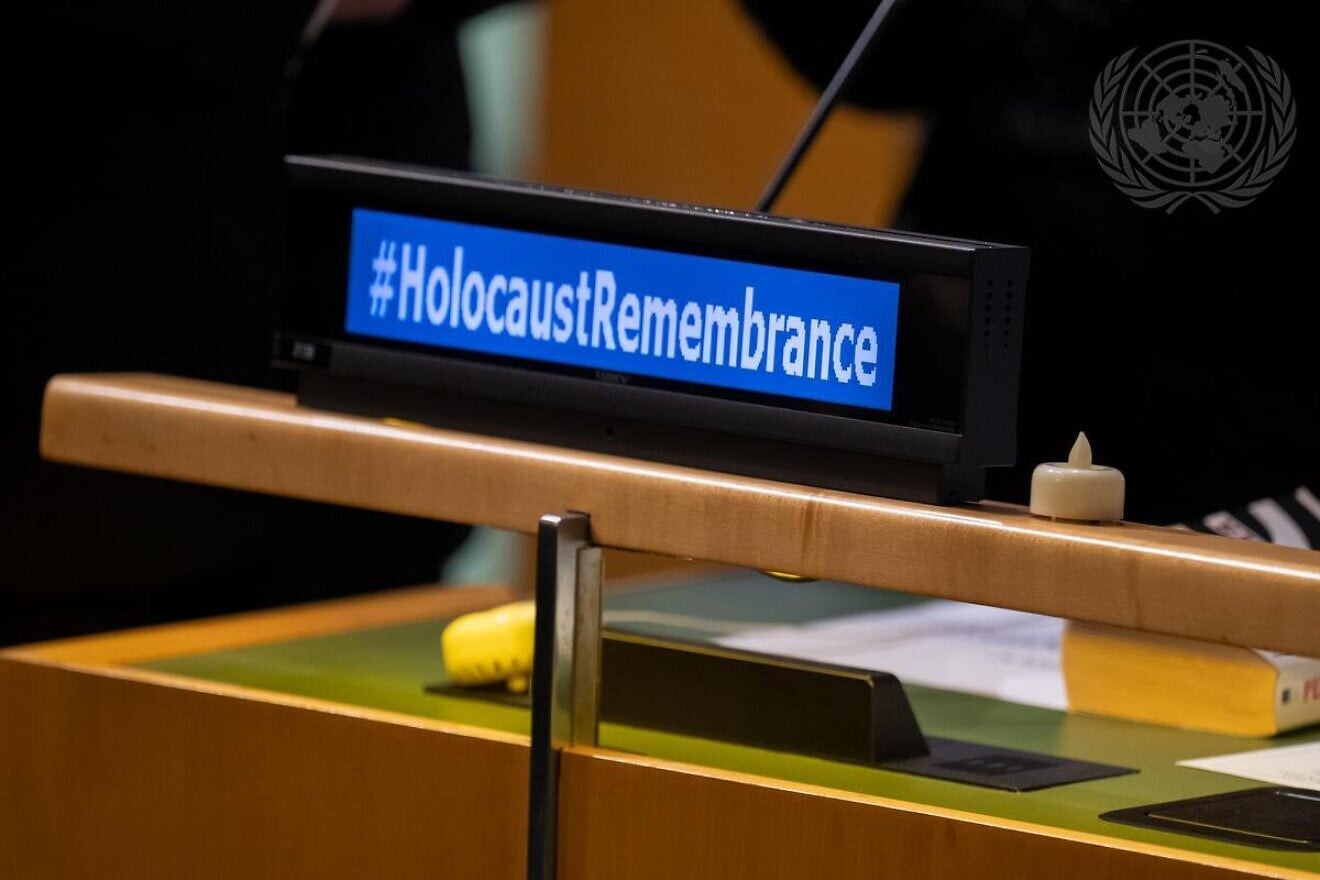
At the U.N. Holocaust Memorial Ceremony on the theme of Holocaust Remembrance for Dignity and Human Rights, Jan. 27, 2025. Credit: Manuel Elías/U.N. Photo.

What does it say about a country where some rudimentary knowledge about the Holocaust is commonplace, but where misleading analogies about it are a routine occurrence in public discourse?

You can ask the same question about the use of the most important term to come out of the Shoah.

The word “genocide” was coined in its aftermath to describe the systematic mass slaughter aimed at the extermination of a single people. But in a country where it is estimated that about three-quarters of American K-12 students get lessons on the murder of 6 million Jews by the German Nazis and their collaborators, it is regularly misapplied to the efforts of the descendants of the survivors of the Holocaust to defend themselves against an attempted genocide.

What has been taught?

As the world commemorates International Holocaust Remembrance Day this week on Jan. 27, the most important question to be asked about public discussion is not so much how to expand education programs devoted to the subject. Rather, it is whether Americans are being taught anything that will help them to understand the subject or what it means today. Even more to the point, it may be necessary to acknowledge that much of what is being taught in schools or said at the ceremonies that will mark this day may actually be doing more harm than good.

As a result, the reaction of the Jewish community to the fuss made about the date ought not to be gratitude for the undoubted efforts of many educators and public officials for keeping the memory of the Six Million alive. Rather, it should be to doubt not only the value of these efforts, but to tell many of them that we’d appreciate it if they simply stopped talking about it.

The point being: If you are promoting memorialization of the Shoah while at the same time dishonoring the memory of the heroes and martyrs of the Holocaust by appropriating their fate to promote some entirely unrelated cause or to express particular displeasure with someone or political foes, the response of the Jewish world should be to tell them to stop.

Even more important, those who cry crocodile tears about the suffering of dead Jews who were slaughtered by their persecutors more than 80 years ago, while smearing live Jews with false charges of genocide, have forfeited their right to speak about the subject.

Unfortunately, that is the proper response this year to all too much of what will be said at countless commemorations of the Holocaust. The subject has been weaponized for political purposes or even to buttress the surge of antisemitism that has spread around the globe since the Hamas-led Palestinian Arab attacks in Israel on Oct. 7, 2023.

One fact that should be noted is that the Jewish people have still not recovered demographically from the disaster of the Holocaust, during which approximately one-third of all Jews alive in 1939 were murdered. Today, the global Jewish population is still far smaller by a factor of about 3 million people than it was in 1939, with half the Jews alive today living in Israel.

Yet many of those who will publicly beat their breasts on Jan. 27 in sorrow about the Six Million are effectively neutral or even in support of the war that Palestinians—backed by much of the Arab and Muslim world, and fashionable opinion elsewhere—are waging against Jews.

Rather than joining them alongside political leaders, journalists, scholars and celebrities who have been part of a growing effort to demonize the one Jewish state on the planet, the response of the community to such events should be a loud and emphatic, “No, thank you!” Honoring the memory of the Holocaust is a sacred obligation. Yet it cannot be done effectively or have any real meaning in a context divorced from the current struggle for Jewish survival against a rising tide of bigotry, hatred and violence.

Denial and false analogies

It is entirely true that Holocaust deniers are not only still among us, but that their visibility and ability to reach the ignorant and ever-gullible consumers of conspiracy theories is greater than ever. For that, the internet can be thanked for the way it has enabled fringe figures once confined to the fever swamps of public discourse to be visible to large audiences. The willingness of podcasters, like former Fox News host Tucker Carlson, to mainstream hateful figures like faux historian Daryl Cooper and neo-Nazi Nick Fuentes plays a large part in this.

But as much as the promotion of these hate-mongers’ lies about the past remains problematic, far too much discourse is distorted among those who don’t believe such falsehoods, though still decide to traffic in Holocaust language and references.

When Minnesota Gov. Tim Walz compared efforts by federal officials to enforce existing laws against illegal immigrants, especially those who have committed crimes, to the efforts of Nazis seeking to capture Jews like Holocaust diarist Anne Frank, the problem isn’t just the cynical appropriation of her memory to pursue a political agenda. Walz is far from the first to behave in this manner. Some on the political right have done the same thing when it comes to opposition to abortion. But in recent years, opponents of President Donald Trump have made false comparisons of him to Adolf Hitler or claimed that he is a Nazi or fascist. It has become so ubiquitous that it almost isn’t worth it to single any of the offenders out.

The problem is not that Walz is unaware of the Holocaust. We know he is not. He is like so many people who have come of age in an era when most Americans possess at least a rudimentary understanding of the basic facts about what happened under the Third Reich. And yet, he and the many others who invoke Frank’s name or use epithets linked to the Holocaust when attacking political foes apparently don’t understand it at all.

Far too much of what passes for Holocaust education is rooted in an attempt to universalize it—to render it not merely more understandable to contemporary audiences but to separate it from its context and the history of antisemitism. In that way, some otherwise well-meaning educators have sought to use it to teach everyone to be nicer to each other and to avoid slipping into racial or religious prejudices. But as scholar Ruth Wisse has taught, antisemitism is not a garden-variety form of hate or intolerance. And it is not merely the oldest hatred. Rather, it is specifically used as a political weapon over and above the way imperfect human beings are prone to slip into unkind or even mean behavior.

The cost of universalizing

The universalization of the Holocaust and the way students are taught a slimmed-down summary of this chapter of history—in brief lessons crammed into the school year—has had unforeseen consequences. It has led to something that survivors, whose numbers are fewer and fewer every year, never envisioned when they began the campaign to spread knowledge of their experiences.

The Holocaust has become a metaphor for anything that people dislike. The predilection to treat anyone with whom we strongly disagree as if they were Hitler is not just a product of the hyperpartisan tone of 21st-century politics or the extreme polarization of the Donald Trump era. It is also the result of the way it has been universalized to the point where many, if not most, ordinary people think it was just a bad thing that happened a long time ago—not the specific result of millennia of Jew-hatred and the powerlessness of nearly an entire people.

Equally unfortunate is the way much of the educational establishment has embraced toxic leftist ideas like critical race theory, intersectionality and settler-colonialism. So-called “progressive” teachings have largely captured primary, secondary and higher education to the point where a generation of Americans has been indoctrinated into believing not merely in concepts that exacerbate racial divisions, but ones that promote the idea that Jews and Israelis are “white” oppressors.

This movement produced the pro-Hamas campus mobs that have targeted Jewish students for intimidation, discrimination and violence since Oct. 7 at universities around the world. Participants are shockingly ignorant of the history of the Middle East, even as they chant slogans endorsing Jewish genocide (“From the river to the sea”) and terrorism against Jews everywhere (“Globalize the intifada”). What they have also done is to appropriate the word genocide, which Holocaust survivor and lawyer Raphael Lemkin coined to describe the Nazi effort to exterminate the Jewish people.

Their claim that Israel’s just war of self-defense against Hamas terrorists is “genocide” is a blatant lie. If applied to any other conflict, it would mean that every war that has ever been fought, including the one waged by the Allies against the Nazis, would be considered genocide. That not only drains the word of its actual meaning. It is, like the libelous efforts to smear Jews as Nazis, a classic trope of antisemitism.

Yet many on the political left, which has embraced this lie about Israel, are also prepared to join in mourning the Holocaust. Some, including that small minority of Jews who, for distorted reasons of their own, join in these antisemitic denunciations of Israelis and their supporters, even claim that they are inspired by the history of the Shoah to speak out against Israel now. Some even support efforts to eradicate the Jewish state—a result that could only be accomplished by the sort of genocidal war that Hamas and its allies are waging.

Our answer to them and others who are either silent about the misappropriation of the Holocaust or join in the blood libels against living Jews while lamenting the fate of dead Jews must be unequivocal.

Prioritize the defense of living Jews

We must tell those, like Walz, who misappropriate the memory of the Six Million, or utter such falsehoods about genocide, like New York City Mayor Zohran Mamdani and others on the intersectional left wing of the Democratic Party, that Holocaust commemorations should be off-limits to them.

The same applies to global organizations like the United Nations, which in 2005 voted to establish International Holocaust Remembrance Day on the anniversary of the liberation of Auschwitz on Jan. 27, 1945. These agencies that claim to speak for human rights and justice for all countries in the world have become cesspools of antisemitism and engines of the war against the Jewish state.

For too long, too many members of the Jewish community have treated the promotion of Holocaust education or ceremonies honoring the dead as more important than efforts to defend the living. 

It’s also true that, as important as teaching young Jews about the Shoah is, it must be linked to learning about the importance of Israel, as well as the life-affirming nature of their heritage and faith.

Above all, we must stop allowing the memory of what happened 80 years ago on Europe’s soil to be used by those who support or are neutral about those seeking to carry on the Nazi project of Jewish genocide. The failure to call an end to this misuse of Jewish history will only contribute to more tragedy.


Jonathan S. Tobin is editor-in-chief of the Jewish News Syndicate, a senior contributor for The Federalist, a columnist for Newsweek and a contributor to many other publications. He covers the American political scene, foreign policy, the U.S.-Israel relationship, Middle East diplomacy, the Jewish world and the arts. He hosts the JNS “Think Twice” podcast, both the weekly video program and the “Jonathan Tobin Daily” program, which are available on all major audio platforms and YouTube. Previously, he was executive editor, then senior online editor and chief political blogger, for Commentary magazine. Before that, he was editor-in-chief of The Jewish Exponent in Philadelphia and editor of the Connecticut Jewish Ledger. He has won more than 60 awards for commentary, art criticism and other writing. He appears regularly on television, commenting on politics and foreign policy. Born in New York City, he studied history at Columbia University.


Zawartość publikowanych artykułów i materiałów nie reprezentuje poglądów ani opinii Reunion’68,
ani też webmastera Blogu Reunion’68, chyba ze jest to wyraźnie zaznaczone.
Twoje uwagi, linki, własne artykuły lub wiadomości prześlij na adres:
webmaster@reunion68.com


Jewish Cemetery Desecrated in Barcelona, More Than 20 Graves Vandalized


Jewish Cemetery Desecrated in Barcelona, More Than 20 Graves Vandalized

David Swindle


Photo of vandalized tombstones in Barcelona via Federation of Jewish Community of Barcelona (CJB).

Vandals on Sunday targeted the Jewish cemetery in Barcelona, desecrating more than 20 graves and smashing tombstones.

The crime comes amid a sharp rise in antisemitic incidents and anti-Israel sentiment across Spain, whose Jewish community has expressed alarm over the increasingly hostile environment.

“We have seen how, at demonstrations, online and on the street, hate speech against Jews became routine. Then signs appeared across the city. Later, posters were hung on public buildings with slogans,” the Jewish Community of Barcelona said in a statement. “After that, a map was published marking Jewish targets, including a school. And now, the desecration of graves. This is not random. This is an escalation. From slogans to marking. From marking to threats. And from threats to action.”

The statement referred to an online platform mapping Jewish-owned businesses, schools, and Israeli-linked companies in Catalonia, a region in northeastern Spain.

A spokesperson for the Catalan police told Agence France Presse that “we are aware of the [cemetery] incident and have opened an investigation,”

The European Jewish Congress (EJC) condemned the vandalism on X.

“What we are seeing is not isolated. It is part of a wider escalation that begins with words, continues with targeting and intimidation and ends in acts like this,” the EJC said. “When hate is normalized in public discourse, the step to physical action becomes smaller.”

Israel’s Foreign Ministry also released a statement with photos of the crime, saying, “We condemn the vandalism of the Jewish cemetery in Barcelona. This despicable act is a result of the anti-Israel campaign by the Sánchez government. We stand with Spain’s Jewish community. Antisemitism must never be normalized and must be firmly rejected in all societies.”

In September, Lorenzo Rodríguez, mayor of Castrillo Mota de Judíos in northern Spain, warned that Spanish Prime Minister Pedro Sánchez had fueled antisemitic sentiment.

“The government is fostering antisemitism that will prove deeply damaging for Spain,” Rodríguez said. “Sánchez’s moves are less about serious foreign policy and more about deflecting attention from his trials and failures in governance.”

Rodríguez described his view that Spain “isn’t leading anything — it’s merely whitewashing Hamas and other terrorist groups.”

Sánchez had told members of his Socialist Workers’ Party that month that Israel should not be allowed to participate in international sports and that the Jewish state “cannot continue to use any international platform to whitewash its image.”

Spain’s Culture Minister Ernest Urtasun has expressed similar calls for boycotting Israel, saying, “We have to make sure that Israel does not take part in the next Eurovision,” referring to the international song contest.

Madrid has been one of the West’s fiercest critics of Israel’s defensive military campaign in Gaza following Hamas’s Oct. 7, 2023, invasion of and massacre across southern Israel.

“What [Israeli] Prime Minister [Benjamin] Netanyahu presented in October 2023 as a military operation in response to the horrific terrorist attacks has ended up becoming a new wave of illegal occupations and an unjustifiable attack against the Palestinian civilian population – an attack that the UN special rapporteur and the majority of experts already describe as a genocide,” Sánchez said in a televised speech last year.

The diplomatic tension between the two nations reached a boiling point in September, when Madrid recalled its ambassador.

The American Jewish Committee (AJC) describes Barcelona as notable for its anti-Israel sentiment, characterizing its position as an “outlier status.”

The AJC wrote in May 2023 that in February of that year, “Barcelona Mayor Ada Colau announced that Spain’s second-largest city would sever ties with its twin city Tel Aviv. The move answered the demands of anti-Israel activists who in January had petitioned the city council to condemn Israel.”

The Anti-Defamation League’s Global 100 report names Spain as one of the most antisemitic countries in Europe (ranked 15 out of 18 in the region), with 26 percent of adults — 10.4 million people — expressing belief in six or more bigoted tropes against Jews.

The Spanish Jewish community recently filed complaints over an online platform that targeted Jewish establishments.

First reported by the local Jewish outlet Enfoque Judío, the interactive map — known as Barcelonaz — was launched by an unidentified group claiming to be “journalists, professors, and students” on the French-hosted mapping platform GoGoCarto.

As a publicly accessible and collaboratively created online platform, the map marked over 150 schools, Jewish-owned businesses — including kosher food shops — and Israeli-linked as well as Spanish and international companies operating in Israel, labeling them as “Zionist.”

Jewish leaders in Spain strongly denounced the BarcelonaZ initiative, warning that it fostered further discrimination and hatred against the community amid an increasingly hostile environment in which Jews and Israelis continue to be targeted.

Amid the backlash, GoGoCarto announced it had removed the BarcelonaZ project from its website after local groups denounced the initiative as blatantly antisemitic and dangerous.


Zawartość publikowanych artykułów i materiałów nie reprezentuje poglądów ani opinii Reunion’68,
ani też webmastera Blogu Reunion’68, chyba ze jest to wyraźnie zaznaczone.
Twoje uwagi, linki, własne artykuły lub wiadomości prześlij na adres:
webmaster@reunion68.com